
Crypto trading conversations often start with fees.
Lower fees. Zero fees. Rebates. Incentives.
But fees only describe the cost of trading. They do not explain how effectively capital is actually being used.
A more important question is often overlooked:
How much can one dollar do inside a trading system?
That question sits at the core of capital efficiency. It is also where meaningful differences between trading platforms begin to appear.
What Capital Efficiency Really Means
Capital efficiency is often reduced to cheaper execution. This definition is incomplete.
In practice, capital efficiency refers to how effectively capital can be deployed, reused, and shared across trading activities without being fragmented, locked, or left idle by system design.
A capital-efficient system allows traders to:
- Use the same capital across multiple activities
- Reuse profits and collateral without unnecessary friction
- Avoid idle balances caused by artificial account boundaries
- Manage risk at the account level rather than product by product
Capital efficiency is not about trading more aggressively. It is about wasting less capital at the system level.
What Breaks Capital Efficiency in Most Trading Systems
Most trading platforms are built around separation: spot accounts, futures accounts, margin accounts, earn or lending accounts.
Each product operates with its own balance, rules, and constraints. Even when users hold sufficient assets overall, capital often sits idle simply because it is locked in the wrong account.
This fragmentation introduces several inefficiencies.
Fragmented Accounts
Capital is divided across isolated wallets, limiting reuse and forcing manual transfers.
Earn Versus Trade Separation
Capital must be moved between earning yield and supporting trades, creating delays and opportunity cost.
Idle Capital
Funds remain unused while waiting for transfers, settlement, or product-specific availability.
Delayed Profit and Loss Settlement
Unrealized PnL may be visible but unusable, preventing capital from being redeployed efficiently.
Forced Actions
Losses in isolated accounts can trigger forced selling or liquidation, even when sufficient capital exists elsewhere.
From a capital perspective, these are not edge cases. They are structural inefficiencies.
How Backpack Enables Capital Efficiency
Backpack approaches capital efficiency at the account level.
Instead of separating capital by product, Backpack is built around a single unified trading account with a shared collateral pool across spot, futures, margin, lending, and yield.
This design changes how capital behaves inside the system.
Unified Account and Unified Collateral
All assets live in one account and contribute to a shared collateral pool. Capital is not fragmented across products, and internal transfers are unnecessary.
Dual-Use Capital with Auto Lend
On many platforms, capital can only do one thing at a time. It is either used for trading or set aside to earn yield. Moving between these states often introduces delays and leaves capital idle.
Backpack removes this trade-off through dual-use capital, supported by Auto Lend.
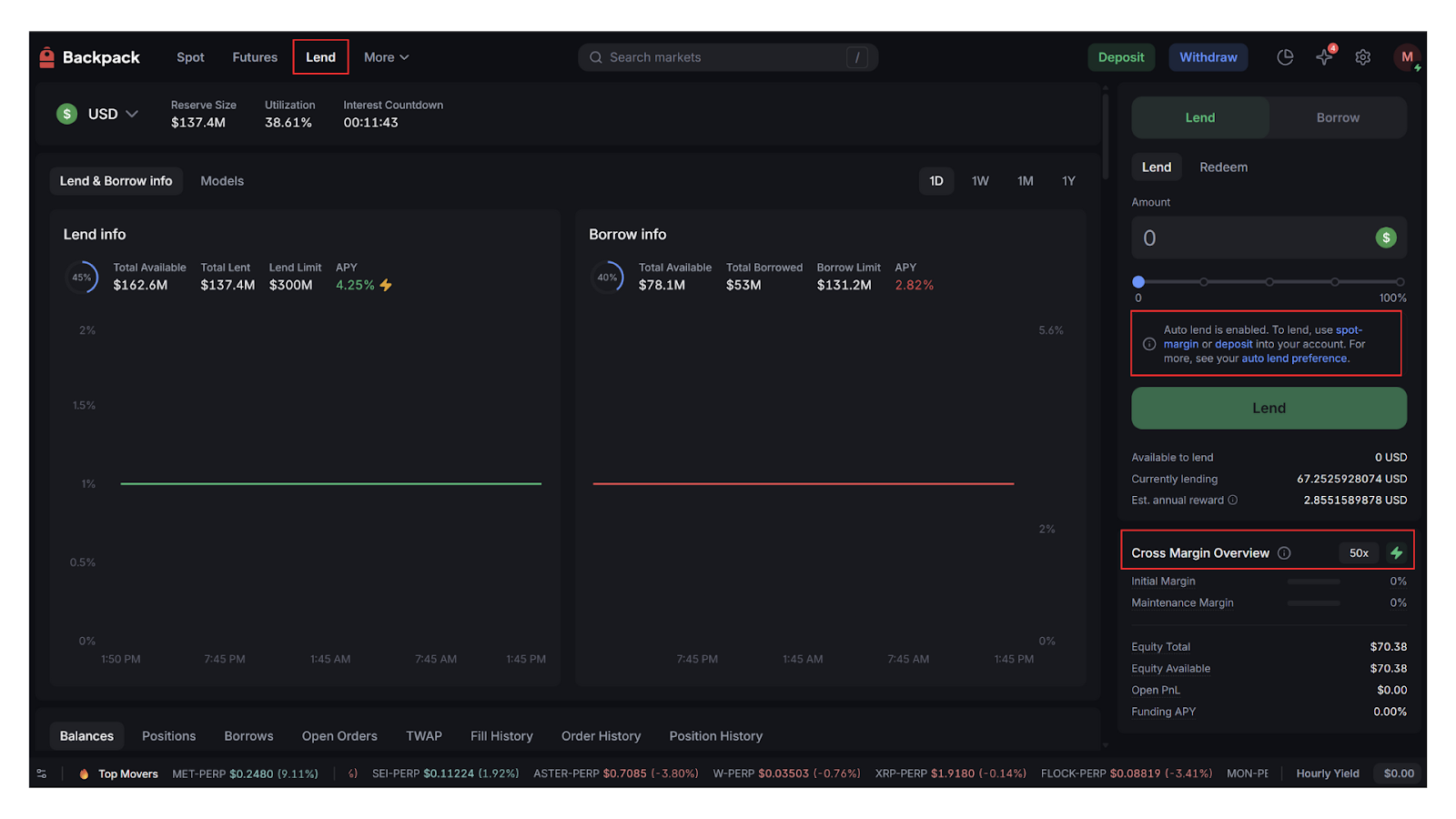
When Auto Lend is enabled, available assets are automatically lent into the lending pool, allowing the same capital to earn yield while simultaneously serving as trading collateral, without requiring separate actions.
As a result, capital remains continuously productive rather than sitting idle.
Frequent PnL Settlement and Capital Reuse
Profits and losses are reflected at the account level frequently enough that capital does not sit idle waiting for settlement. Gains become usable capital faster, and risk is managed continuously rather than episodically.
Account-Level Risk Absorption
Losses are managed at the account level rather than triggering immediate forced actions within isolated products. This reduces unnecessary capital disruption and preserves overall capital structure.
These mechanisms are not individual features. Together, they form a system where capital is continuously available, reusable, and managed holistically.
Why Capital Efficiency Matters Long Term
Capital efficiency compounds over time. Systems that use capital well tend to:
- Attract disciplined, repeat traders
- Sustain liquidity without relying on excessive incentives
- Scale without constantly increasing risk
- Remain resilient across market cycles
Inefficient systems often depend on short-term activity spikes driven by rewards or promotions. When those incentives fade, capital tends to leave.
Capital efficiency is not a growth tactic. It is a foundation for durable trading infrastructure.
The Conversation the Market Needs to Have
As trading infrastructure matures, the focus will continue to shift.
Not toward who charges the lowest fees. Not toward who offers the loudest incentives.
But toward who allows capital to move, adapt, and compound with the least friction across an entire system.
That conversation starts with how accounts are structured. And it is where Backpack is intentionally focused.
Conclusion
Capital efficiency is ultimately about how capital flows through a system, not how cheaply trades are executed.
As trading infrastructure matures, the focus will continue to shift away from surface-level optimizations and toward systems that allow capital to move, adapt, and compound with minimal friction.
This starts with account structure and how capital is organized at the system level. Platforms that get this right tend to attract better traders, build more durable liquidity, and hold up across market cycles.
This is not a short-term tactic. It is a long-term design choice, and it is where Backpack is intentionally focused.
Learn more about Backpack
Exchange | Wallet | Twitter | Discord | Reddit
Disclaimer: This content is presented to you on an “as is” basis for general information and educational purposes only, without representation or warranty of any kind. It should not be construed as financial, legal or other professional advice, nor is it intended to recommend the purchase of any specific product or service. You should seek your own advice from appropriate professional advisors. Where the article is contributed by a third party contributor, please note that those views expressed belong to the third party contributor, and do not necessarily reflect those of Backpack. Please read our full disclaimer for further details. Digital asset prices can be volatile. The value of your investment may go down or up and you may not get back the amount invested. You are solely responsible for your investment decisions and Backpack is not liable for any losses you may incur. This material should not be construed as financial, legal or other professional advice.