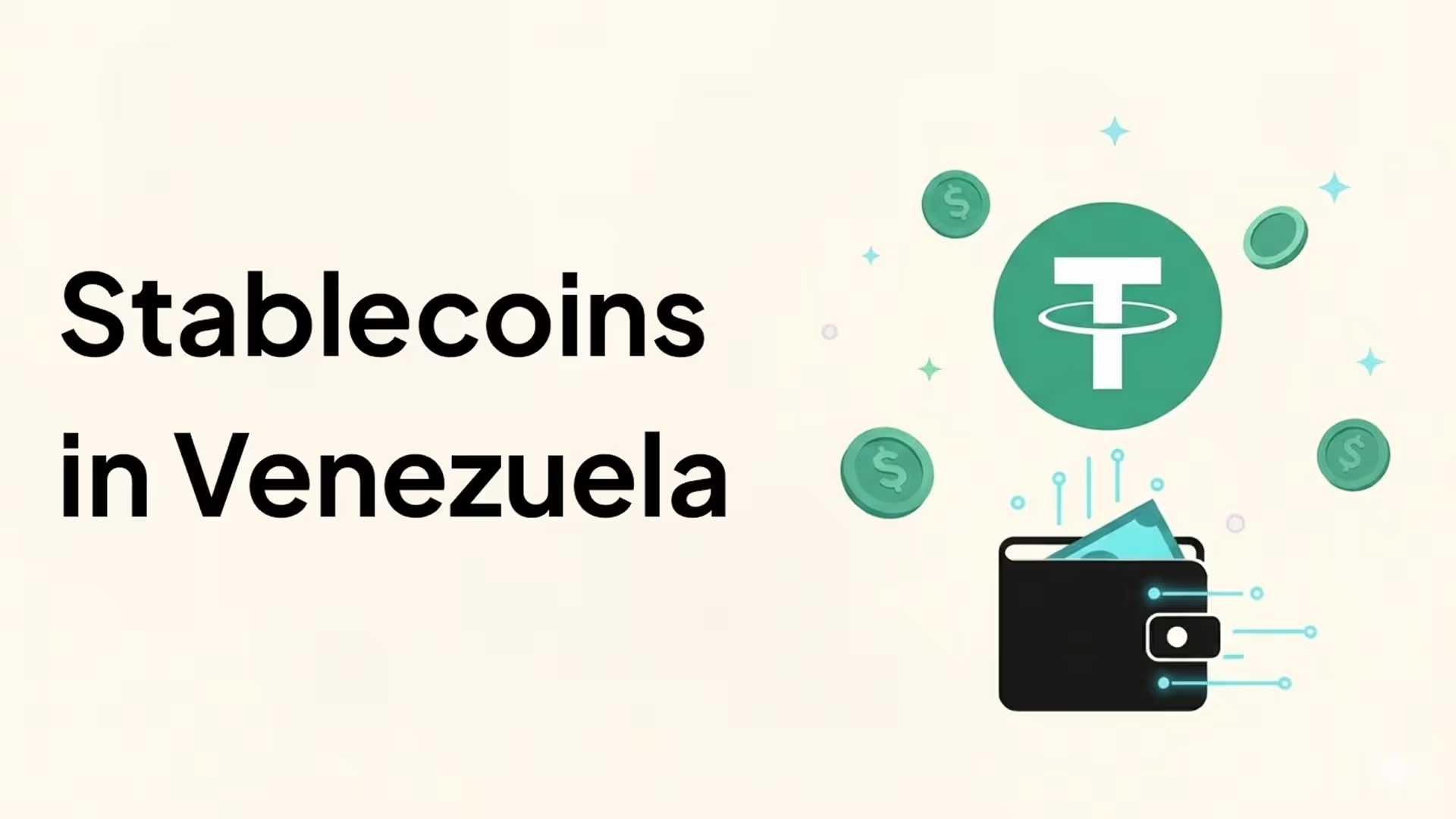
With 229% inflation and a collapsing currency, Venezuelans have turned to Tether and other stablecoins for everyday transactions, remittances, and savings.
Key Takeaways
- USDT (Tether) has become a de facto parallel currency in Venezuela, used for groceries, rent, and cross-border payments.
- Approximately 10% of grocery payments and 40% of peer-to-peer transactions in Venezuela now involve cryptocurrency.
- Around 9% of Venezuela's $5.4 billion in annual remittances flows through blockchain networks.
- Venezuela ranks 18th globally in crypto adoption according to Chainalysis, with over 38% of activity occurring on P2P platforms.
- Stablecoins offer Venezuelans a dollar-pegged store of value without relying on the traditional banking system.
Introduction
Venezuela's economy has been defined by hyperinflation for years. The bolívar, the national currency, lost approximately 70% of its value in 2025 alone. Annual inflation reached 229% by May 2025, according to the Venezuelan Finance Observatory. For millions of Venezuelans, holding bolívars means watching their savings evaporate.
In response, a parallel financial system has emerged—one built on stablecoins, particularly USDT (Tether). What started as a niche tool for tech-savvy users has become a mainstream financial infrastructure. Venezuelans now use stablecoins to buy groceries, pay rent, receive remittances from abroad, and preserve purchasing power in an economy where the local currency cannot be trusted.
What Are Stablecoins?
Stablecoins are cryptocurrencies designed to maintain a stable value, typically pegged 1:1 to a fiat currency like the US dollar. Unlike Bitcoin or Ethereum, which can fluctuate significantly in price, stablecoins aim to combine the benefits of cryptocurrency—speed, borderless transfers, censorship resistance—with the price stability of traditional money.
USDT, issued by Tether, is the largest stablecoin by market capitalization. Other popular stablecoins include USDC (issued by Circle) and DAI (a decentralized stablecoin). In Venezuela, USDT dominates—so much so that locals often refer to it simply as 'Binance Dollars', a reference to the popular cryptocurrency exchange where many Venezuelans trade.
Why Venezuelans Use USDT
Protection Against Inflation
With the bolívar losing value rapidly, holding savings in a dollar-pegged asset offers protection. A Venezuelan worker paid in bolívars can convert their wages to USDT immediately, preserving purchasing power until they need to spend. This simple act of conversion has become routine for many.
Lower Remittance Fees
Millions of Venezuelans have emigrated, and remittances are a lifeline for families who remain. Traditional remittance channels can charge fees exceeding 50% during peak crisis periods. Sending USDT via blockchain networks costs a fraction of that and settles in minutes rather than days. TRM Labs data indicates that approximately 9% of Venezuela's $5.4 billion in annual remittances now flow through cryptocurrency channels.
Access Without Banks
Venezuela's banking infrastructure has been described as collapsed. Account freezes, withdrawal limits, and unreliable services have pushed people toward alternatives. Stablecoins require only a smartphone and an internet connection. Peer-to-peer platforms allow users to buy and sell USDT directly, bypassing banks entirely.
Everyday Transactions
Stablecoin usage has moved beyond savings and remittances into daily commerce. Reports indicate that approximately 10% of grocery payments in Venezuela now involve cryptocurrency. Major supermarket chains have reportedly trained staff to process digital asset payments. For merchants, accepting USDT means receiving a stable dollar-equivalent rather than a depreciating bolívar.
How the Parallel Economy Works
The stablecoin economy in Venezuela operates largely through peer-to-peer (P2P) trading platforms. Chainalysis reports that over 38% of Venezuela's cryptocurrency activity occurs on P2P platforms, one of the highest rates globally. These platforms connect buyers and sellers directly, allowing users to exchange bolívars for USDT and vice versa.
A typical transaction might work like this: A Venezuelan receives USDT from a family member abroad. They hold it in a mobile wallet until needed. When they want to buy groceries, they either pay the merchant directly in USDT (if accepted) or convert a portion to bolívars through a P2P trade. The conversion happens within minutes, and the user avoids holding the depreciating local currency longer than necessary.
This system operates alongside—and sometimes in place of—traditional banking. It is not regulated in the same way, which introduces both flexibility and risk. Users must trust the platforms and counterparties they trade with, and there is no deposit insurance or consumer protection in the traditional sense.
Venezuela's Crypto Adoption by the Numbers
- Global ranking 18th in crypto adoption (Chainalysis 2025)
- Per capita ranking 9th globally
- P2P activity 38%+ of all crypto transactions
- Grocery payments ~10% involve cryptocurrency
- P2P transactions ~40% involve cryptocurrency
- Remittances via blockchain ~9% of $5.4 billion annually (TRM Labs)
- Annual inflation 229% as of May 2025 (Venezuelan Finance Observatory)
- Bolívar depreciation ~70% loss in 2025
Why USDT Over Bitcoin?
Bitcoin is often discussed as a hedge against inflation, but in Venezuela, stablecoins dominate day-to-day usage. The reasons are practical:
- Price stability: USDT maintains a consistent dollar value. Bitcoin can swing 5-10% in a day, which is problematic for everyday transactions.
- Familiar unit of account, Venezuelans already think in dollars due to informal dollarization. USDT fits naturally into this mental framework.
- Lower transaction costs: Sending USDT on networks like Tron is cheaper than Bitcoin transactions for small amounts.
- Immediate usability. There's no need to time the market or worry about volatility when paying for goods and services.
Bitcoin still plays a role—some Venezuelans hold BTC as a longer-term store of value—but for the parallel economy of daily commerce and remittances, stablecoins are the clear preference.
What Happened to the Petro?
In 2018, the Venezuelan government launched the Petro, a state-backed cryptocurrency allegedly backed by oil reserves. It was promoted as a way to circumvent US sanctions and stabilize the economy. The project failed to gain traction and was discontinued in 2024.
The Petro's failure contrasts sharply with the organic adoption of USDT. Where the government-mandated cryptocurrency struggled to find users, market-driven stablecoin adoption flourished. Venezuelans chose the tools that actually worked for their needs—dollar-pegged, widely accepted, and accessible through global platforms—rather than a state-issued token with questionable backing and limited utility.
Risks and Considerations
While stablecoins have provided a financial lifeline, they are not without risks:
- Counterparty risk: USDT's value depends on Tether's reserves and management. Questions about reserve transparency have persisted in the broader crypto market.
- Regulatory uncertainty: Stablecoin regulations are evolving globally. Changes could affect access or usability.
- Scams and fraud in P2P trading carry risks of bad actors. Users must exercise caution when transacting with unknown counterparties.
- Technical barriers: Not all Venezuelans have smartphones or reliable internet access, limiting adoption in some areas.
- No consumer protection: Unlike traditional banking, there is no deposit insurance or formal recourse if funds are lost or stolen.
The Bigger Picture
Venezuela's stablecoin economy is often cited as a case study in cryptocurrency adoption driven by necessity rather than speculation. When a national currency fails, people find alternatives. In this case, that alternative has been USDT and other dollar-pegged digital assets.
The pattern is not unique to Venezuela. Similar dynamics have been observed in other high-inflation economies, including Argentina, Turkey, and Lebanon. Stablecoins offer a way to access dollar-denominated value without needing a US bank account or physical cash—an increasingly relevant use case in economically unstable regions.
For the global cryptocurrency industry, Venezuela represents both validation and caution. It demonstrates that digital assets can serve real-world needs beyond trading and speculation. But it also highlights the stakes: when people rely on these tools for basic financial survival, the consequences of failures—whether technical, regulatory, or institutional—are severe.
Conclusion
Stablecoins have become essential infrastructure in Venezuela's economy. USDT, in particular, functions as a parallel currency—used for savings, remittances, and daily transactions by millions of people. This adoption was not driven by government policy or institutional promotion but by practical necessity in the face of economic collapse.
Venezuela's experience offers a glimpse of how cryptocurrency adoption can unfold when traditional financial systems fail. Whether this model expands to other countries or remains a crisis-specific phenomenon will depend on broader economic and regulatory developments. For now, stablecoins remain a lifeline for Venezuelans navigating one of the world's most challenging economic environments.
Learn more about Backpack
Exchange | Wallet | Twitter | Discord | Reddit
Disclaimer: This content is presented to you on an “as is” basis for general information and educational purposes only, without representation or warranty of any kind. It should not be construed as financial, legal or other professional advice, nor is it intended to recommend the purchase of any specific product or service. You should seek your own advice from appropriate professional advisors. Where the article is contributed by a third party contributor, please note that those views expressed belong to the third party contributor, and do not necessarily reflect those of Backpack. Please read our full disclaimer for further details. Digital asset prices can be volatile. The value of your investment may go down or up and you may not get back the amount invested. You are solely responsible for your investment decisions and Backpack is not liable for any losses you may incur. This material should not be construed as financial, legal or other professional advice.