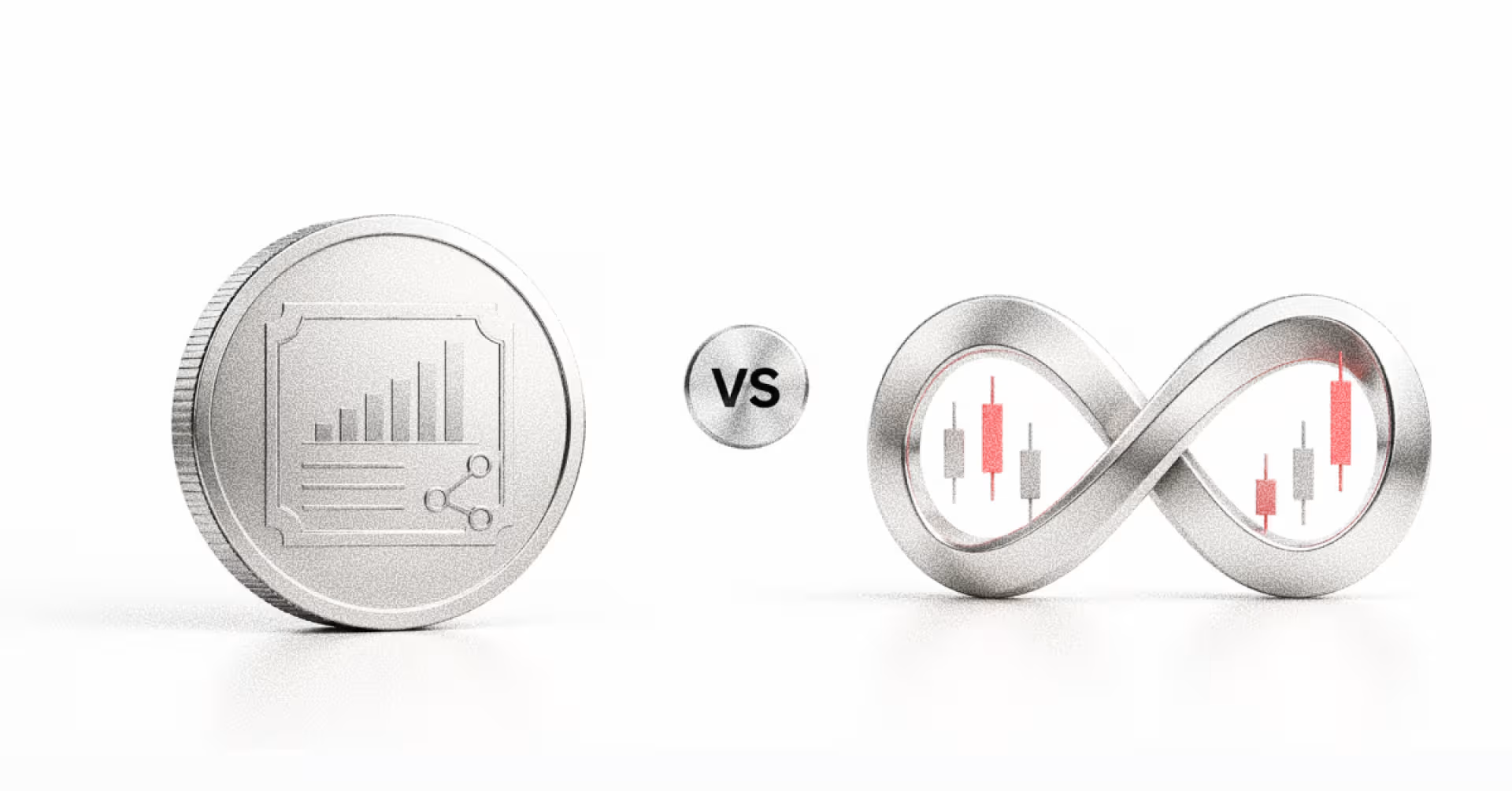
Tokenized stocks and equity perps can both provide exposure to a company's share price, but they are different instruments. A tokenized stock represents a security or a claim defined by its issuer. An equity perp is a margined derivative with no scheduled expiry and no ownership of the underlying shares.
The practical comparison comes down to what you hold, how you pay for exposure, and what can force you to exit.
Key Facts
- A stock ticker does not tell you what rights a token provides. Read its legal structure and redemption terms.
- Equity perpetual futures, also called stock perps, let traders take long or short positions using margin, without acquiring the underlying shares.
- Fully paid spot tokens have no perpetual funding payments. Perp funding can be paid or received, depending on the rate.
- Both products may trade outside regular stock-market hours. Availability and liquidity depend on the product and venue.
- A token held without borrowing or collateral obligations avoids margin liquidation from that holding alone. A perp remains subject to margin requirements.
Tokenized Stocks vs. Equity Perps at a Glance
The token column below refers to an ordinary, unleveraged spot holding. Borrowing against that token adds a separate layer of risk.
Do Tokenized Stocks Give You Ownership of Real Shares?
Sometimes, but the label alone is insufficient. Tokenization describes how an instrument is represented or transferred. It does not establish identical rights across products.
The SEC staff distinguishes issuer-sponsored tokens from third-party structures, including custodial interests and synthetic exposure. A token may represent an interest in an underlying security, or it may represent a separate obligation linked to that security's value. Source: SEC staff statement.
Before buying, ask:
- Who owes me the claim represented by this token?
- What assets support it, and who holds them?
- What happens if the issuer or custodian fails?
- Can I redeem it, and what do I receive?
How Do Funding and Holding Costs Differ?
A fully paid spot token avoids perp funding, but it is not free to hold or trade. Review transaction spreads, issuer charges, network costs and conversion terms.
Perp funding is exchanged between long and short positions. Under the usual sign convention, a positive rate means longs pay shorts; a negative rate reverses the payment. Each contract's specifications set the calculation and interval. Funding helps align prices but does not guarantee that a perp always matches the underlying.
Illustrative calculation: assume a constant $1,000 notional position pays 0.001% every hour for 30 days.
$1,000 × 0.00001 × 24 × 30 = $7.20 in funding.
That equals 0.72% of the notional, or 3.6% of a $200 margin at 5x leverage. This is a hypothetical rate and interval, not a quote or forecast. Actual rates and notional values change, and the position might receive funding instead.
What Does the Same $1,000 Exposure Look Like?
Assume a stock reference price of $100. Compare a fully paid tokenized stock representing ten shares of exposure with a linear long perp representing the same ten-share exposure.
This is a hypothetical illustration, not a quote. It assumes identical price tracking, no corporate actions and no intervening liquidation, and excludes fees, spreads, taxes and funding.
At the same exposure, the dollar price move is the same. Leverage changes the capital supporting that exposure and the risk of being forced out.
A perp can be liquidated when account margin no longer meets maintenance requirements. Funding, other positions and changes in collateral value can affect that threshold.
How Do Dividends and Stock Splits Work?
Tokenized products can pass through the economics of dividends without paying cash directly into your wallet. Some reinvest distributions and adjust the holder's balance or economic exposure.
For example, Backpack automatically reinvests dividends on tokenized securities into additional tokenized shares. Applicable corporate actions, such as stock splits, are reflected through proportional token balance adjustments designed to maintain economic equivalence with the underlying security.
Dividend events can still move the underlying price for equity perp holders, even without a dividend entitlement. Check the venue's terms for any contract adjustment.
Can Both Products Trade When the Stock Market Is Closed?
Some tokenized stocks and equity perps support continuous trading. A 24/7 schedule describes access to that market; it does not promise continuous access to the same liquidity or pricing available in the underlying stock.
Tokenized stocks issued by Backpack Securities on Solana and equity perps on Backpack can both trade 24/7. That lets you respond to news that breaks outside US market hours, such as earnings released after the close or weekend events, without waiting for the next session. When the underlying market is closed, equity perp pricing is kept within a discovery band anchored to the last close.
How Do Tokenized Stocks and Equity Perps Work on Backpack?
Tokenized stocks on Backpack are issued by Backpack Securities on Solana. Each token is backed 1:1 by the underlying shares, held through an SPV, and can be redeemed 1:1 through Backpack Securities for the underlying stock. Because they live on Solana, they can also move to compatible wallets and connect with DeFi protocols. Redeeming converts the token into a stock holding rather than selling it for cash, and account verification and product eligibility apply.
Equity perps on Backpack let you go long or short on US stocks and ETFs from the same account you use for crypto, with no separate brokerage login. Funding settles every hour, which helps keep the contract price close to the underlying stock. With Auto-Lend enabled, unrealized PnL on an open position can also earn USD yield.
Which Product Fits Which Objective?
Start with the job you need the instrument to do.
A tokenized stock's convenience is only useful if its legal claim and exit route match your needs. An equity perp's flexibility is only useful if you can manage the funding and margin required to keep it open.
Learn more about Backpack
Exchange | Wallet | Twitter | Discord | Reddit
Disclaimer: This content is presented to you on an “as is” basis for general information and educational purposes only, without representation or warranty of any kind. It should not be construed as financial, legal or other professional advice, nor is it intended to recommend the purchase of any specific product or service. You should seek your own advice from appropriate professional advisors. Where the article is contributed by a third party contributor, please note that those views expressed belong to the third party contributor, and do not necessarily reflect those of Backpack. Please read our full disclaimer for further details. Digital asset prices can be volatile. The value of your investment may go down or up and you may not get back the amount invested. You are solely responsible for your investment decisions and Backpack is not liable for any losses you may incur. This material should not be construed as financial, legal or other professional advice.