
edgeX is a decentralized exchange (DEX) for trading perpetual futures, designed to combine the speed of centralized platforms with the security of self-custody.
It allows users to trade crypto derivatives using an orderbook system without depositing funds into a centralized exchange. With the EDGE token generation event (TGE) taking place on March 31, 2026, edgeX is entering a new phase as a community-driven ecosystem.
Key Takeaways
- edgeX is a decentralized perpetual futures exchange built on an application-specific Ethereum rollup, using an orderbook model with sub-10ms matching latency.
- The protocol combines an off-chain matching engine with on-chain settlement, aiming to deliver execution quality comparable to centralized exchanges while maintaining self-custody.
- edgeX was incubated by Amber Group and has received strategic investment from Circle Ventures, with USDC as the primary collateral asset.
- The EDGE token generation event (TGE) is scheduled for March 31, 2026, with approximately 25–30% of total supply allocated to the community at launch through the Genesis Distribution (25%) and Pre-TGE Season programs (up to 5%)
Why edgeX Matters
Crypto traders today face a structural tradeoff.
Centralized exchanges offer fast execution, deep liquidity, and advanced trading tools, but require users to give up custody of their assets. Decentralized exchanges prioritize transparency and self-custody, but have historically struggled with slower execution, limited liquidity, and fewer advanced trading features.
edgeX is positioned between these two models, combining an orderbook-based execution system with on-chain settlement. This design reflects an effort to provide execution quality closer to centralized exchanges while maintaining the self-custodial properties of decentralized finance.
What Is edgeX?
edgeX is a decentralized exchange designed for perpetual futures trading, combining the execution quality of centralized platforms with the self-custody and transparency of decentralized finance.
In practical terms, edgeX allows users to trade crypto derivatives with leverage using an orderbook system, without depositing funds into a centralized exchange. User funds remain in self-custodial accounts and are settled on-chain, meaning the platform does not take custody of assets in the way a centralized exchange does.
Launched publicly in November 2024, edgeX has since expanded its product offering to include spot trading and prediction market integration. The protocol's longer-term roadmap involves transitioning from its current StarkEx-based architecture to EDGE Chain, a purpose-built execution layer designed for high-frequency financial markets.
How edgeX Works
Hybrid architecture. edgeX processes orders through an off-chain matching engine and settles the resulting trades on-chain. The current V1 infrastructure is built on StarkEx, a ZK-rollup engine developed by StarkWare, which batches transactions from the platform and verifies them using zero-knowledge proofs before committing to Ethereum. This approach reduces settlement costs while maintaining Ethereum-level security guarantees.
Execution performance. The edgeX order book is capable of processing 200,000 orders per second with a matching latency of under 10 milliseconds. These figures are comparable to centralized exchange infrastructure and represent a meaningful improvement over earlier AMM-based decentralized exchanges, where execution speed and price discovery were constrained by base-layer blockchain throughput.
Multichain deposits. edgeX supports self-custodial deposits from Ethereum, BNB Chain, and Arbitrum via cross-chain messaging. The platform uses an independent oracle provider, Stork, to price assets and reduce manipulation risk.
EDGE Stack (V2). The upcoming V2 upgrade will introduce EDGE Stack, an app-specific execution layer featuring a modular multi-VM architecture, Deterministic Parallel Transaction Execution (PTE) for concurrent orderbook processing, and FlashLane — a QoS routing system that prioritizes low-latency trading actions. V2 is also designed to support permissionless market creation for third-party developers.
Key features
- Leverage and trading pairs: more than 100 trading pairs, with leverage up to 100x on major assets and up to 5x on long-tail assets.
- eLP Vault: a passive market-making vault that acts as counterparty to traders. Returns are variable and not guaranteed.
- Mobile and web access: web interface and mobile app for iOS and Android, with sub-account support and MPC-based wallet login.
- USDC integration: native USDC serves as the primary collateral and settlement asset on the platform.
The EDGE Token
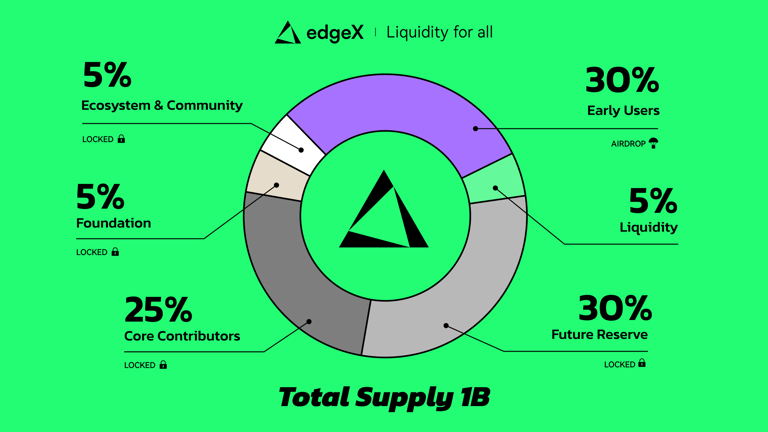
EDGE is the native cryptocurrency and governance asset of the edgeX protocol, with a fixed maximum supply of 1 billion tokens. The token generation event is scheduled for March 31, 2026.
Token utility.
- Governance: EDGE holders can vote on edgeX Improvement Proposals (eIPs), covering matters such as fee structure adjustments, new asset listings, blockchain compatibility upgrades, and security protocol enhancements.
- Staking: EDGE holders can delegate to validators responsible for validating transactions and maintaining the integrity of the edgeX orderbook, earning a share of protocol rewards in return. Tokens subject to lock-up periods cannot be staked during the lock-up period.
- Ecosystem incentives: EDGE is intended to support developer grants, early adopter programmes, and liquidity provision rewards as the protocol grows.
Token distribution.
- Early Users (30%): fully unlocked at genesis — 25% via Genesis Distribution to points and NFT holders, and up to 5% for Pre-TGE Season participants.
- Future Reserve (30%): locked for 18 months after TGE, followed by 24 months of linear monthly vesting.
- Core Contributors (25%): locked for 24 months after TGE, followed by 24 months of linear monthly vesting.
- Liquidity (5%): subject to edgeX's official documentation.
- Ecosystem & Community (5%): locked for 12 months after TGE, followed by 24 months of linear monthly vesting.
- Foundation (5%): locked for 12 months after TGE, followed by 24 months of linear monthly vesting.
Who Is edgeX For?
edgeX is primarily designed for traders who want access to perpetual futures in a non-custodial environment.
It may be particularly relevant for users who value execution quality, orderbook-based price discovery, and the ability to maintain control over their funds. Traders familiar with centralized exchanges may find the interface and trading experience more intuitive compared to traditional DeFi platforms.
The eLP vault may appeal to users seeking passive exposure to market-making activity, although this involves variable returns and counterparty risk. Mobile access and simplified onboarding features may also lower the barrier to entry for newer users.
Availability of edgeX products may vary depending on jurisdiction, and users should ensure compliance with local regulations.
edgeX Vision and Roadmap
edgeX's longer-term vision centers on building a high-performance execution environment designed for both human traders and AI agents, with the goal of enabling autonomous financial interaction across multiple asset classes at millisecond speeds.
The technical roadmap is organized around four phases of EDGE Stack development:
- Phase 1 — Deterministic Parallelism & Scale: optimization of the PTE engine for near-linear throughput scaling via market-sharded state access.
- Phase 2 — Modular Multi-VM & Zero-Copy Interaction: deployment of the Host Function Interface (HFI) to enable atomic interoperability between edgeVM and edgeEVM, with cross-VM efficiency improvements.
- Phase 3 — FlashLane Finality & Economic Security: full integration of protocol-native QoS traffic shaping and cryptographically signed execution commitments for near-instant economic finality.
- Phase 4 — AI-Native Infrastructure & Privacy Zones: designated execution environments for on-chain machine learning inference and research into zero-knowledge privacy zones for institutional participants.
Roadmap timelines and scope are subject to change. Readers should refer to edgeX's official documentation for the most current development updates.
Risks to Consider
Smart contract and execution layer risk. edgeX's V1 infrastructure relies on StarkWare's StarkEx system. Any vulnerability or operational issue at the infrastructure layer could affect the platform. Security audits do not eliminate risk.
Leverage risk. Trading perpetual futures with leverage amplifies exposure in both directions. High-leverage positions can be liquidated by relatively small price movements against the trader's direction, depending on margin requirements and funding rates at the time of the trade.
Competitive risk. The perpetual DEX sector is competitive and rapidly evolving. edgeX's market position may change as competing platforms update their infrastructure, fee structures, or incentive programs.
Token launch volatility. The EDGE token does not yet have a live trading history on the open market. Tokens at TGE may experience significant price fluctuations in both directions, particularly in the period immediately following launch.
Regulatory risk. Decentralized derivatives trading operates in a regulatory environment that varies by jurisdiction and continues to evolve. Users are responsible for determining whether use of the platform is permissible under applicable local laws.
Final Thoughts
edgeX represents a new generation of crypto trading infrastructure that seeks to combine the strengths of centralized and decentralized systems.
By integrating high-speed execution with a self-custodial design, the protocol provides an alternative for traders who want performance without giving up control over their assets.
As the ecosystem develops, the EDGE token launch on March 31, 2026 marks an important step in the protocol’s transition toward a more community-driven model.
Learn more about Backpack
Exchange | Wallet | Twitter | Discord | Reddit
Disclaimer: This content is presented to you on an “as is” basis for general information and educational purposes only, without representation or warranty of any kind. It should not be construed as financial, legal or other professional advice, nor is it intended to recommend the purchase of any specific product or service. You should seek your own advice from appropriate professional advisors. Where the article is contributed by a third party contributor, please note that those views expressed belong to the third party contributor, and do not necessarily reflect those of Backpack. Please read our full disclaimer for further details. Digital asset prices can be volatile. The value of your investment may go down or up and you may not get back the amount invested. You are solely responsible for your investment decisions and Backpack is not liable for any losses you may incur. This material should not be construed as financial, legal or other professional advice.


