Modern DeFi applications increasingly require real-time execution, predictable transaction ordering, and consistent performance. However, many blockchains struggle to deliver low latency and high throughput at scale without compromising usability or execution quality.
Fogo is designed to address these performance constraints by focusing on speed, execution reliability, and developer compatibility. This article explains what Foge is, how it works, and how it is used within the broader DeFi ecosystem.
Key Takeaways
- Fogo is a Layer 1 blockchain optimized for performance-sensitive DeFi applications.
- It is fully compatible with the Solana Virtual Machine (SVM).
- The network uses a Firedancer-based client and multi-local consensus to reduce latency.
- Fogo supports applications such as on-chain order books, derivatives, and real-time auctions.
- The $FOGO token is designed to be used for gas, staking, and network security, with a structured tokenomics model.
What Is Fogo?
Fogo is a Layer 1 blockchain built for high-throughput, low-latency DeFi applications. It is fully compatible with the Solana Virtual Machine (SVM), allowing existing Solana programs, tooling, and infrastructure to run on Fogo without modification.
The network is designed to support applications that depend on precise execution timing and real-time responsiveness, such as on-chain order books, perpetual futures, auctions, and liquidation-sensitive protocols, use cases that are difficult to support reliably on general-purpose blockchains.
How Does Fogo Work?
Fogo builds on Solana’s core architectural components while optimizing their implementation for performance.
The protocol inherits key elements from Solana’s design, including Proof of History (PoH) for global time coordination, Tower BFT for fast finality, Turbine for efficient block propagation, and the Solana Virtual Machine for transaction execution.
To maximize performance, Fogo standardizes on a single high-performance validator client based on Firedancer. This approach avoids the performance bottlenecks that can arise from supporting multiple client implementations with varying optimization levels.
Fogo also introduces multi-local consensus, where validators operate in close physical proximity within designated zones to minimize network latency. These zones rotate across epochs through on-chain coordination, helping balance performance with decentralization and resilience.
Key Features of Fogo
SVM Compatibility
Fogo maintains execution-layer compatibility with the Solana ecosystem, enabling developers to deploy existing programs without rewriting smart contracts or tooling.
Firedancer-Based Client
The network runs a Firedancer-based validator client optimized for parallel execution, efficient memory usage, and low-latency networking.
Multi-Local Consensus
Validators co-locate within performance-optimized zones to reduce communication delays, while zone rotation helps distribute infrastructure and jurisdictional exposure over time.
Curated Validator Set
Fogo uses a curated validator model that enforces both economic and operational standards, helping maintain consistent network performance and stability.
Fogo Sessions
Fogo Sessions are a chain-level primitive that enable gasless, session-based interactions. Using account abstraction and paymasters, users can interact with applications without signing every transaction or holding native gas tokens, while retaining self-custody and security controls.
What Is Fogo Used For?
Fogo is designed for DeFi applications that require fast, predictable, and precise execution, including:
- On-chain order book exchanges
- Perpetual futures and derivatives protocols
- Real-time auctions and batch execution models
- Money markets with time-sensitive liquidations
- Trading and infrastructure tools that depend on low and consistent latency
These use cases benefit from Fogo’s execution model, which reduces latency and limits advantages based purely on transaction ordering speed.
The $FOGO Token
The $FOGO token is the native asset of the Fogo network and is designed to play a core role at the protocol level once the network reaches full mainnet.
At present, $FOGO has not yet launched as a publicly tradable token. Distribution and usage are tied to the network’s rollout and ecosystem activation.
$FOGO is designed to support the network through several key functions:
- Network fees, including support for fee abstraction through paymasters
- Staking and network security, enabling validator participation and consensus
- Long-term protocol alignment among validators, builders, and the community
While most user-facing activity on Fogo is expected to use SPL tokens, $FOGO is intended to remain essential for core protocol operations. Details related to launch timing and market availability are expected to be announced closer to mainnet.
Fogo Tokenomics
Fogo’s tokenomics are structured to balance long-term network security, ecosystem growth, and community ownership, with incentives aligned over time.
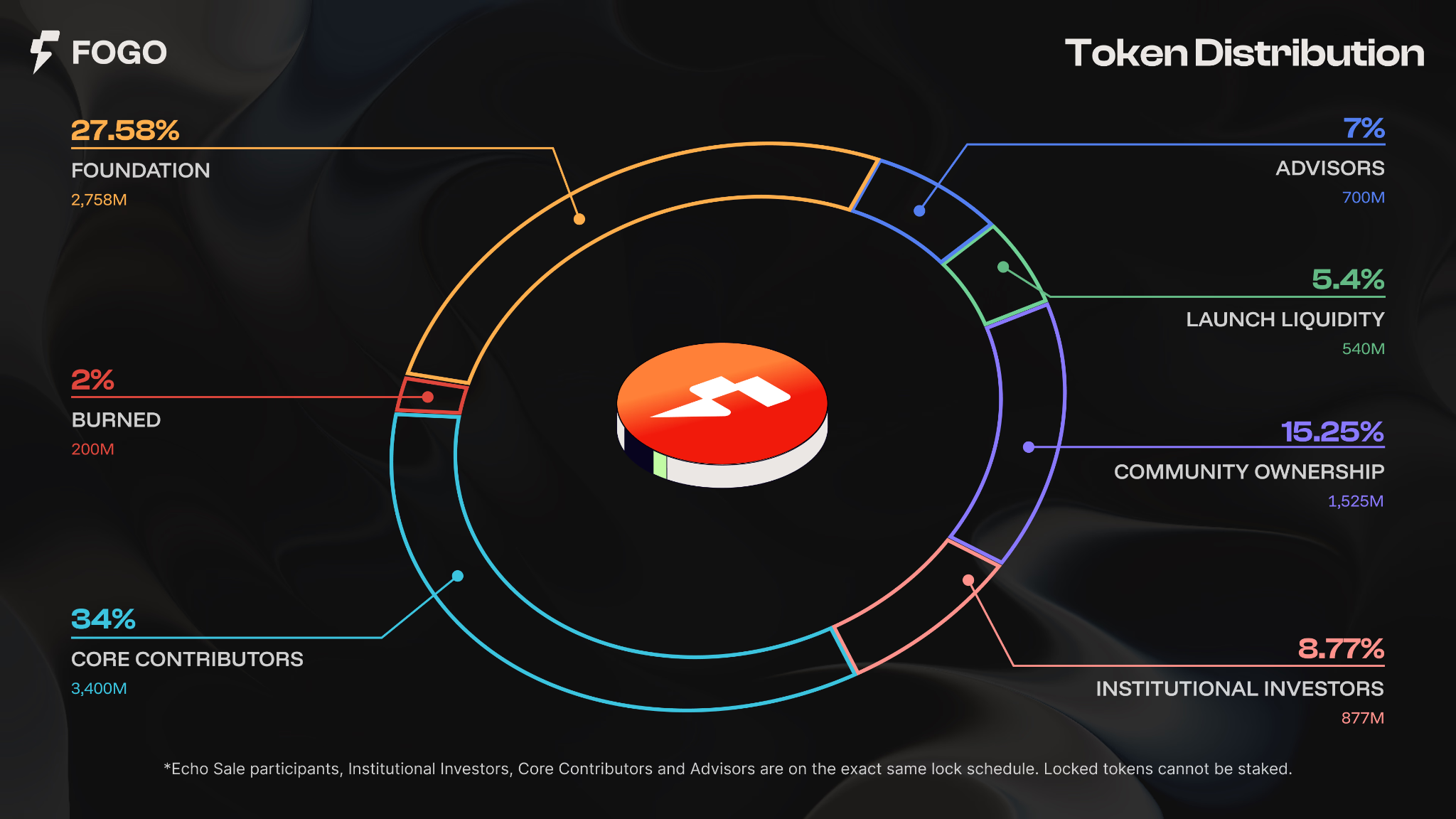
At genesis, the $FOGO supply is distributed across the community, core contributors, investors, advisors, the foundation, and launch liquidity.
- Community Ownership (15.25%): Includes the Echo raises and community airdrops. Echo raise tokens unlock over four years from September 26, 2025, with a 12-month cliff, while airdrop allocations are unlocked at genesis. Additional allocations support public mainnet rewards and future ecosystem campaigns.
- Core Contributors (34%): Fully locked at genesis and vesting over four years with a 12-month cliff, aligning long-term development with the network’s growth.
- Foundation (27.58%): Unlocked and used to fund grants, incentives, and ecosystem programs.
- Institutional Investors (8.77%) and Advisors (7%): Fully locked at genesis and vesting over four years with a 12-month cliff.
- Launch Liquidity (5.4%): Unlocked to support third-party liquidity provisioning at launch.
- Burned Supply (2%): Permanently removed from circulation.
At launch, 59.02% of the genesis supply is locked, with unlocks occurring gradually over four years. The remaining supply is available for ecosystem support, community distribution, and liquidity, providing early participation while maintaining long-term supply discipline.
The Fogo Ecosystem
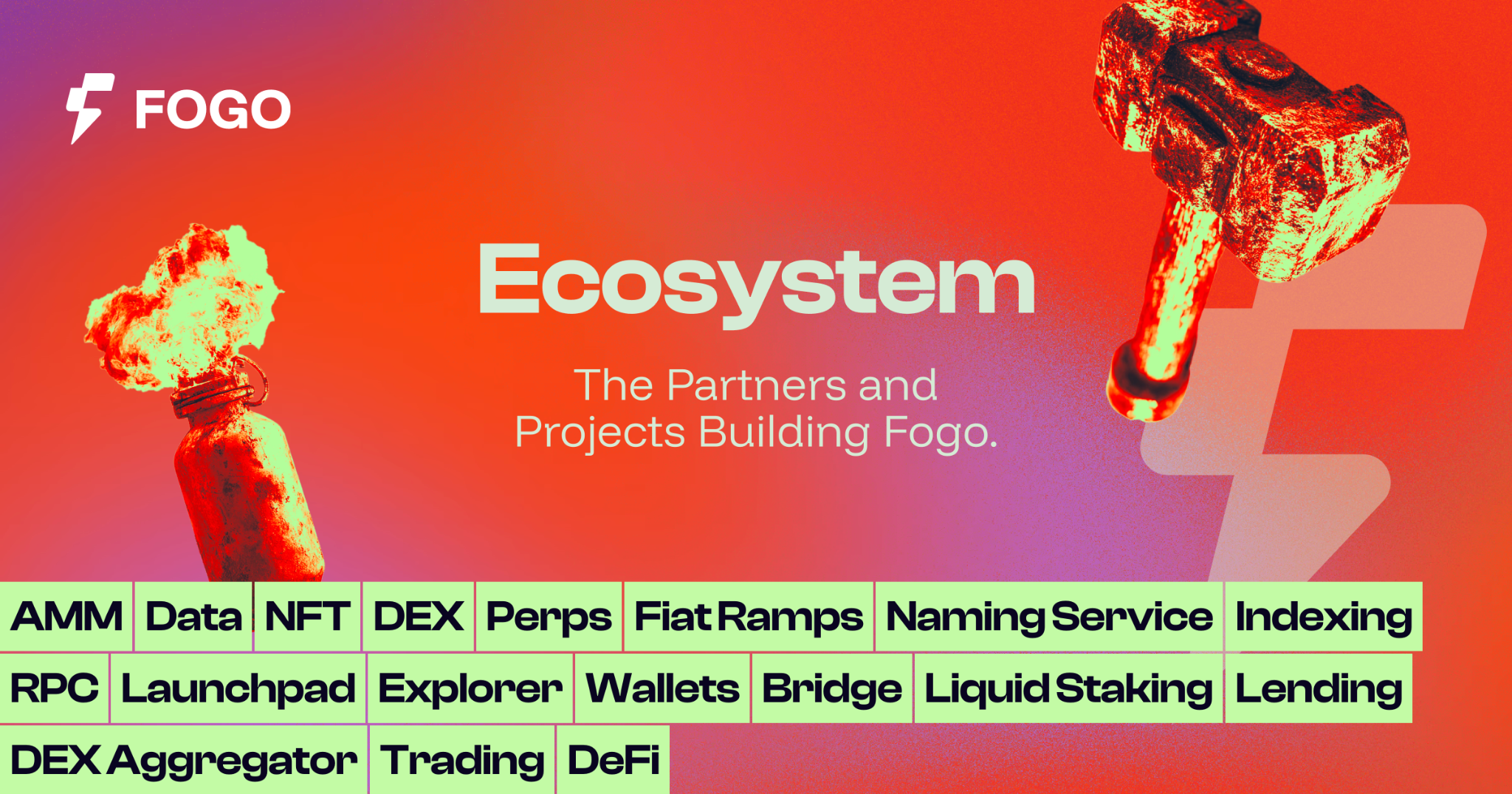
The Fogo ecosystem is centered around DeFi and on-chain trading applications that benefit from low latency and predictable execution. A growing number of dApps are building on Fogo’s performance-oriented environment, with a focus on trading, liquidity, and capital efficiency.
Early applications in the ecosystem span derivatives, spot trading, lending, liquid staking, and cross-chain infrastructure.
Key Ecosystem Applications
- Ambient: An on-chain perpetual futures platform designed for Fogo. Ambient uses a Dual Flow Batch Auction (DFBA) model instead of a traditional order book, aiming to reduce MEV, improve execution fairness, and concentrate liquidity through batch-based settlement.
- Valiant: A spot trading platform that aims to support multiple market structures, including concentrated liquidity pools, on-chain order books, native bridging, and token launch infrastructure.
- Pyron and FogoLend: Money market protocols focused on low-latency lending and borrowing, with configurable risk parameters and on-chain transparency.
- Brasa: A liquid staking protocol that enables users to stake $FOGO while maintaining liquidity through a staking derivative.
- FluxBeam: A suite of on-chain trading and tooling products, including a spot DEX, contract inspection tools, and a Telegram-based trading interface.
- Wormhole: The primary cross-chain bridge for Fogo at launch, enabling asset transfers to and from the network via Portal Bridge and integration with Fogo Sessions.
Together, these applications illustrate how Fogo’s execution model supports real-time, on-chain financial activity while remaining compatible with the Solana Virtual Machine.
Risks and Considerations
As with any blockchain network, users and developers should consider several factors:
- Early-stage infrastructure and tooling risks
- Validator set design and governance dynamics
- Smart contract and application-level risks
- Regulatory uncertainty affecting DeFi and digital assets
Fogo prioritizes performance and execution quality, but outcomes depend on adoption, ecosystem development, and ongoing network evolution.
Final Thoughts
Fogo is a performance-focused Layer 1 blockchain designed for DeFi applications that demand speed, precision, and predictable execution. By combining SVM compatibility, a Firedancer-based client, and multi-local consensus, Fogo provides an execution environment optimized for real-time on-chain activity.
For developers and users building latency-sensitive DeFi infrastructure within the Solana ecosystem, Fogo represents a specialized approach to scaling on-chain performance.
Learn more about Backpack
Exchange | Wallet | Twitter | Discord | Reddit
Disclaimer: This content is presented to you on an “as is” basis for general information and educational purposes only, without representation or warranty of any kind. It should not be construed as financial, legal or other professional advice, nor is it intended to recommend the purchase of any specific product or service. You should seek your own advice from appropriate professional advisors. Where the article is contributed by a third party contributor, please note that those views expressed belong to the third party contributor, and do not necessarily reflect those of Backpack. Please read our full disclaimer for further details. Digital asset prices can be volatile. The value of your investment may go down or up and you may not get back the amount invested. You are solely responsible for your investment decisions and Backpack is not liable for any losses you may incur. This material should not be construed as financial, legal or other professional advice.