
Key Takeaways
- Linea is an Ethereum Layer 2 network developed by Consensys, the company behind MetaMask and Infura.
- Linea uses zero-knowledge rollup technology to process transactions on Layer 2, then submit validity proofs back to Ethereum.
- Linea is EVM-equivalent, which means Ethereum smart contracts and developer tools can work on Linea with minimal changes.
- ETH is used as gas on Linea. LINEA is not a gas token.
- The LINEA token is designed to support ecosystem growth, incentives, liquidity, and Ethereum public goods.
- LINEA has a total supply of 72,009,990,000 tokens, with 85% allocated to the ecosystem and 15% allocated to the Consensys treasury.
- Eligible users who want exposure to LINEA price movement can trade LINEA-PERP on Backpack Exchange.
What Is Linea?
Linea is an Ethereum Layer 2 network developed by Consensys, the company behind MetaMask and Infura. It is built to help Ethereum scale by making transactions faster and cheaper while keeping the experience close to Ethereum mainnet. Linea’s support documentation describes it as Consensys’ zkEVM rollup network and a public network that works like an extension of Ethereum.
The network uses zero-knowledge rollup technology. Instead of sending every transaction directly to Ethereum mainnet one by one, Linea processes activity on Layer 2, groups transactions into batches, and submits proofs back to Ethereum. This helps reduce costs for users while keeping Linea connected to Ethereum’s settlement layer.
In simple terms, Linea gives users and developers a more efficient way to use Ethereum-style applications. It keeps ETH as the gas token, supports Ethereum-compatible smart contracts, and focuses on scaling without forcing developers to rebuild their apps from scratch.
How Linea Works
Linea works as a zero-knowledge rollup, also called a zk-rollup. A rollup is a Layer 2 blockchain that runs activity outside Ethereum mainnet, then periodically submits batches of transactions back to Ethereum for confirmation. Linea’s help center explains that bundling transactions together can reduce gas costs because users share the cost of submitting a larger group of transactions.
What makes Linea a zk-rollup is its use of validity proofs. When Linea submits a bundle of transactions to Ethereum, it also submits a proof that verifies those transactions produced the correct state changes. Ethereum does not need to re-execute every transaction individually. It checks the proof instead.
This is the basic trade-off Linea is designed around: move execution to Layer 2, keep verification anchored to Ethereum, and make the experience cheaper for users.
Transaction Flow
A typical Linea transaction moves through four stages:
- Transaction submission: A user submits a transaction on Linea, such as sending funds or interacting with a decentralized app.
- Batching: Linea groups many Layer 2 transactions together.
- Proof generation: Linea generates a validity proof showing that the transactions in the batch are correct.
- Ethereum verification: The batch and proof are submitted to Ethereum, where the proof is verified by smart contracts.
This process allows Linea to scale Ethereum activity while preserving a connection to Ethereum’s security model.
Key Features of Linea
EVM Equivalence
Linea is EVM-equivalent. According to Linea’s help center, this means Linea mirrors the behavior and conditions of Ethereum closely enough that anything that works on Ethereum mainnet should work on Linea too. Smart contracts do not need to be rewritten, and developers can use familiar tools and infrastructure.
For developers, that matters. A Layer 2 can have strong technology, but if builders need to rewrite contracts, change tools, or rework their stack, adoption becomes harder. Linea’s EVM equivalence lowers that friction.
Lower Fees
Linea reduces fees by batching transactions before submitting them to Ethereum. Instead of each user paying the full cost of an individual Ethereum mainnet transaction, users pay a smaller share of the cost of a larger batch. Linea’s rollup explainer describes this batching model as one reason rollups can be considerably cheaper for users.
Actual fees can still vary. Costs depend on network activity, Ethereum settlement costs, and the app or transaction being used.
ETH as Gas
Linea uses ETH for gas. This is one of its most important design choices. Users do not need LINEA to pay transaction fees on the network.
Linea’s official tokenomics page states that LINEA is not a gas token and that ETH is used as gas.
Ethereum Alignment
Linea presents itself as an Ethereum-aligned Layer 2. Its tokenomics are designed to reinforce ETH usage, support builders, and fund Ethereum public goods rather than replace Ethereum’s core economic role.
That makes Linea different from networks that try to use their own token as the center of the ecosystem. On Linea, ETH remains central to transaction fees, while LINEA is used for ecosystem coordination and incentives.
Technical Architecture
Linea’s architecture combines Ethereum-style execution with zero-knowledge proof verification. The goal is to let developers keep using familiar Ethereum tools while giving users a cheaper Layer 2 environment.
zk-Proof System
Linea uses zero-knowledge validity proofs to verify batches of transactions. A validity proof confirms that the transactions included in a batch produce the state changes Linea claims they produce. This allows Ethereum to verify Linea’s activity without processing each transaction individually.
This proof system is the core of Linea’s scaling model. Execution happens on Layer 2, while Ethereum verifies the correctness of the result.
Provers and Sequencers
Linea, like other rollups, relies on infrastructure that orders transactions, produces blocks, and generates proofs.
The sequencer is responsible for ordering transactions and helping provide a faster user experience on Layer 2. The prover is responsible for producing the validity proofs that connect Linea’s execution back to Ethereum verification.
This design gives Linea strong scaling benefits, but users should still understand that Layer 2 networks have their own infrastructure assumptions. Sequencers, provers, bridge contracts, upgrades, and application-level smart contracts can all introduce risks that are separate from Ethereum mainnet itself.
Security and Trust Model
Linea settles through Ethereum using validity proofs. That means Linea’s batches are accepted only if the proof verifies on Ethereum.
A precise way to describe this is that Linea has Ethereum-backed settlement, not that it is identical to Ethereum in every risk category. Users still need to consider Layer 2 risks such as bridge contracts, sequencer infrastructure, smart contract bugs, upgrade controls, and app-specific vulnerabilities.
Developer Stack
Linea is designed for Ethereum developers. Because it is EVM-equivalent, developers can use Solidity contracts, familiar tooling, Ethereum-style wallets, and existing infrastructure with less friction.
That gives Linea a practical advantage. The easier it is for Ethereum teams to deploy on Linea, the faster the network can grow its application ecosystem.
Linea Ecosystem and Integrations
Linea has an active ecosystem across DeFi, bridges, wallets, infrastructure, stablecoins, and payments. The Linea ecosystem portal lists applications across categories such as swapping, lending, bridging, payments, gaming, NFTs, and developer infrastructure.
DeFi and DEXs
Linea supports DeFi activity such as swaps, liquidity provision, lending, borrowing, and bridging. Apps listed in the Linea ecosystem include names such as Aave, 1inch, Uniswap, Sushi, Across, and other projects available through the Linea Hub.
For users, this means Linea is not only a technical scaling network. It is also an environment where Ethereum-style DeFi activity can happen at lower cost.
Cross-chain Connectivity
Bridges are important for any Layer 2 because users need ways to move assets between Ethereum, Linea, and other networks. Linea’s help center explains that users can bridge ETH to Linea, and its ecosystem resources point users toward available apps and bridging options.
Cross-chain connectivity is useful, but it also comes with risk. Users should pay attention to the bridge they use, the asset they are moving, and whether they are interacting with official or third-party infrastructure.
Oracles and Interoperability
DeFi applications often depend on reliable data and cross-chain infrastructure. Lending markets, swaps, derivatives, and other financial apps need accurate pricing, messaging, and execution support.
Linea’s ecosystem includes infrastructure providers that help support these use cases. As the network matures, the depth and reliability of this infrastructure will play a major role in how much activity Linea can support.
Stablecoins and Payments
Stablecoins are important for Layer 2 adoption because they support payments, trading, lending, and liquidity. Linea has supported native USDC through Circle’s bridged-to-native USDC upgrade and Cross-Chain Transfer Protocol support, according to Linea’s official blog.
This matters because an ecosystem with native stablecoin support is easier for users and applications to adopt. Stablecoin liquidity often becomes the base layer for DeFi activity.
Linea Tokenomics
What Is the LINEA Token?
LINEA is the native token of the Linea ecosystem, but it is not used to pay gas fees. ETH is the gas token on Linea.
Instead, LINEA is designed as an economic coordination tool. According to Linea’s official tokenomics, LINEA is used to fund builders, users, liquidity providers, and Ethereum public goods.
That distinction is important. LINEA is not trying to replace ETH inside the Linea network. It is designed to support ecosystem growth around an ETH-based gas model.
Supply and Allocation
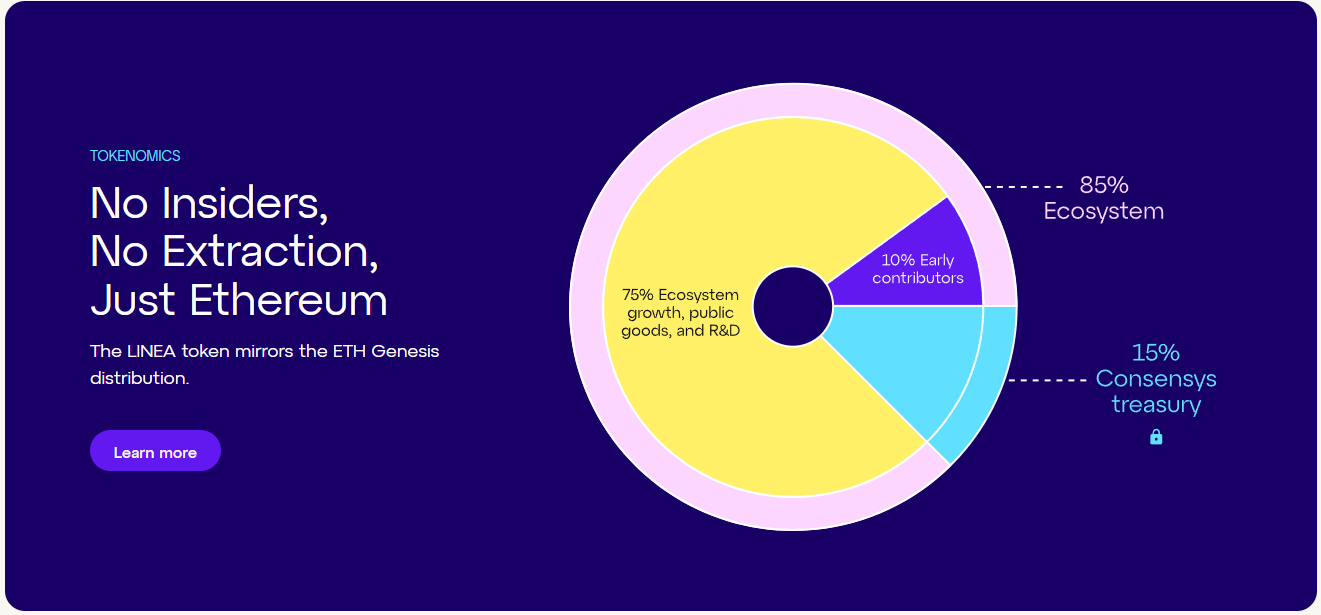
Linea’s total token supply is 72,009,990,000 LINEA. The allocation is split into two main categories:
- 85% ecosystem allocation
- 10% for early contributors, including 9% for user airdrops and 1% for builder rewards
- 75% for the Ecosystem Fund
- 15% Consensys treasury
- Subject to a five-year unlock
The Ecosystem Fund is intended to support users, builders, liquidity providers, applications, partnerships, research, and public goods over time.
Deflationary Mechanism
Linea uses a dual-burn model tied to net fee revenue. Official tokenomics state that after Layer 1 costs are accounted for, 20% of net ETH fees are burned, while the remaining 80% are used to burn LINEA.
This creates a direct relationship between network usage and supply reduction for both ETH and LINEA.
Governance
LINEA currently carries no on-chain governance rights, and Linea does not operate through a token-holder DAO. Strategic decisions around token emissions, grants, incentives, and fund allocations are overseen by the Linea Consortium.
This is a different model from many crypto networks. Rather than relying on token voting, Linea uses a consortium-led structure to guide ecosystem funding and alignment.
Linea vs Other Layer 2s
Ethereum’s Layer 2 ecosystem includes optimistic rollups, zk-rollups, app-specific networks, and other scaling designs. Linea belongs to the zk-rollup category, with a focus on EVM equivalence.
The key difference between Linea and optimistic rollups is the proof model. Optimistic rollups assume transactions are valid unless they are challenged during a dispute period. zk-rollups like Linea submit validity proofs to Ethereum, which verify that the transactions in a batch produce the correct state changes.
Linea’s edge is its combination of zk-rollup verification and EVM equivalence. Developers get a familiar Ethereum-style environment, while users get lower-cost Layer 2 transactions.
That does not mean Linea removes every trade-off. zk systems can be complex, and Layer 2 networks still depend on their own operational infrastructure. The stronger argument for Linea is not that it has no risks. It is that it gives Ethereum users and developers a practical scaling path that stays close to Ethereum’s existing standards.
Why Linea Matters for Users and Developers
For Users
Linea matters because it makes Ethereum-style apps cheaper and easier to use. Users can pay gas in ETH, interact with DeFi applications, bridge assets, use stablecoins, and access Layer 2 activity without moving into a completely separate ecosystem.
The practical benefit is simple: more on-chain activity becomes affordable.
For Developers
Linea matters because it reduces the cost of scaling Ethereum applications. Developers can use familiar contracts, tools, wallets, and infrastructure while reaching users who want lower transaction fees.
That is the real value of EVM equivalence. It lowers the switching cost for builders and makes Linea feel more like a continuation of Ethereum than a separate development environment.
The Future of Linea
Linea’s future depends on three things: ecosystem depth, decentralization, and Ethereum alignment.
First, Linea needs applications that users return to after initial incentives fade. Token distributions can bring attention, but long-term growth depends on liquidity, useful apps, and repeat activity.
Second, Linea needs to continue improving its infrastructure and decentralization. Like many Layer 2 networks, it still depends on specific operational components, including sequencing and proving infrastructure.
Third, Linea’s Ethereum-aligned design has to prove itself over time. The ETH gas model, dual-burn mechanism, ecosystem allocation, and consortium-led funding structure all point toward a network that wants to reinforce Ethereum rather than compete with it.
Conclusion
Linea is a zkEVM Layer 2 built to scale Ethereum while keeping the developer and user experience close to Ethereum mainnet. It uses zero-knowledge rollup technology, settles through validity proofs on Ethereum, and supports EVM-equivalent smart contract deployment.
The LINEA token adds an ecosystem funding layer rather than replacing ETH as gas. With 85% of supply allocated to the ecosystem, a dual-burn model tied to network fees, and a consortium-led funding structure, Linea is designed to support long-term Ethereum-aligned growth.
For users, Linea offers lower-cost access to Ethereum-style applications. For developers, it offers a scaling environment that does not require leaving the EVM behind.
You can trade LINEA-PERP and check the latest LINEA price on Backpack Exchange.
Learn more about Backpack
Exchange | Wallet | Twitter | Discord | Reddit
Disclaimer: This content is presented to you on an “as is” basis for general information and educational purposes only, without representation or warranty of any kind. It should not be construed as financial, legal or other professional advice, nor is it intended to recommend the purchase of any specific product or service. You should seek your own advice from appropriate professional advisors. Where the article is contributed by a third party contributor, please note that those views expressed belong to the third party contributor, and do not necessarily reflect those of Backpack. Please read our full disclaimer for further details. Digital asset prices can be volatile. The value of your investment may go down or up and you may not get back the amount invested. You are solely responsible for your investment decisions and Backpack is not liable for any losses you may incur. This material should not be construed as financial, legal or other professional advice.


