
What is Zama?
Zama is an open source cryptography company that develops Fully Homomorphic Encryption (FHE) solutions for blockchain and artificial intelligence applications. The company provides tools and libraries that enable developers to build confidential smart contracts and decentralized applications on existing blockchain networks.

Understanding the Zama Confidential Blockchain Protocol
The Zama Confidential Blockchain Protocol (commonly referred to as the Zama Protocol) is a cross-chain confidentiality layer that enables confidential smart contracts on existing public blockchains without requiring users to bridge to a new chain. The protocol functions as a layer that sits on top of existing L1 and L2 blockchains rather than operating as a separate blockchain.
Core Technology: Fully Homomorphic Encryption
At the foundation of Zama's technology is Fully Homomorphic Encryption, a cryptographic method that allows computation to be performed directly on encrypted data. This means sensitive information can remain encrypted throughout processing, never requiring decryption to perform operations.
The protocol addresses three key limitations that previously made FHE impractical for blockchain applications:
- Processing speed that was too slow for real-world use
- Limited application support
- Complex implementation requirements for developers
Zama's FHE implementation is post-quantum secure, meaning it remains resistant to attacks from quantum computers.
Key Features of the Zama Protocol
End-to-End Encryption
Transaction inputs and state remain encrypted throughout their lifecycle. Node operators and other network participants cannot view the underlying data, providing genuine confidentiality for blockchain applications.
Composability
The protocol supports interaction between confidential contracts and traditional non-confidential contracts. Developers can build applications that leverage existing tokens, contracts, and decentralized applications while maintaining confidentiality where needed.
Programmable Confidentiality
Smart contracts define access control rules, specifying which parties can decrypt specific data. This gives developers granular control over confidentiality rules within their applications, enabling compliance features to be built directly into contract logic.
The $ZAMA Token
The $ZAMA token is the native asset of the Zama Protocol and is designed to support protocol-level operations related to confidential computation. $ZAMA is scheduled to launch on February 2, 2026, and will be issued as an ERC-20 token on Ethereum.
According to Zama’s documentation, $ZAMA plays a central role in the protocol’s economic and security model, supporting several core functions at the protocol level, including:
- Protocol fees, such as payments for encryption, decryption, and other confidential computation services
- Staking and delegation, enabling operators to run protocol infrastructure and allowing token holders to participate in securing the network
The Zama Protocol uses a Delegated Proof-of-Stake–style model, in which operators stake $ZAMA to participate in running protocol infrastructure, while token holders may delegate their tokens to operators and share in protocol rewards.
Ahead of mainnet launch, Zama conducted a public token sale using a confidential sealed-bid auction built directly on the Zama Protocol. The auction served as an early production deployment of encrypted value transfer and encrypted computation using Fully Homomorphic Encryption.
Security Approach
Zama implements a defense-in-depth security model that combines cryptographic, infrastructure, and governance mechanisms, including:
Cryptographic and protocol security
- Fully Homomorphic Encryption with a target security level of 128 bits
- Public verifiability of FHE operations
- Zero-knowledge proofs used to support protocol correctness
Infrastructure and operational security
- Multiple FHE nodes coordinated through consensus mechanisms
- A set of MPC nodes with a two-thirds majority requirement for threshold operations
- MPC protocols running inside secure execution environments
Governance and audits
- Governance-based slashing mechanisms for operator misbehavior
- Genesis operators selected based on reputation and operational reliability
- Independent security audits conducted by Trail of Bits and Zenith
Roadmap and Future Development
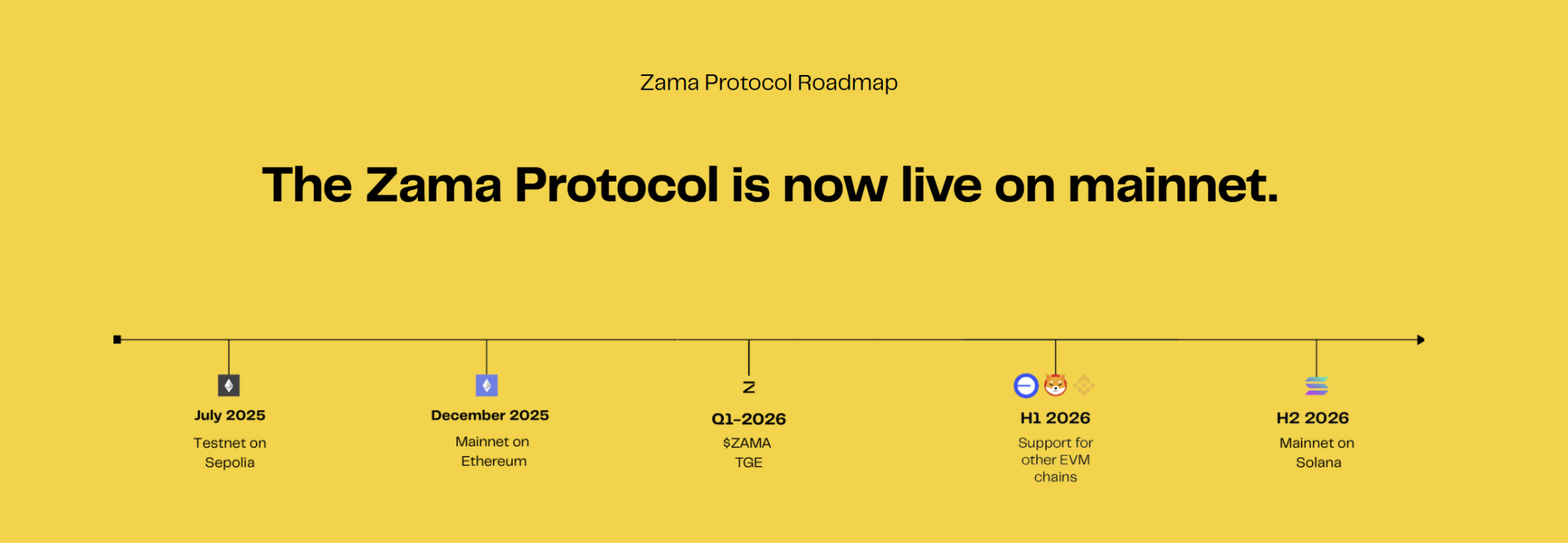
Current Status: The protocol testnet is operational, with Ethereum mainnet launching by the end of 2025.
2026 H1: Support for additional EVM-compatible chains, enabling cross-chain confidential applications.
2026 H2: Solana integration for confidential Solana Virtual Machine applications.
Future Improvements:
- New FHE techniques targeting 10-20x performance improvements
- Dedicated FHE ASICs for 100-1,000x speedup
- ZK-rollup migration for the Gateway
- Zero-knowledge proofs for MPC operations
- Post-quantum zero-knowledge proofs and signatures

Conclusion
Zama provides infrastructure for building confidential blockchain applications through Fully Homomorphic Encryption technology. The Zama Protocol operates as a cross-chain confidentiality layer compatible with existing blockchain networks, enabling developers to create applications with end-to-end encryption, composability with existing contracts, and programmable access control. The technology addresses previous limitations of FHE through improved performance, simplified developer experience, and a scalable architecture combining FHE, MPC, and zero-knowledge proofs.
Following the launch of $ZAMA, Backpack Exchange plans to support ZAMA perpetual contracts, enabling users to trade ZAMA-PERP with leverage.