
Backpack’s tokenomics are not structured around short-term liquidity events.
They are built around one long-term objective: developing a global financial infrastructure company capable of going public in the United States.
In a market where many token models prioritize early unlocks and rapid liquidity, Backpack has taken a different structural path. The model centers on user-first distribution, growth-based supply expansion, and equity-aligned incentives.
This article explains the philosophy behind the structure and why Backpack’s approach differs from conventional token launches.
$BP Token Details
The Core Principle: Insider Dumping Should Be Impossible
At the foundation of Backpack’s tokenomics is a clear constraint:
No founder, executive, employee, or venture investor should be able to extract value from the token before the company succeeds at scale.
To enforce this structure:
- There are no direct token allocations to founders
- There are no direct token allocations to employees
- There are no direct token allocations to venture investors
Instead, the entire team allocation sits in a corporate treasury held on the company’s balance sheet. This treasury is fully locked until at least one year after a potential IPO.
Team members and investors receive exposure only through equity ownership in the company, not through direct token grants.
This removes the typical misalignment seen in many token projects where insiders receive liquid allocations long before product maturity.
Backpack’s structure ensures that insiders benefit only if the company achieves durable, public-market scale.
Defining Escape Velocity in Corporate Terms
Many projects reference long-term vision without defining what success actually requires.
Backpack defines escape velocity explicitly: access to the largest and most liquid capital markets in the world through a United States IPO.
An IPO is not guaranteed. Timelines are uncertain. Market conditions fluctuate.
But the existence of that objective imposes discipline.
To go public in the United States, a company must demonstrate:
- Regulatory credibility
- Durable revenue
- Institutional-grade governance
- Scalable infrastructure
- Transparent reporting
Token design, in this context, cannot be optimized for short-term speculation. It must align with corporate durability.
While many token projects optimize for TGE, Backpack optimizes for IPO.
That difference reshapes incentives across the entire ecosystem.
Growth-Triggered Unlocks Instead of Time-Based Emissions
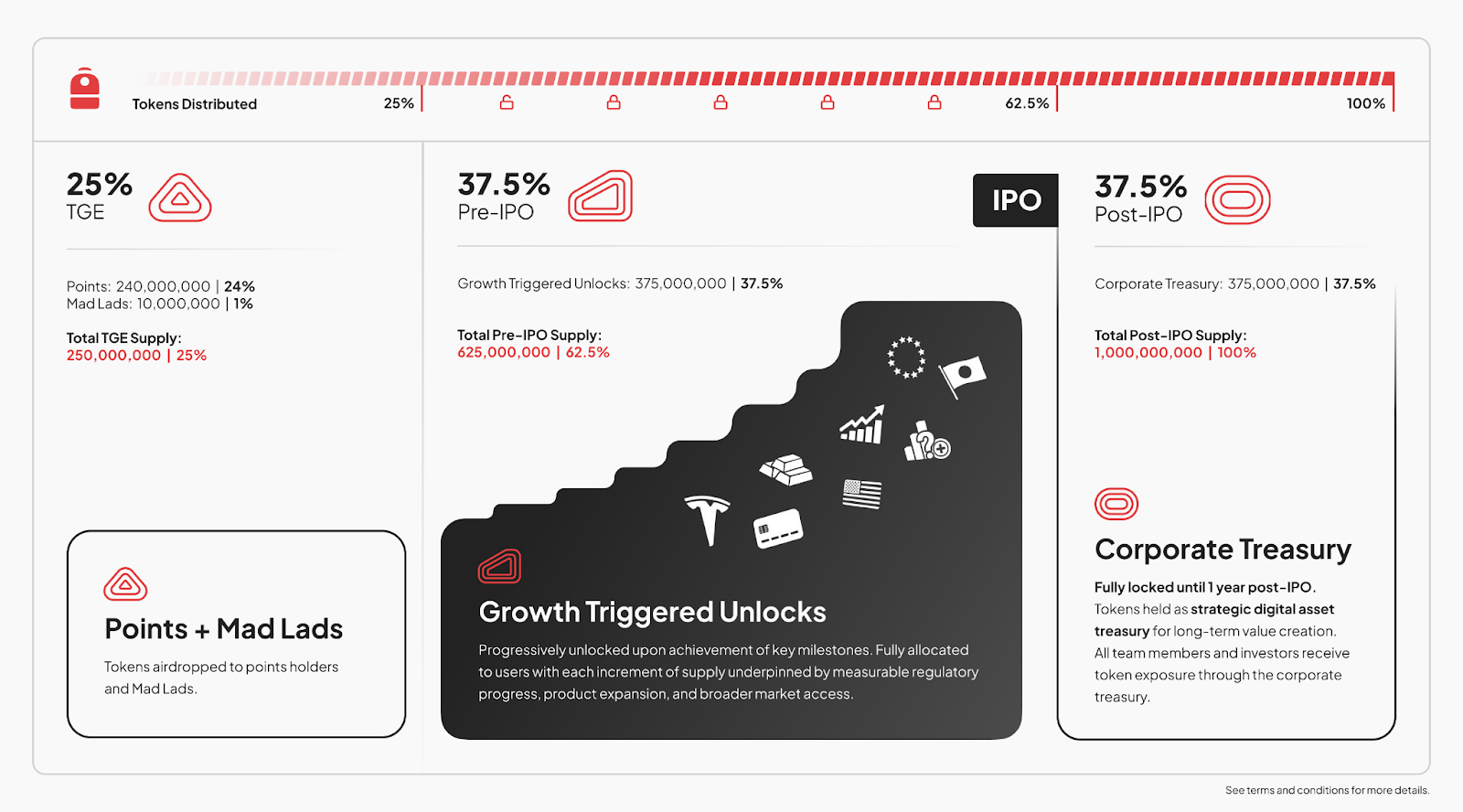
Backpack’s token supply expands in defined phases:
- 25% available at Token Generation Event
- 37.5% allocated to pre-IPO growth-triggered unlocks
- 37.5% held in corporate treasury post-IPO
The key distinction lies in how supply expands before IPO.
Unlocks are not tied to arbitrary time schedules. They are triggered by measurable progress such as:
- Regulatory advancement
- Expansion into new jurisdictions
- Launch of new product verticals
- Broader global access
Each unlocked tranche is allocated to users.
This ensures that increases in circulating supply correspond with increases in platform scale and utility.
The economic constraint is straightforward.
The value created by growth must exceed the dilution introduced by new token unlocks.
As long as that condition holds, token distribution operates as a growth accelerator rather than a value extraction mechanism.
A Hybrid Vision: Crypto Infrastructure and Regulated Finance
Backpack is not building a single-product crypto exchange.
The long-term strategy includes:
- Multi-currency client accounts including USD, EUR, and JPY
- Global banking rails
- Regulated exchange infrastructure
- Securities access
- Institutional-grade financial products
At present, Backpack Exchange serves only part of the global market. Significant geographic expansion remains ahead.
Each new region and product vertical represents both a business expansion opportunity and a potential growth milestone within the token framework.
The token is not positioned as a standalone speculative asset. It operates within a broader strategy of regulated global financial expansion.
Why This Model Is Structurally Rare
Most token launches follow a familiar pattern:
- Insider allocations at inception
- Time-based vesting schedules
- Early liquidity for private investors
- Circulating supply pressure during growth phase
Backpack inverts that structure.
- No direct insider token allocations
- No early insider liquidity
- Corporate treasury locked until post-IPO
- Insider exposure exclusively through equity
This alignment model is more commonly found in public companies than in token launches.
It borrows discipline from capital markets rather than from crypto cycle dynamics.
That makes it structurally rare within the digital asset space.
What This Means for Users
Prior to any IPO event, all circulating tokens are allocated to users.
This reinforces three core principles.
User-first distribution. Circulating supply before IPO belongs to the community rather than insiders.
Growth-backed expansion. Supply increases are tied to measurable platform progress.
Equity-aligned incentives. Insider wealth creation depends on company-level success, not token-level timing.
The token model is structured to compound alongside platform growth rather than front-load value extraction.
A Built-In Discipline
Backpack’s tokenomics impose structural discipline on the company itself.
If growth does not justify supply expansion, unlocks cannot occur responsibly.
If the company does not reach public-market scale, insiders cannot realize token-derived wealth.
This creates a higher alignment threshold than typical crypto token launches.
In practical terms, Backpack either builds a globally recognized financial infrastructure company or it does not unlock its full economic upside.
Conclusion: A Long-Term Financial Infrastructure Strategy
Backpack’s tokenomics are not engineered for a single market cycle.
They are structured around regulatory expansion, product depth, institutional access, and public-market ambition.
The objective is not simply to launch a token. The objective is to build a company capable of sustaining long-term global relevance.
Within that framework, the token functions as a growth mechanism embedded in a broader corporate strategy.
Backpack is not optimizing for short-term token liquidity.
It is optimizing for long-term institutional scale.
That distinction defines the model.
Learn more about Backpack
Exchange | Wallet | Twitter | Discord | Reddit
Disclaimer: This content is presented to you on an “as is” basis for general information and educational purposes only, without representation or warranty of any kind. It should not be construed as financial, legal or other professional advice, nor is it intended to recommend the purchase of any specific product or service. You should seek your own advice from appropriate professional advisors. Where the article is contributed by a third party contributor, please note that those views expressed belong to the third party contributor, and do not necessarily reflect those of Backpack. Please read our full disclaimer for further details. Digital asset prices can be volatile. The value of your investment may go down or up and you may not get back the amount invested. You are solely responsible for your investment decisions and Backpack is not liable for any losses you may incur. This material should not be construed as financial, legal or other professional advice.


.avif)