Ethereum Price Prediction for 2026–2030: Long-Term Outlook for ETH
Note: This article explores possible scenarios based on available data and market trends. It is not financial advice.
Ethereum Fundamentals That Influence Long-Term Value
Ethereum’s long-term valuation is shaped by structural factors that determine supply, demand, and network utility. Key fundamentals include:
- EIP-1559 fee burn mechanism, which permanently removes a portion of ETH from circulation
- Proof-of-Stake (PoS), which incentivizes staking and reduces liquid supply
- Ongoing network upgrades focused on scalability
- Layer-2 ecosystems that significantly increase transaction throughput
- DeFi and dApp activity, which drive gas consumption
- Institutional adoption and evolving regulatory clarity
- Tokenization of real-world assets (RWA)
- Competition from other smart-contract platforms
Ethereum’s evolving tokenomics, particularly the potential for net-deflation during high activity periods, is an important factor in long-term ETH forecasts.
Key Growth Drivers for ETH From 2026 to 2030
1. Network Upgrades and Scalability Improvements
Ethereum’s roadmap includes upgrades designed to improve transaction speed and reduce costs. Combined with layer-2 networks such as Optimism, Arbitrum, Base, and zk-rollups, Ethereum’s throughput is expected to expand significantly. Greater scalability supports broader adoption and long-term demand for ETH.
2. Growth of DeFi, dApps, and On-Chain Activity
Ethereum remains the largest ecosystem for decentralized exchanges, lending platforms, stablecoins, NFTs, and tokenization solutions. Higher activity in these sectors increases demand for ETH as gas and collateral.
3. Staking Participation and Supply Dynamics
A significant portion of ETH is staked, reducing circulating supply. When combined with EIP-1559’s burn mechanism, Ethereum can experience net-deflation during periods of high network usage. Reduced supply pressure supports long-term price appreciation.
4. Institutional Interest and Real-World Adoption
Institutions increasingly view Ethereum as a programmable settlement layer, a foundation for tokenized assets, and a yield-generating digital asset through staking. Tokenization of bonds, equities, and other real-world assets may become a major driver of ETH demand by 2030.
5. Macro Conditions and Crypto Market Cycles
Ethereum’s valuation is influenced by global liquidity, interest rates, Bitcoin market cycles, and overall risk-asset sentiment. High liquidity environments typically support stronger ETH performance.
Risks and Challenges for Ethereum’s Long-Term Outlook
Competition From Other Layer-1 Blockchains
Platforms such as Solana, Avalanche, and Aptos compete for developers and users. High-performance alternatives could pressure Ethereum’s market share.
Slow or Complex Upgrade Implementation
Ethereum’s scaling roadmap is technically demanding. Delays in rollup adoption or roadmap execution may limit network efficiency.
Regulatory Uncertainty
Ethereum’s regulatory classification remains unclear in some regions. Restrictions on staking or DeFi could impact adoption.
Market Downturns and Liquidity Compression
Recession risks, reduced liquidity, or prolonged bear markets can negatively affect ETH demand.
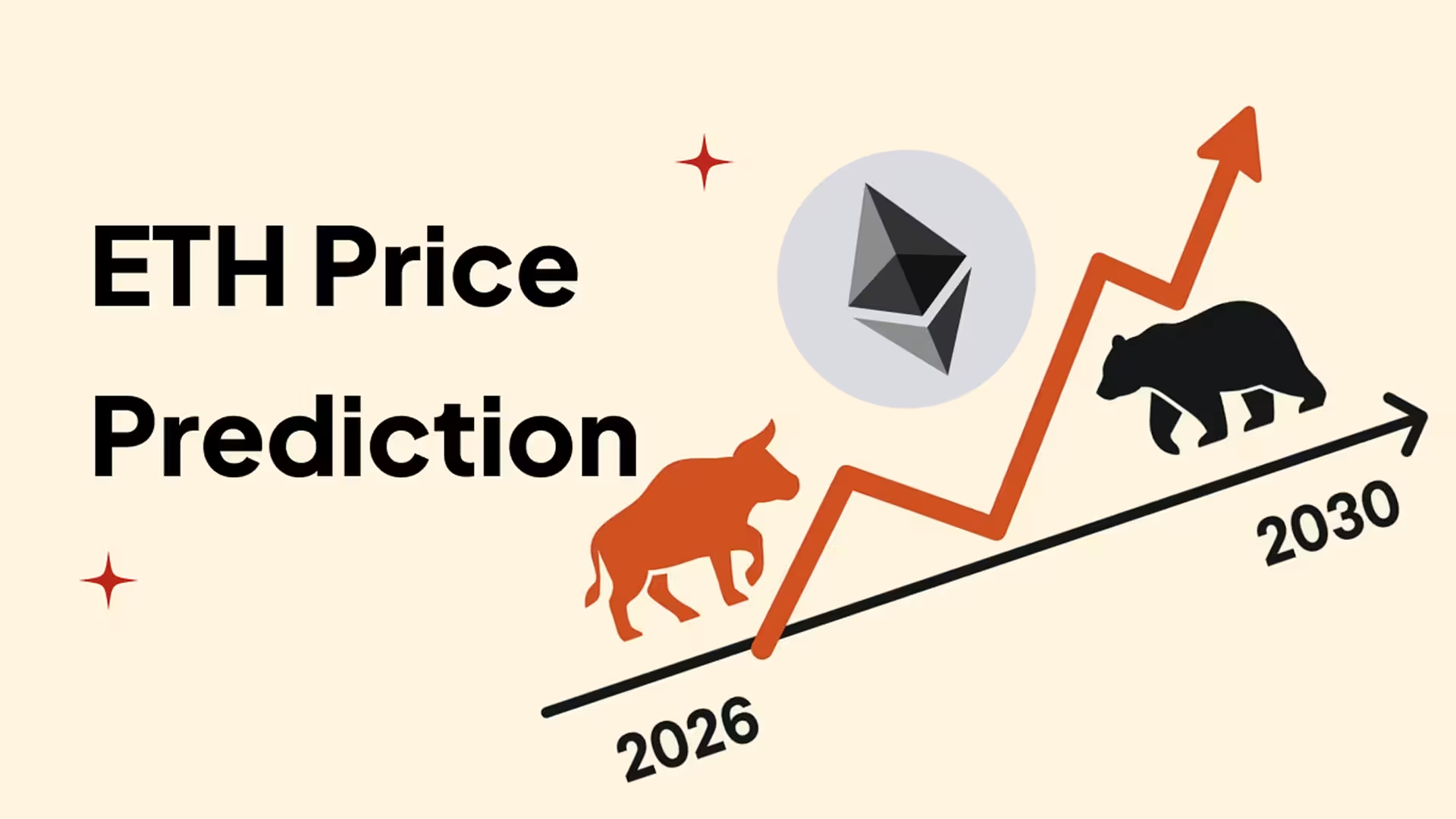
Ethereum Price Forecast Scenarios for 2026–2030
Forecasts should be treated as scenarios rather than exact predictions. Ethereum’s future value will depend on adoption trends, tokenomics, network innovation, regulation, and global macro conditions.
2026 to 2027: Growth Recovery Phase
If scalability upgrades accelerate and layer-2 adoption continues, Ethereum may experience renewed growth. Improved liquidity and expanding staking participation could support long-term appreciation.
Potential range: 3,000 to 6,000 USD
2028 to 2029: High-Adoption Expansion Phase
This period may offer the strongest potential for significant price growth, driven by expanding tokenization markets, increased institutional use of DeFi, higher ETH burn rates, and deeper layer-2 integration.
Potential range: 5,000 to 9,000 USD
2030: Long-Term Maturity Phase
By 2030, Ethereum’s valuation will depend on sustained blockspace demand, institutional settlement use cases, tokenized asset markets, staking participation, and long-term supply trends.
Potential range: 6,000 to 12,000 USD
Ethereum Outlook Summary for 2026–2030
Key Indicators to Monitor Through 2030
Investors tracking Ethereum’s long-term potential should monitor:
- Total eth staked and staking yield
- Supply changes after eip-1559
- Layer-2 transaction volume and rollup adoption
- Defi total value locked (TVL)
- Tokenization activity and institutional participation
- Gas fees and network revenue
- Active addresses and developer engagement
- Global regulatory developments
These metrics help assess Ethereum’s real-world demand and sustainability.
Final Thoughts
Ethereum continues to lead the smart-contract ecosystem and remains central to the development of decentralized applications. Its long-term value will depend on successful network upgrades, layer-2 adoption, institutional activity, tokenization growth, and macroeconomic conditions.
While ETH has strong long-term potential between 2026 and 2030, outcomes depend on execution, competition, regulation, and global liquidity. Forecasts should be viewed as scenarios, not certainties, and ongoing research remains essential.
Learn more about Backpack
Exchange | Wallet | Twitter | Discord | Reddit
Disclaimer: This content is presented to you on an “as is” basis for general information and educational purposes only, without representation or warranty of any kind. It should not be construed as financial, legal or other professional advice, nor is it intended to recommend the purchase of any specific product or service. You should seek your own advice from appropriate professional advisors. Where the article is contributed by a third party contributor, please note that those views expressed belong to the third party contributor, and do not necessarily reflect those of Backpack. Please read our full disclaimer for further details. Digital asset prices can be volatile. The value of your investment may go down or up and you may not get back the amount invested. You are solely responsible for your investment decisions and Backpack is not liable for any losses you may incur. This material should not be construed as financial, legal or other professional advice.