When trading on Solana, many users ask the same question: Solana DEX vs CEX, which is better?
The answer depends on what you are trading, how much you are trading, and your risk preferences. A decentralized exchange (DEX) enables onchain, wallet-based trading with self-custody, while a centralized exchange (CEX) operates through a custodial account and internal order book.
Understanding the structural differences between DEX vs CEX on Solana is essential before choosing where to execute your trades.
Solana DEX vs CEX: What’s the Difference?
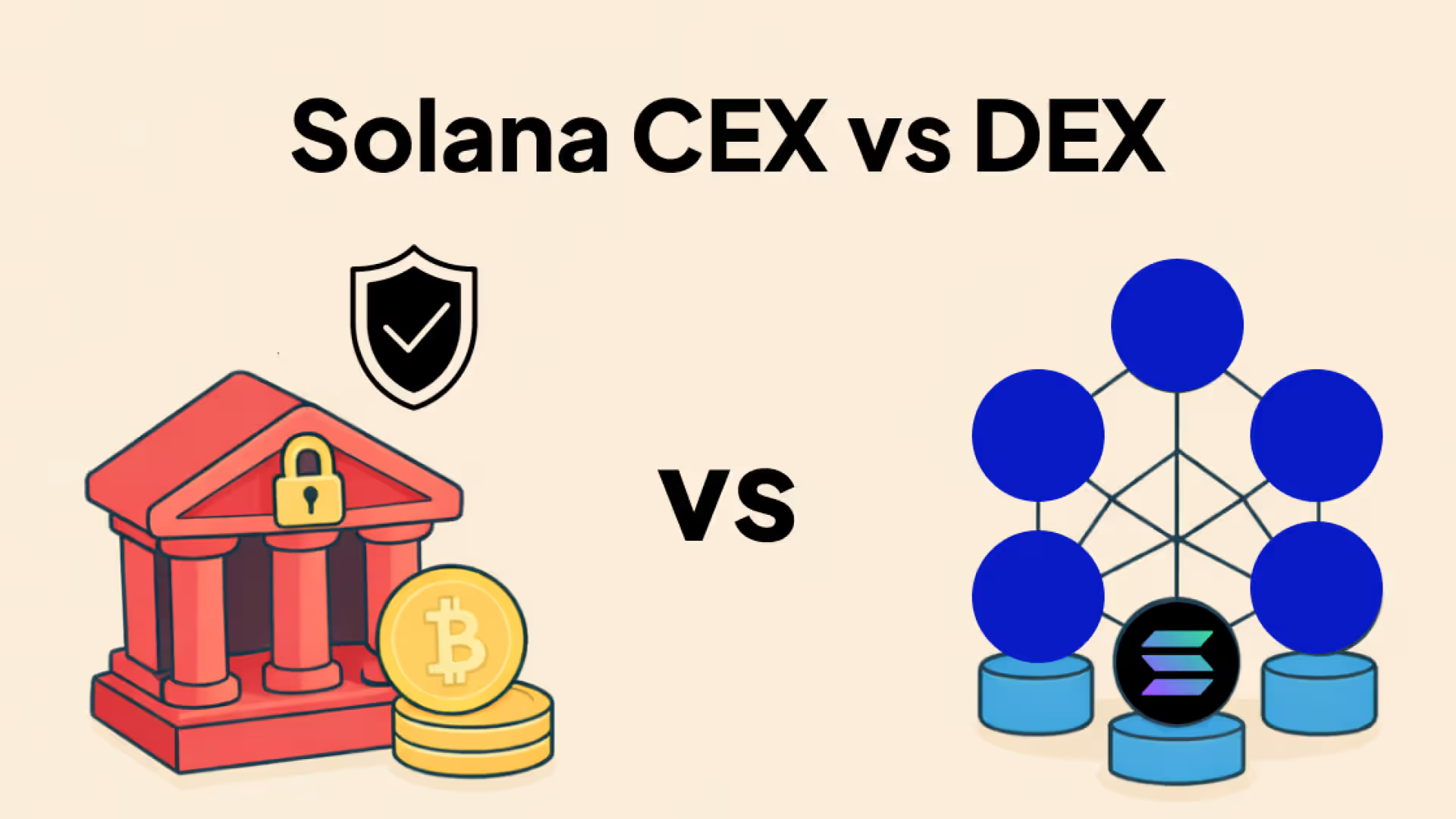
A Solana DEX (decentralized exchange) allows users to trade directly from their wallet through smart contracts onchain, maintaining full self-custody. A Solana CEX (centralized exchange) requires users to deposit funds into a custodial account, where trades are matched through an internal order book. DEXs prioritize self-custody and token access, while CEXs prioritize liquidity, advanced tools, and fiat integration.
What Is a Solana DEX?
A Solana DEX (decentralized exchange) is a platform that allows users to trade tokens directly from their wallet using onchain smart contracts.
Instead of depositing funds into a custodial account, users connect a wallet and approve each transaction themselves, maintaining full self-custody. Most Solana DEXs use liquidity pools or automated market makers (AMMs) to execute trades.
For example, Jupiter acts as a DEX aggregator on Solana, routing trades across multiple liquidity pools to find competitive pricing.
Because listings are permissionless, new tokens typically appear on DEXs before centralized exchanges. However, liquidity depth and slippage depend on pool size and market conditions.
What Is a Solana CEX?
A Solana CEX (centralized exchange) is a trading platform where users deposit funds into a custodial account and execute trades through a centralized order book.
Instead of trading directly from a personal wallet onchain, orders are matched internally using the exchange’s matching engine. This structure typically provides deeper liquidity, tighter spreads, and more consistent execution for large trades.
Platforms such as Backpack Exchange operate under this model, offering fiat deposits and withdrawals, advanced trading tools, and a curated token listing process. However, because assets are held in custody by the exchange, users assume custodial risk and are generally required to complete identity verification (KYC).
Solana DEX vs CEX: Side-by-Side Comparison
Fees and Slippage: What Do You Actually Pay?
When comparing Solana DEX vs CEX, trading costs typically come down to three factors: platform fees, network fees, and slippage.
On a Solana DEX
DEX fees usually include a swap fee (often around 0.1–0.3 percent, depending on the liquidity pool) plus a small Solana network fee. Because trades execute against liquidity pools, price impact can increase on larger orders if liquidity is limited.
For smaller trades, the total cost difference may be minimal. However, on larger trades, slippage can become a meaningful factor if pool depth is insufficient.
On a Solana CEX
CEX fees are typically structured as maker and taker fees, often ranging between 0.1–0.2 percent depending on the exchange and user tier. There are no onchain gas fees for internal trades since execution happens off-chain.
Because centralized exchanges rely on deep order books and professional market makers, slippage is generally lower for highly liquid trading pairs.
Cost Consideration by Trade Size
- Small trades: Cost differences are often minor between DEX and CEX.
- Medium trades: Liquidity depth starts to matter more.
- Large trades: Centralized order books often provide more price stability on major pairs.
Ultimately, whether a DEX or CEX is cheaper depends on market liquidity, trade size, and the specific token being traded.
Security and Risk: Different Risk Models
When evaluating Solana DEX vs CEX, security depends on what type of risk you are willing to accept. DEXs and CEXs do not eliminate risk. They distribute it differently.
Risk Model of a Solana DEX
On a decentralized exchange, users maintain self-custody of their assets. This removes custodial risk, but introduces technical and operational risks.
Common DEX risks include:
- Smart contract vulnerabilities: Bugs or exploits in liquidity pools or routing contracts can lead to loss of funds.
- Malicious or fake tokens: Because listings are permissionless, scam tokens can appear quickly.
- User error: Sending assets to the wrong address or approving malicious contracts cannot be reversed.
DEX security largely depends on smart contract audits, platform reputation, and user awareness.
Risk Model of a Solana CEX
On a centralized exchange, users deposit assets into a custodial account. This removes smart contract interaction risk during trading, but introduces custodial exposure.
Common CEX risks include:
- Custodial risk: Users rely on the exchange’s solvency and security practices.
- Regulatory intervention: Governments can impose restrictions or freeze assets.
- Platform outages: During periods of volatility, centralized systems may experience downtime.
CEX security depends on internal controls, regulatory compliance, and operational resilience.
Which Is Safer?
There is no universally safer option.
A Solana DEX reduces counterparty risk but increases personal responsibility and smart contract exposure. A Solana CEX reduces technical complexity but requires trust in a centralized operator.
The safer choice depends on your experience level, custody preference, and risk tolerance.
When to Use a Solana DEX vs CEX
The choice between a Solana DEX and a CEX depends primarily on your trading objective, size, and risk preference.
Use a Solana DEX if:
- You want access to newly launched or unlisted tokens.
- Self-custody is a priority and you prefer trading directly from your wallet.
- You are actively participating in DeFi protocols and need seamless onchain integration.
- You are making smaller or experimental trades where liquidity conditions are sufficient.
Use a Solana CEX if:
- You are trading larger amounts and require deeper liquidity.
- You need advanced order types such as limit or stop-loss orders.
- You want to deposit or withdraw fiat currency.
- You prefer trading only vetted tokens within a regulated environment.
In practice, many experienced traders use both. A CEX may be preferred for core liquidity and active trading, while a DEX can be useful for early token access and onchain activity.
A Practical Hybrid Approach
In reality, many Solana traders do not choose exclusively between a DEX or a CEX. They use both strategically.
A common approach is to use a centralized exchange for fiat deposits, larger trades, and active position management, while using a decentralized exchange for newly launched tokens and onchain DeFi activity.
For example, a trader may acquire SOL or stablecoins on a centralized platform such as Backpack Exchange for liquidity efficiency, then transfer a portion to a self-custody wallet to access tokens available only on DEXs like Jupiter.
This hybrid model allows traders to balance liquidity, access, and risk management rather than relying entirely on one structure.
Conclusion
So, Solana DEX vs CEX: which is better for trading in 2026?
Neither is universally better. They are built for different purposes.
A Solana DEX offers self-custody, permissionless token access, and seamless integration with DeFi. A Solana CEX provides deeper liquidity, advanced trading infrastructure, and fiat connectivity.
The right choice depends on your trade size, strategy, and risk tolerance. Many experienced traders combine both approaches, using centralized exchanges for liquidity and execution efficiency, and decentralized exchanges for early access and onchain activity.
Understanding these structural differences allows you to use the right tool for the right situation, rather than relying on habit or assumption.
Learn more about Backpack
Exchange | Wallet | Twitter | Discord | Reddit
Disclaimer: This content is presented to you on an “as is” basis for general information and educational purposes only, without representation or warranty of any kind. It should not be construed as financial, legal or other professional advice, nor is it intended to recommend the purchase of any specific product or service. You should seek your own advice from appropriate professional advisors. Where the article is contributed by a third party contributor, please note that those views expressed belong to the third party contributor, and do not necessarily reflect those of Backpack. Please read our full disclaimer for further details. Digital asset prices can be volatile. The value of your investment may go down or up and you may not get back the amount invested. You are solely responsible for your investment decisions and Backpack is not liable for any losses you may incur. This material should not be construed as financial, legal or other professional advice.
.png)