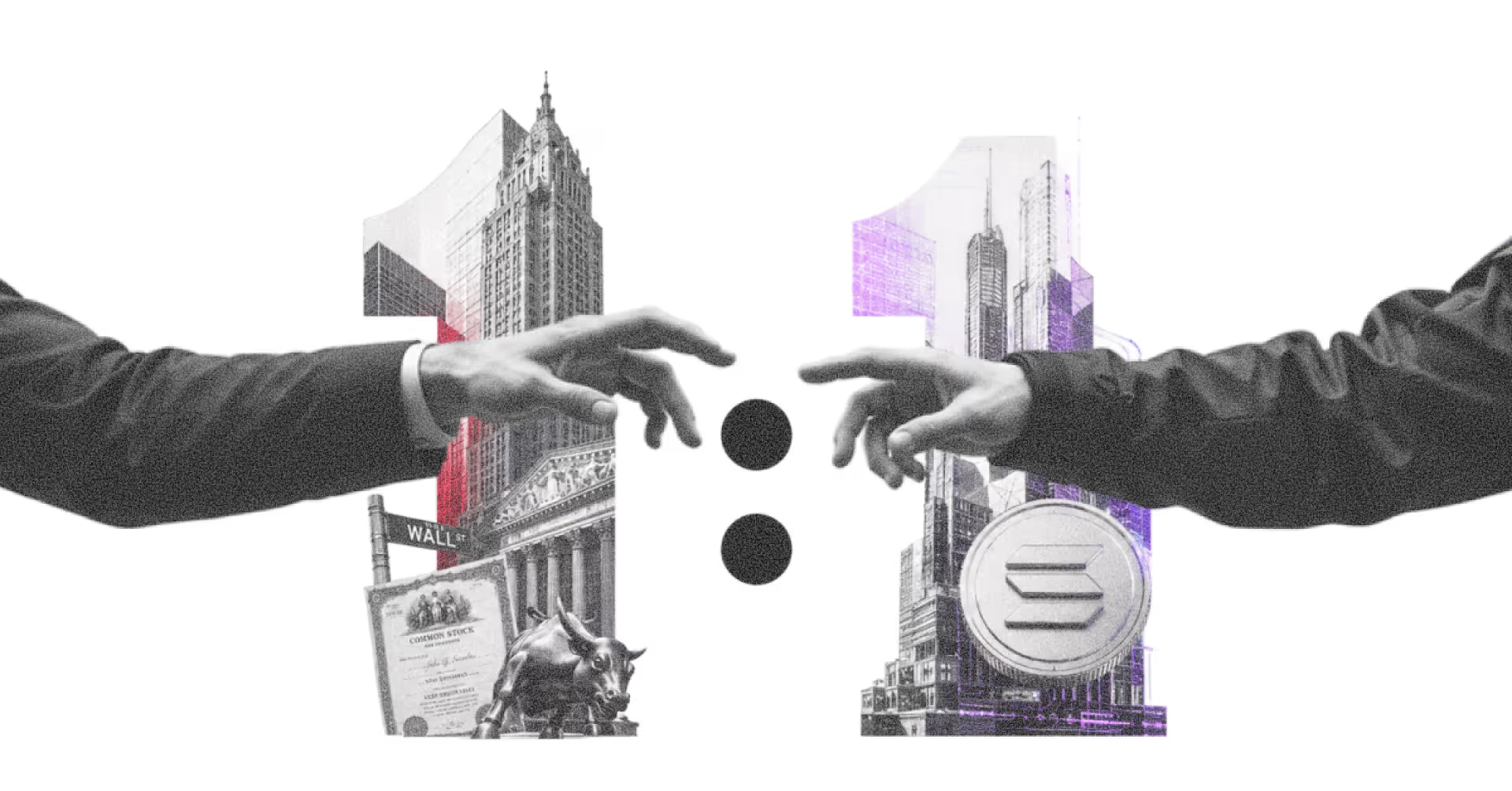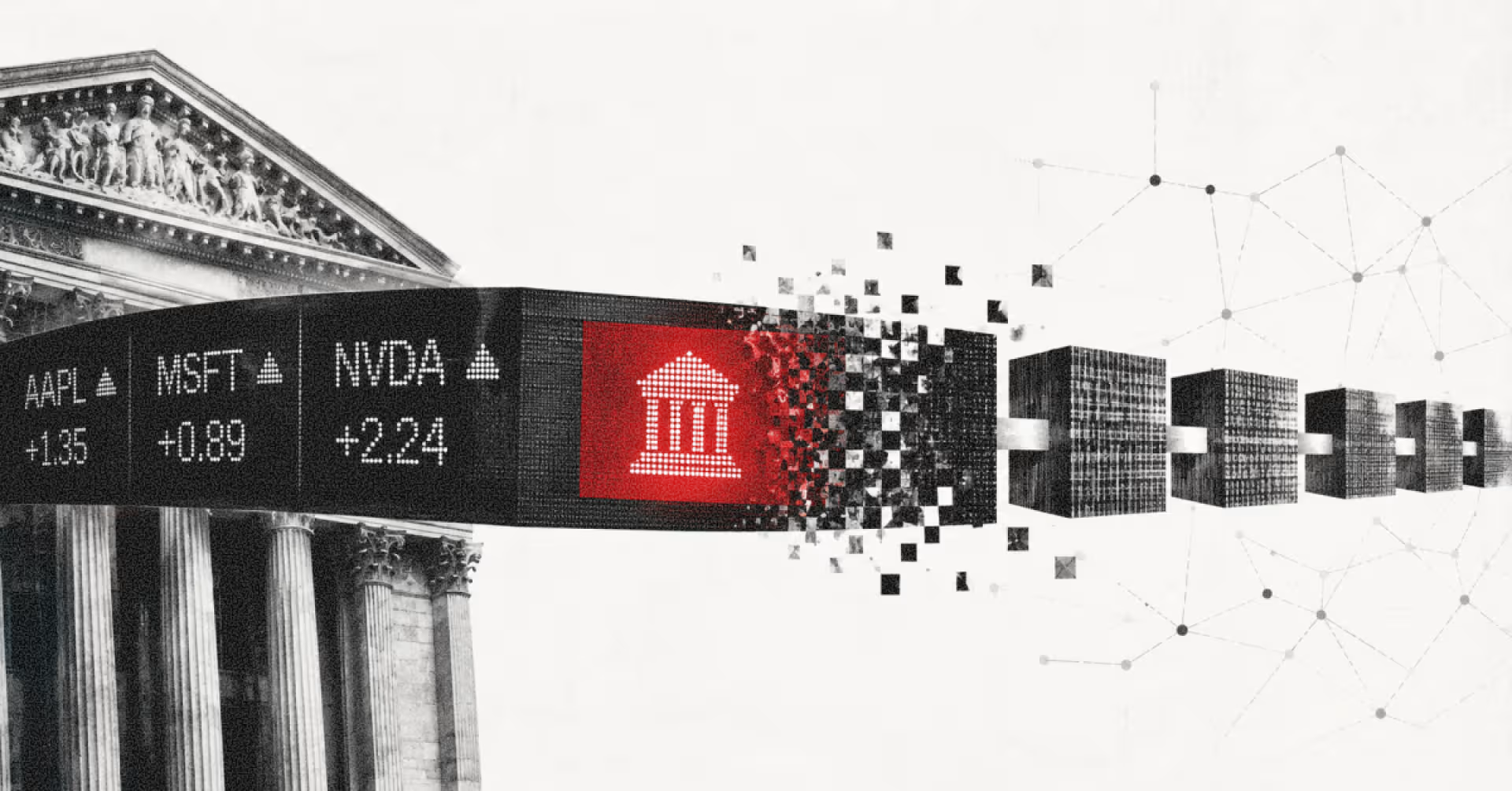

Traditional finance (TradFi) uses banks, brokers, exchanges, clearing firms, custodians, payment companies, and other institutions to provide financial services. Decentralized finance (DeFi) uses blockchain networks and smart contracts to provide services such as trading, lending, borrowing, and asset management with fewer centralized intermediaries. The systems increasingly overlap, but they differ in custody, access, transparency, settlement, operating hours, and risk.
Key Facts
- TradFi relies mainly on regulated institutions and centralized market infrastructure.
- DeFi uses public blockchains, smart contracts, and crypto wallets to automate financial functions.
- TradFi accounts are closely tied to legal identity; DeFi access is often wallet-based, although front ends and service providers can impose restrictions.
- DeFi protocols can operate 24/7, while many traditional markets follow exchange and business-day schedules.
- Onchain transparency can make transactions and smart contracts inspectable, but it does not remove code, oracle, governance, wallet, or liquidity risk.
- Stablecoins, tokenized real-world assets, tokenized securities, and blockchain settlement are bringing TradFi and DeFi closer together.
What Is Traditional Finance?
Traditional finance is the established system of banks, brokers, stock exchanges, payment processors, insurers, asset managers, custodians, clearing firms, and regulators that supports modern financial activity.
If a person deposits money at a bank, buys a stock through a broker, uses a credit card, takes out a mortgage, or invests in a mutual fund, they are using TradFi infrastructure. Institutions maintain customer records, enforce eligibility rules, safeguard assets, and process transactions through regulated systems.
What Is DeFi?
Decentralized finance is a broad term for financial applications built on blockchains and smart contracts. Common DeFi activities include decentralized exchange trading, collateralized borrowing, lending, stablecoin transfers, staking, derivatives, prediction markets, and onchain asset management.
Instead of asking a bank to approve a loan or a broker to route a trade, a user can interact with a smart contract through a crypto wallet. The contract applies programmed rules for collateral, pricing, fees, liquidation, and settlement.
TradFi vs. DeFi: What Are the Key Differences?
TradFi and DeFi differ most clearly in custody, access, market hours,
transparency, intermediaries, settlement, and recourse.
Custody
TradFi commonly uses custodial institutions. A broker or bank records the customer’s claim and manages assets within regulated account structures.
DeFi commonly lets users hold assets in self-custody wallets and sign transactions directly. Self-custody increases user control but also shifts responsibility for private keys, phishing, and transaction approvals to the user.
Access
Traditional financial services generally require identity verification, account approval, and eligibility under local laws. Products can be restricted by country, investor status, age, income, or market access.
Many DeFi protocols are technically accessible through a compatible wallet and internet connection, but front ends and service providers can still restrict access. Users also remain subject to applicable laws.
Market hours
Stock exchanges, banks, and payment systems generally operate on defined schedules, although electronic trading and instant-payment systems have extended access.
Public blockchains operate continuously, so DeFi protocols can be available 24/7. Liquidity, oracle updates, and network congestion can still vary throughout the day.
Transparency
Traditional institutions publish financial statements, regulatory filings, and disclosures, but internal ledgers and customer-level operations are generally not public.
DeFi smart contracts and onchain transactions can often be inspected by anyone. That transparency can help users verify balances, collateral, and protocol activity, but public code and data can still be complex or difficult to interpret.
Intermediaries
TradFi uses specialized intermediaries for custody, execution, clearing, settlement, compliance, and recordkeeping.
DeFi automates more of these functions through smart contracts. This can reduce some coordination steps, but it replaces parts of institutional trust with assumptions about code, cryptography, blockchain consensus, oracles, and governance.
Settlement
Traditional securities transactions can settle on a prescribed timetable after execution. Bank transfers can range from near-instant to multiple business days depending on the payment rail and geography.
Blockchain transactions can settle onchain once confirmed by the network. Moving assets between chains, redeeming tokenized real-world assets, or converting crypto into bank money can still introduce external settlement steps.
What Can You Do in DeFi?
DeFi covers most of the functions traditional finance provides, rebuilt as smart contracts:
- Trading. Swap tokens directly from a wallet on a decentralized exchange such as Uniswap, which prices trades against liquidity pools instead of an order book.
- Lending and borrowing. Deposit assets into a shared pool to earn interest, or post crypto as collateral to borrow against it. Rates adjust automatically based on how much of the pool is currently borrowed.
- Stablecoin payments. Send dollar-pegged tokens such as USDC across a blockchain without a bank transfer.
- Staking. Lock tokens to help secure a proof-of-stake network in exchange for rewards. Liquid staking protocols issue a token representing the staked position so it stays usable elsewhere.
- Derivatives. Trade perpetual futures and options onchain, with margin and liquidation handled by smart contracts.
- Asset management. Deposit into vaults that run a strategy automatically, rather than selecting positions manually.
These applications are composable: a token or position from one protocol can be used as an input in another. A staked asset can serve as collateral for a loan, and the borrowed funds can be deployed elsewhere. Composability increases flexibility, and it also means a failure in one protocol can propagate to others that depend on it.
What Are the Main Risks of TradFi?
Institutional failure
Banks and brokers can fail, and a deposit is legally a liability of the bank rather than property held for the customer. Deposit insurance covers balances up to defined limits, such as $250,000 per depositor per insured bank in the US, and amounts above those limits are not guaranteed.
Counterparty risk
Most traditional transactions depend on another party fulfilling an obligation later, whether clearing a trade, crediting a transfer, or repaying a loan. Clearing houses and collateral requirements contain this risk but also concentrate it in a small number of critical institutions.
Limited transparency
Customers cannot independently verify what an institution holds on their behalf, since internal ledgers are private and disclosures arrive on a schedule. Balance sheet problems often become visible only after they are reported.
Censorship and account restrictions
Accounts can be frozen, payments blocked, and services closed under compliance requirements, sanctions, court orders, or an institution's own risk policies. The customer often has limited visibility into the reason and limited ability to reverse it quickly.
Operational and settlement delay
US equity trades settle one business day after execution, and cross-border transfers can take several business days depending on the payment rail. Positions cannot be adjusted while the market is closed, so news breaking outside trading hours cannot be acted on until it reopens.
Inflation and monetary policy
Cash balances lose purchasing power through decisions made by central banks rather than by the account holder. US consumer price inflation reached roughly nine percent in mid-2022, reducing the real value of savings held in cash.
What Are the Main Risks of DeFi?
Smart-contract risk
A bug or exploit can drain or permanently lock funds, and onchain transactions cannot be reversed once confirmed. Audits reduce this risk but do not eliminate it, and there is usually no institution to appeal to or insurance scheme to fall back on.
Oracle risk
Protocols rely on external price feeds to value collateral and trigger liquidations. If a feed is delayed, incorrect, or manipulated, the contract executes on bad data and the resulting trades or liquidations still stand.
Liquidation risk
Borrowers post crypto collateral, and if its value falls below the required threshold the position is liquidated automatically. Liquidation happens without notice or grace period, and can cascade during sharp market moves when many positions cross their thresholds at once.
Wallet and phishing risk
A compromised recovery phrase or a single malicious signature can result in irreversible loss. Self-custody removes intermediary dependency but places the full burden of key management and transaction review on the user.
Liquidity and market risk
DeFi markets can be thin, producing slippage on larger orders and sharp price moves. Stablecoins and pegged assets can also trade away from their intended value during periods of stress.
Governance and admin risk
Many protocols can be upgraded, paused, or modified by governance token holders or a multisignature group of administrators. Decentralization is a spectrum, and a protocol described as decentralized may still have a small number of parties able to change how it works.
How Are TradFi and DeFi Converging?
The boundary between the systems is increasingly blurred. Stablecoins connect bank money with blockchain markets. Tokenized Treasury funds and other real-world assets bring traditional instruments onchain. Financial institutions are experimenting with blockchain settlement, tokenized deposits, digital bonds, and institutional onchain products.
Tokenized securities are another example. A stock or other security can be represented on a blockchain while the product still depends on securities law, custody, issuer obligations, and a defined legal structure.
The likely direction is not simply “TradFi versus DeFi.” Financial products can combine regulated institutions with programmable settlement and onchain distribution.
How Does Backpack Fit Into TradFi-DeFi Convergence?
Backpack spans crypto trading and self-custody wallet use, while Backpack Securities provides eligible users access to traditional securities infrastructure. These are separate product and legal structures even when they are presented through a connected user experience.
Backpack Securities combines traditional securities ownership infrastructure with onchain distribution. Eligible investors can hold securities through established brokerage infrastructure, convert eligible securities into tokenized securities on Solana, and redeem tokenized securities back into the corresponding security entitlement through Backpack Securities.
This is a concrete example of convergence: traditional securities infrastructure and blockchain-native distribution can connect without making the two ownership forms legally identical.
The point is not that one system replaces the other. It is that the same asset can move between them.
The Bottom Line
TradFi and DeFi solve many of the same financial problems using different infrastructure. Traditional finance relies on institutions and regulated account systems; DeFi relies more heavily on blockchains, smart contracts, and wallets. As tokenization and digital settlement expand, the systems are increasingly overlapping. Users should focus less on labels and more on custody, legal rights, liquidity, transparency, and the specific risks of each product.
Learn more about Backpack
Exchange | Wallet | Twitter | Discord | Reddit
Disclaimer: This content is presented to you on an “as is” basis for general information and educational purposes only, without representation or warranty of any kind. It should not be construed as financial, legal or other professional advice, nor is it intended to recommend the purchase of any specific product or service. You should seek your own advice from appropriate professional advisors. Where the article is contributed by a third party contributor, please note that those views expressed belong to the third party contributor, and do not necessarily reflect those of Backpack. Please read our full disclaimer for further details. Digital asset prices can be volatile. The value of your investment may go down or up and you may not get back the amount invested. You are solely responsible for your investment decisions and Backpack is not liable for any losses you may incur. This material should not be construed as financial, legal or other professional advice.