What Is a Stock?
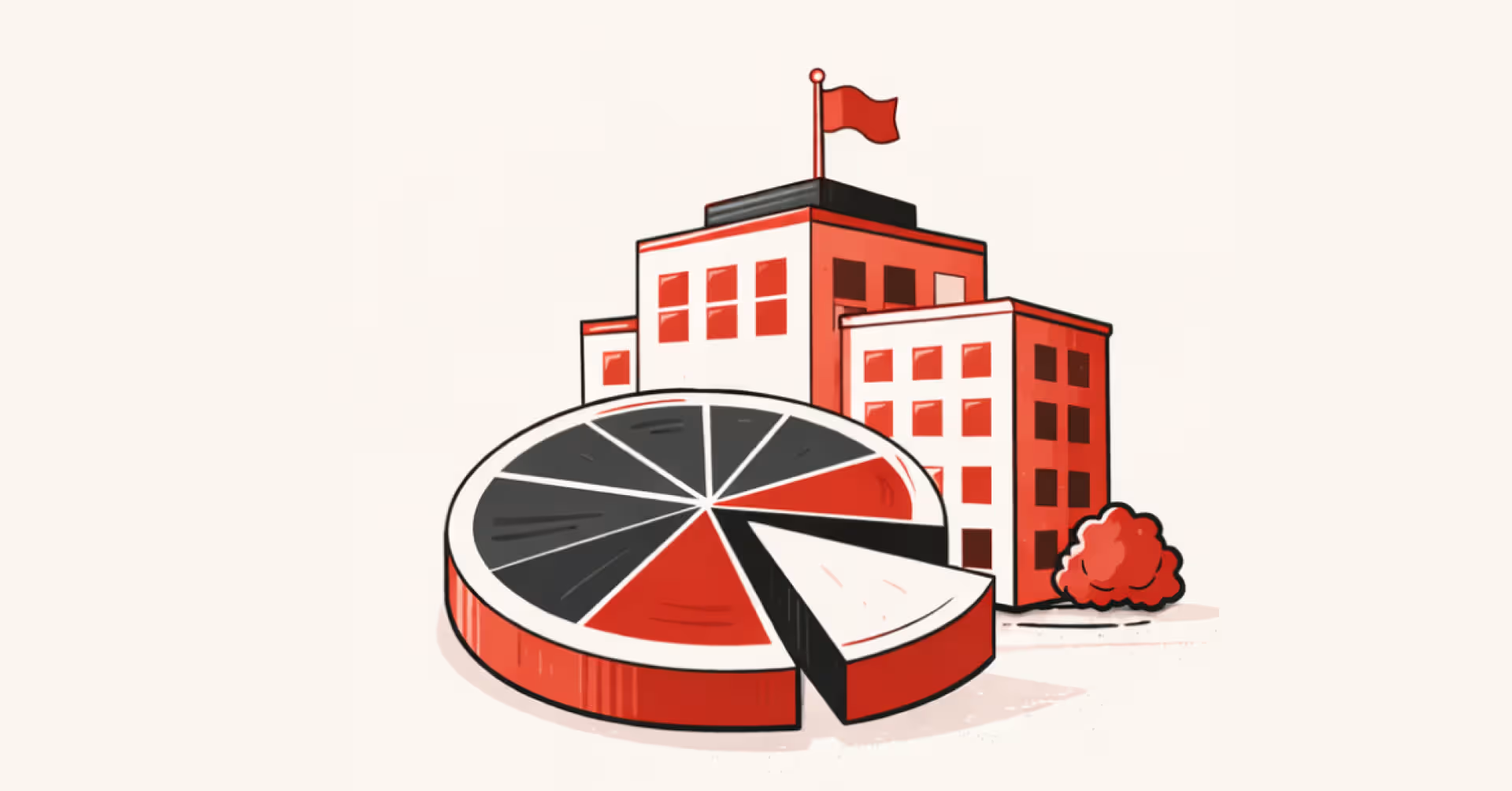
A stock, also called a share or equity, represents fractional ownership in a publicly traded company.
When a company needs capital to grow, it divides ownership into millions of shares and sells them to investors on a stock exchange. Each share entitles the holder to a proportional claim on the company's assets and earnings.
If a company issues 1,000,000 shares and you own 1,000 of them, you own 0.1% of that company. If the company doubles in value, your shares double in value too.
Why Do Companies Issue Stocks?
Companies issue stocks to raise capital without taking on debt.
The alternative, borrowing from a bank, requires repayment with interest regardless of business performance. Selling shares shifts some of that risk to investors, who accept the uncertainty in exchange for the potential to profit from the company's growth.
The first time a company sells shares to the public is called an Initial Public Offering, or IPO. After the IPO, shares trade freely between buyers and sellers on stock exchanges.
How Do Stocks Work?
Stocks are bought and sold on regulated exchanges, including the New York Stock Exchange (NYSE), the Nasdaq in the United States, and the London Stock Exchange (LSE) in the UK.
Exchanges operate during set hours. US markets are open from 09:30 to 16:00 Eastern Time on weekdays, excluding public holidays. Unlike crypto markets, which trade 24 hours a day seven days a week, stock exchanges are closed on weekends.
Stock prices change in real time based on supply and demand.
How Do Investors Make Money from Stocks?
There are two main ways stocks generate returns.
Capital appreciation means the stock price rises over time. If you buy a share at $50 and sell it at $90, you realise a $40 gain per share. This gain only becomes real when you sell. Until then, it remains an unrealised gain on paper.
Dividends are cash payments some companies distribute to shareholders from their profits, typically on a quarterly basis. A company paying $4 per share annually on a $100 stock has a dividend yield of 4%. Dividends provide income without requiring you to sell your shares.
Types of Stocks
Common stock is the standard form most investors hold. Common shareholders may receive dividends and have voting rights at annual shareholder meetings, but are last in line if the company is liquidated.
Preferred stock gives holders priority over common shareholders when dividends are paid and in liquidation. In exchange, preferred shareholders typically have no voting rights. Preferred stock behaves more like a fixed-income instrument than typical equity.
Growth stocks are shares in companies expected to grow revenues faster than the market average. They typically pay no dividends and reinvest profits instead. Higher growth potential, higher volatility.
Value stocks trade at a lower price relative to their underlying fundamentals, such as lower price-to-earnings ratios, stable cash flows, and established business models.
Dividend stocks distribute regular income to shareholders. Common in mature, stable industries such as utilities, banking, and consumer staples.
What Moves Stock Prices?
Earnings reports are the most significant regular driver. Every quarter, public companies report revenue and profit figures. Beat expectations and the stock typically rises. Miss expectations and the stock typically falls, sometimes sharply.
Interest rates set by central banks affect borrowing costs for companies and the relative attractiveness of stocks versus bonds. Rising rates generally pressure stock prices downward.
Economic data, including inflation figures, GDP growth, and unemployment data, signals the health of the broader economy and shapes investor confidence across markets.
Company-specific news such as product launches, leadership changes, mergers, regulatory actions, or legal disputes can move an individual stock significantly regardless of what the broader market is doing.
Investor sentiment can shift faster than fundamentals change. Fear and greed drive short-term price movements across entire markets, often independently of underlying business performance.
Important Stock Market Terms
Market capitalisation (market cap): share price multiplied by total shares outstanding. Used to categorise companies by size. Large-cap companies are generally those with a market cap above $10 billion, mid-cap between $2 billion and $10 billion, and small-cap below $2 billion, though exact thresholds vary by index provider.
Earnings per share (EPS): Net profit divided by shares outstanding measures profitability on a per-share basis.
Price-to-earnings ratio (P/E ratio): share price divided by EPS. A high P/E suggests investors expect strong future growth. A low P/E may indicate undervaluation or weak prospects.
Dividend yield: annual dividend per share divided by share price, expressed as a percentage.
S&P 500: An index tracking 500 leading companies listed on US stock exchanges, selected by committee based on size, liquidity, and sector representation. Widely used as the benchmark for overall US stock market performance.
Bull market: sustained price increases of 20% or more from a recent low.
Bear market: sustained decline of 20% or more from a recent high.
Stocks vs Bonds vs Crypto
The boundaries between these categories are shifting. Tokenized stocks allow on-chain trading of equities alongside digital assets on the same infrastructure.
Risks of Investing in Stocks
Market risk: broad economic downturns, recessions, and financial crises affect most stocks regardless of individual company performance.
Company risk: a single business can fail or significantly underperform even when the broader market is healthy. Individual stocks can fall 30–50% or more on a single earnings miss or sector shift.
Volatility: stock prices fluctuate daily. Short-term movements can be significant, particularly for smaller or growth-oriented companies.
Liquidity risk: less relevant for large-cap stocks, but smaller or thinly traded stocks may be difficult to buy or sell at a fair price.
Past performance is not indicative of future results. Investing in stocks involves the risk of loss, and you may not recover the full amount invested.
Conclusion
Stocks are one of the most established instruments in global financial markets. Understanding what a stock is, how ownership works, what drives prices, and what risks are involved gives you the foundation to participate in equity markets with greater clarity.
As traditional finance and crypto continue to converge, stocks are no longer a separate world from digital assets. Tokenized stocks, on-chain IPO access, and cross-asset portfolios are making it possible to hold stocks and crypto side by side, on the same infrastructure, in the same account.
Learn more about Backpack
Exchange | Wallet | Twitter | Discord | Reddit
Disclaimer: This content is presented to you on an “as is” basis for general information and educational purposes only, without representation or warranty of any kind. It should not be construed as financial, legal or other professional advice, nor is it intended to recommend the purchase of any specific product or service. You should seek your own advice from appropriate professional advisors. Where the article is contributed by a third party contributor, please note that those views expressed belong to the third party contributor, and do not necessarily reflect those of Backpack. Please read our full disclaimer for further details. Digital asset prices can be volatile. The value of your investment may go down or up and you may not get back the amount invested. You are solely responsible for your investment decisions and Backpack is not liable for any losses you may incur. This material should not be construed as financial, legal or other professional advice.