
The stock market is a collective term for all the exchanges and trading venues where shares of publicly listed companies are issued, bought, and sold.
It serves two primary functions. First, it allows companies to raise capital by selling ownership stakes to the public. Second, it gives investors the ability to buy and sell those ownership stakes, profiting if the companies they invest in grow, or losing if they decline.
How Does the Stock Market Work?
When a private company wants to raise money from public investors, it goes through an Initial Public Offering, or IPO. During an IPO, the company lists its shares on a stock exchange for the first time, selling them to institutional and retail investors at an agreed price. This is called the primary market.
After the IPO, those shares trade freely between investors on the exchange. Investors buying and selling shares of already-listed companies make up what is known as the secondary market. The secondary market is where the vast majority of daily stock trading takes place.
The Major Stock Exchanges
New York Stock Exchange (NYSE) is the world's largest stock exchange by market capitalisation. It operates as a hybrid market, combining electronic trading with a physical trading floor in Lower Manhattan. Companies listed on the NYSE include some of the world's largest corporations.
Nasdaq is the second-largest exchange globally and is heavily weighted toward technology companies. Unlike the NYSE, Nasdaq is fully electronic, and there is no physical trading floor. Apple, Microsoft, Amazon, and Nvidia are among the companies listed on Nasdaq.
London Stock Exchange (LSE) is the largest stock exchange in Europe and one of the oldest in the world, dating back to 1801. It lists companies from across the UK and internationally.
Other major exchanges include the Tokyo Stock Exchange, Shanghai Stock Exchange, Hong Kong Stock Exchange, and Euronext. Each operates under its own regulatory framework and serves as the primary listing venue for domestic and international companies in its region.
What Are Stock Market Indices?
A stock market index tracks the combined performance of a selected group of stocks. Indices are used as benchmarks, providing a quick way to gauge whether the market as a whole is rising or falling.
S&P 500 tracks 500 leading companies listed on US exchanges, selected by committee based on size, liquidity, and sector. It covers approximately 80% of total US market capitalisation and is the most widely used benchmark for overall US stock market performance.
Dow Jones Industrial Average (DJIA) tracks 30 large, well-established US companies. It is the oldest and most widely recognised stock market index, though its narrow composition of just 30 stocks means it is less representative of the broader market than the S&P 500.
Nasdaq Composite tracks all stocks listed on the Nasdaq exchange, approximately 3,500 companies, and is heavily weighted toward technology.
When a news headline says "the market was up today," it typically means one of these indices rose in value.
Who Participates in the Stock Market?
Retail investors are individual investors, people who buy and sell stocks through brokerage accounts for personal investment goals.
Institutional investors are organisations that trade in large volumes on behalf of others, including mutual funds, pension funds, hedge funds, and insurance companies. Institutional investors account for the majority of daily trading volume.
Market makers are firms or individuals that continuously quote buy and sell prices for specific stocks, providing liquidity and ensuring there is always a counterparty available to trade.
Brokers are intermediaries who execute trades on behalf of clients, either for a fee or through platforms that earn revenue through other means such as payment for order flow.
Each participant type plays a distinct role in keeping markets liquid, efficient, and continuously priced.
How Are Stock Prices Set?
Stock prices change in real time based on supply and demand. Every transaction on a stock exchange involves a willing buyer and a willing seller agreeing on a price.
In the short term, prices respond to news events, earnings reports, economic data, and investor sentiment. A company reporting stronger-than-expected earnings will typically see its share price rise. A profit warning or regulatory fine will typically push the price lower.
Over the long term, a stock's price tends to reflect the underlying performance of the business, including its revenue growth, profitability, competitive position, and the quality of its management.
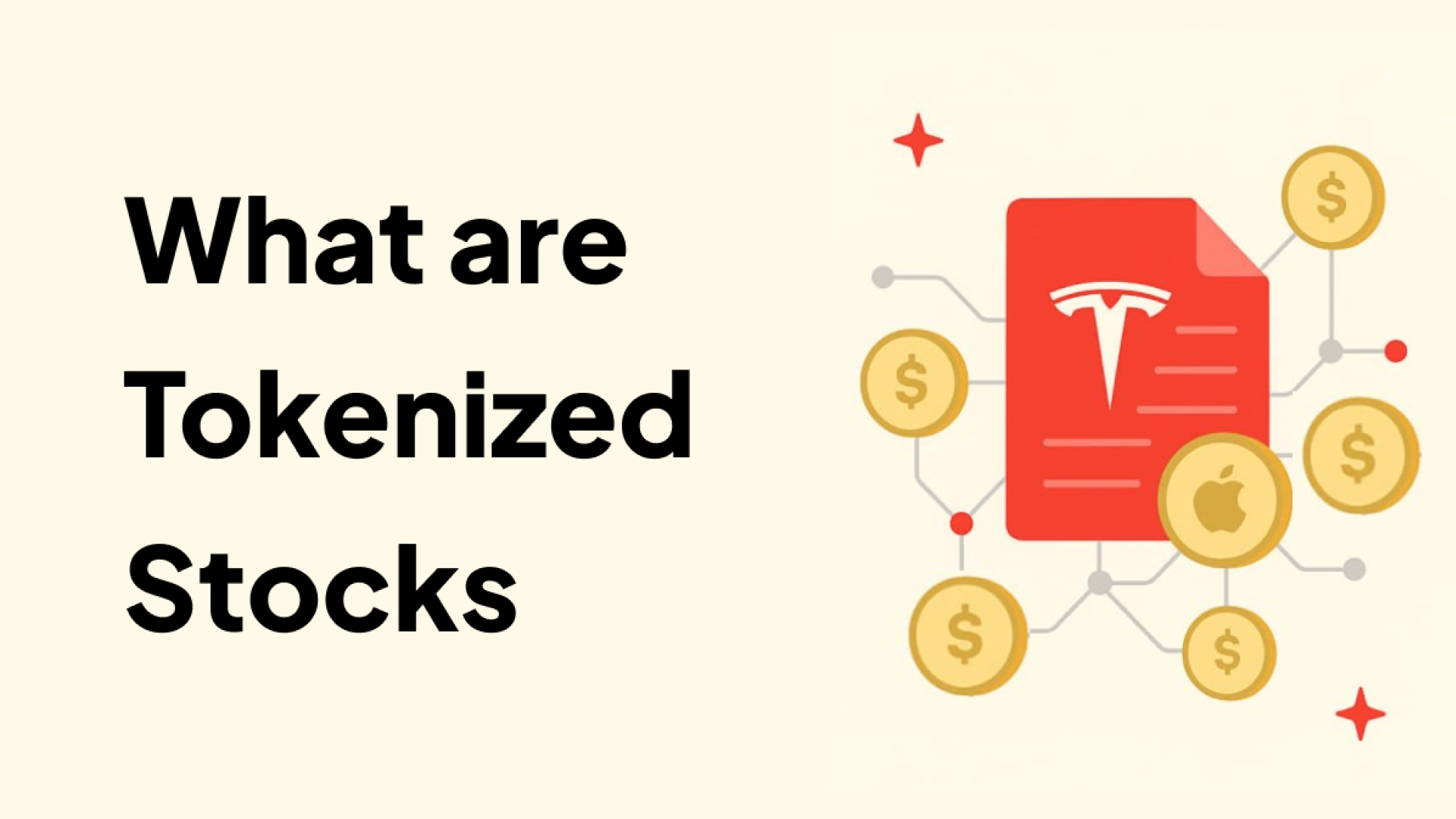
Tokenized stocks allow on-chain trading of equities outside traditional exchange hours, with settlement in seconds rather than days.
Stock Market Hours
US stock markets, both the NYSE and Nasdaq, operate from 09:30 to 16:00 Eastern Time, Monday through Friday, excluding public holidays.
Pre-market trading runs from approximately 04:00 to 09:30 ET, and after-hours trading extends to approximately 20:00 ET, though volume and liquidity are significantly lower outside regular hours.
Most major global exchanges follow a similar weekday schedule, adjusted for local time zones. The London Stock Exchange opens at 08:00 and closes at 16:30 local UK time.
Unlike crypto markets, which operate 24 hours a day seven days a week, traditional stock markets are closed on weekends and public holidays. This difference in market structure is one of the key distinctions between equity and digital asset markets.
What Is Market Capitalisation?
Market capitalisation, or market cap, is the total value of all shares outstanding in a company, calculated by multiplying the share price by the total number of shares. It is one of the most commonly used measures of a company's size, and forms the basis for how stock market indices like the S&P 500 are weighted.
Risks of Stock Market Investing
The stock market offers the potential for long-term wealth growth, but it carries real risks that investors should understand before committing capital.
Market risk is the risk that the overall market declines, reducing the value of most stocks simultaneously. Recessions, financial crises, and geopolitical events can trigger broad market falls.
Volatility means stock prices fluctuate continuously. Individual stocks can move significantly on a single piece of news. Broad indices can also experience sharp drawdowns during periods of uncertainty.
Liquidity risk is generally low for stocks listed on major exchanges but may be a concern for smaller or less actively traded companies.
Past performance is not indicative of future results. Investing in the stock market involves the risk of loss, and investors may not recover the full amount invested.
Conclusion
The stock market is the infrastructure that connects companies seeking capital with investors seeking returns. It has operated in various forms for centuries and remains one of the largest financial systems in the world
As digital assets and traditional finance continue to converge, the boundaries of what constitutes a "market" are shifting. Tokenized stocks are beginning to bring equity market exposure on-chain, enabling trading outside of traditional exchange hours, fractional ownership, and settlement in seconds rather than days.
Understanding how traditional stock markets work is the foundation for navigating what comes next.
Learn more about Backpack
Exchange | Wallet | Twitter | Discord | Reddit
Disclaimer: This content is presented to you on an “as is” basis for general information and educational purposes only, without representation or warranty of any kind. It should not be construed as financial, legal or other professional advice, nor is it intended to recommend the purchase of any specific product or service. You should seek your own advice from appropriate professional advisors. Where the article is contributed by a third party contributor, please note that those views expressed belong to the third party contributor, and do not necessarily reflect those of Backpack. Please read our full disclaimer for further details. Digital asset prices can be volatile. The value of your investment may go down or up and you may not get back the amount invested. You are solely responsible for your investment decisions and Backpack is not liable for any losses you may incur. This material should not be construed as financial, legal or other professional advice.