
Artificial intelligence is increasingly produced and controlled by a small number of centralized organizations. Bittensor is an open-source network that takes a fundamentally different approach. It uses cryptoeconomic incentives to coordinate a marketplace where independent participants contribute digital commodities, including AI inference, AI training, compute power, data processing and storage, and more, and earn rewards based on performance.
This guide explains what Bittensor is, how its subnet architecture works, what the TAO token does, how emissions are allocated today, and how users typically buy, stake, or participate in the network.
Key Takeaways
- Bittensor is a decentralized marketplace for AI and other digital commodities built around a subnet architecture
- TAO has a fixed maximum supply of 21 million with a supply-based halving mechanism
- Dynamic TAO introduced subnet-specific Alpha tokens and AMM-based staking
- Subnet emissions are allocated using a flow-based model called Taoflow, driven by net TAO staking flows
- TAO holders can participate through staking, delegation, or mining depending on their level of involvement
- Halving events are triggered by supply milestones rather than fixed calendar dates
Bittensor at a Glance
- Network type: Open-source, decentralized protocol
- Native token: TAO (τ)
- Maximum supply: 21,000,000 TAO (hard cap)
- Block time: 12 seconds
- Pre-first-halving emission: 1 TAO per block (~7,200 TAO/day)
- Post-first-halving emission: 0.5 TAO per block (~3,600 TAO/day)
- Current emissions model: Flow-based ("Taoflow"), active since November 2025
- Major upgrade: Dynamic TAO (dTAO), introduced in February 2025
- Halving mechanism: Supply-threshold based (not time-based)
- Subnet architecture: Multiple specialized subnets operating under one economic layer
What Is Bittensor?
Bittensor is an open-source protocol that coordinates a peer-to-peer market for machine intelligence and related digital commodities. In practice, participants run software that competes within specialized sub-networks called subnets. High-performing contributions earn rewards, while lower-performing ones earn less and may eventually be removed according to subnet rules.
A useful mental model is to compare it with centralized AI systems. Instead of one organization hosting and monetizing an AI model, Bittensor allows many independent contributors to provide AI outputs and compute resources in a competitive environment where rewards are programmatically allocated based on performance evaluation.
The foundational research paper, "Bittensor: A Peer-to-Peer Intelligence Market," introduced the core concepts behind the network and its incentive-driven design for coordinating distributed machine intelligence.
How Bittensor Works: Subnets, Miners, and Validators
All economic activity on Bittensor takes place within subnets.
Subnets
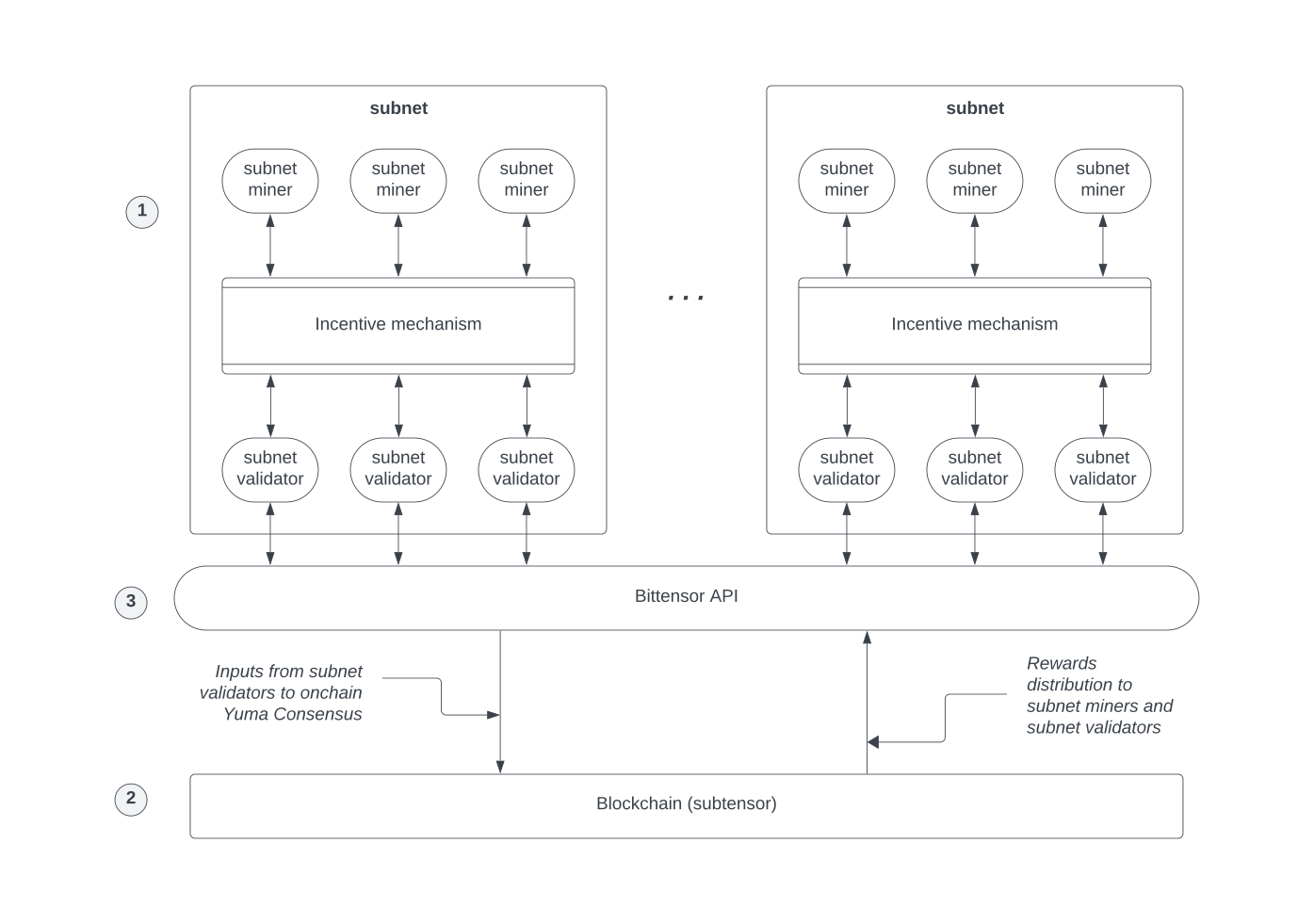
A subnet is a specialized marketplace that defines what digital commodity it produces, how contributions are evaluated, and how rewards are distributed. Each subnet sets its own incentive mechanism, which determines how participants are scored and compensated.
Subnets support a wide range of AI-related digital commodities, including language model inference, image generation, compute marketplaces, and other specialized tasks. The number of active subnets changes over time as new markets are created and others become inactive.
Miners
Miners produce the subnet’s defined commodity and compete based on performance. Rewards are allocated according to evaluation scores, and miners must continuously optimize their outputs to remain competitive.
Validators
Validators evaluate miner outputs and assign scores used to distribute emissions. Bittensor’s reward allocation framework is based on the Yuma Consensus family of mechanisms. Higher-performing miners earn a larger share of rewards.
Subnet Creators
Anyone can register a new subnet and define its incentive structure. Creating a subnet requires a TAO recycling cost that cannot be recovered. The required amount adjusts over time according to protocol rules.
What Is TAO? Token Utility and Tokenomics
TAO (τ) is the native token of the Bittensor network. It functions as the base currency across the protocol’s economic activity.
What TAO Is Used For
- Rewards: Distributed to miners, validators, and stakers according to subnet incentive rules
- Staking and delegation: TAO holders can stake to validators to participate in network emissions
- Network participation: TAO is required for actions such as registering miners, validators, and subnets
- Protocol fees: Transaction fees are recycled within the protocol according to network rules
TAO Tokenomics
Bittensor follows a fixed-supply model similar in structure to Bitcoin.
- Maximum supply: 21,000,000 TAO
- Block time: 12 seconds
- Pre-first-halving emission: 1 TAO per block
- Post-first-halving emission: 0.5 TAO per block
- Halving mechanism: Emission rates are reduced by 50% when total issued supply reaches predefined thresholds. Halvings are supply-based rather than time-based. TAO recycling, including recycled transaction fees and subnet registration costs, re-enters the emission pool and can affect when a halving threshold is reached.
TAO issuance continues under this schedule until the maximum supply of 21 million tokens is reached.
Dynamic TAO (dTAO)
Dynamic TAO (dTAO), introduced in February 2025, was a major protocol upgrade that added subnet-specific tokens and modified staking and emission mechanics.
What Changed
Under the earlier design, a limited set of Root Network validators, capped at 64 by stake weight, influenced how TAO emissions were allocated across subnets.
dTAO introduced:
- A unique Alpha (α) token for each subnet
- An Automated Market Maker (AMM) pool pairing TAO and Alpha
- Staking that swaps TAO for Alpha via the AMM
- Unstaking that converts Alpha back into TAO at the pool rate
Because staking interacts with an AMM, transactions may experience slippage.
Subnet Zero
Subnet Zero does not issue an Alpha token and does not host miners. TAO holders can stake to validators on Subnet Zero while remaining denominated in TAO, avoiding exposure to subnet-specific Alpha token price movements.
Emission Model Update
The original dTAO design referenced price-based allocation. As of November 2025, the network uses a flow-based model known as Taoflow, where subnet emission shares are determined by net TAO staking flows rather than Alpha token prices.
How Emissions Work in 2026
Bittensor emissions operate through a two-stage process that applies to every subnet.
Two Stages of Emissions
Injection:
Each block, new TAO and Alpha token liquidity is injected into subnet AMM pools. A subnet’s emission share depends on the active allocation model.
Distribution:
At the end of each tempo, approximately 360 blocks, accumulated emissions are distributed to miners, validators, and stakers according to Yuma Consensus evaluation.
Taoflow: The Current Emissions Model
Bittensor currently uses a flow-based allocation model called Taoflow.
- Subnet emissions are determined by net TAO staking flows
- Net inflows and outflows are smoothed using an Exponential Moving Average with an effective window of about 86.8 days
- Subnets with sustained negative net flows may receive zero emissions
Under Taoflow, emission allocation is based on staking behavior rather than Alpha token price.
TAO Halving
The TAO halving mechanism is supply-threshold based, not time-based.
- A TAO halving is triggered when total TAO issuance reaches predefined milestones
- TAO recycling, including recycled transaction fees and subnet registration costs, re-enters the emission pool and can affect halving timing
- The first TAO halving reduced emissions from 1 TAO per block to 0.5 TAO per block
A TAO halving reduces TAO injected into subnet pools and proportionally reduces Alpha token liquidity injection. It does not automatically reduce Alpha token rewards distributed within a subnet, which follow subnet-level mechanics.
Notable Bittensor Subnets
The Bittensor subnet ecosystem spans a wide range of AI and compute applications. Individual subnets specialize in different digital commodities, and their focus may evolve over time.
Examples include:
- Subnet 1 (Apex): Focused on text generation and prompt-based AI tasks
- Subnet 19 (Nineteen AI): Focused on large language model inference
- Subnet 21 (Celium): Focused on decentralized GPU and compute marketplaces
- Subnet 64 (Chutes): Focused on AI API services
- Subnet 0 (Root Subnet): A special subnet with no miners and no Alpha token, where TAO holders can stake directly to validators while remaining denominated in TAO
Subnet availability, numbering, and performance characteristics change over time. For updated listings and real-time subnet data, refer to official network dashboards such as tao.app.
TAO Network Milestones
TAO's market performance has historically moved in tandem with broader AI and crypto market cycles. As a market-traded asset, its price has reflected shifts in AI sector sentiment, network upgrades, and exchange listings.
Key protocol milestones include:
- February 2025: Dynamic TAO (dTAO) introduced subnet-specific Alpha tokens and AMM-based staking
- November 2025: The network transitioned to the Taoflow emissions model, replacing the earlier price-based allocation system
- December 2025: First TAO halving — emissions were reduced from 1 TAO per block to 0.5 TAO per block under the supply-threshold-based halving mechanism
As with most crypto assets, TAO's market price is determined by supply and demand on exchanges and may fluctuate significantly over time.
Bittensor vs Other AI Crypto Projects
Bittensor is often compared with other AI-focused crypto networks. While all operate at the intersection of AI and blockchain, their architecture, token design, and incentive mechanisms differ.
Summary of Key Differences
Bittensor differs from many other AI crypto projects in two primary ways. First, it combines a fixed-supply token model with a supply-based halving schedule. Second, it uses a subnet architecture that allows multiple specialized AI markets to operate under one shared economic layer.
Rather than focusing on a single vertical such as AI agents, GPU rendering, or data exchange, Bittensor is designed as a general-purpose incentive network for machine intelligence.
How to Get Exposure to TAO
There are two primary ways to gain exposure to TAO: purchasing the spot token on an exchange that lists it, or trading TAO perpetual futures.
Option 1: Buy Spot TAO
TAO spot tokens are available on various centralized exchanges. The general process is similar across platforms.
Step 1: Choose an exchange that lists TAO spot. Availability may vary by jurisdiction, so confirm that TAO trading is supported in your region.
Step 2: Create and verify your account. Most regulated exchanges require identity verification before enabling deposits and trading.
Step 3: Deposit fiat currency or cryptocurrency. Common TAO trading pairs may include stablecoins or major cryptocurrencies.
Step 4: Place your order. A market order executes at the current market price, while a limit order executes only at your specified price.
Step 5: After purchasing, you may keep TAO on the exchange or withdraw it to a compatible self-custody wallet.
Option 2: Trade TAO Perpetual Futures
TAO perpetual futures (TAO-PERP) allow traders to gain price exposure without holding the underlying spot token. Such contracts are available on select derivatives exchanges, including Backpack Exchange.
Perpetual futures enable traders to:
- Take long or short positions
- Use leverage
- Hedge existing TAO exposure
When trading perpetual futures, users do not take custody of the underlying TAO token. However, derivatives involve additional risks, including leverage-related liquidation risk and funding rate costs. These products may not be suitable for all users.
How to Stake Bittensor (TAO)
Staking allows TAO holders to participate in emission distribution by delegating stake to validators.
Key Staking Parameters
- Minimum stake: 0.1 TAO
- Minimum transaction amount: 0.0005 TAO (500,000 RAO)
- Validators charge a commission (default 18%, configurable)
- Staking and unstaking transactions incur network fees
- Subnet staking interacts with an AMM and may involve slippage
Two Staking Approaches
Subnet Staking
TAO can be staked to a validator on a specific subnet. The TAO is exchanged for that subnet’s Alpha token through the subnet AMM. Stakers receive Alpha token rewards, which may fluctuate in value relative to TAO.
Root Subnet Staking (Subnet Zero)
TAO can also be staked to validators on Subnet Zero. In this case, stake remains denominated in TAO and does not involve exposure to subnet-specific Alpha tokens.
After validator commission is deducted, remaining emissions are distributed proportionally to stakers based on their stake.
Mining (Advanced Participation)
Mining involves registering on a subnet, paying a TAO recycling cost, running subnet-specific software, and competing based on performance under Yuma Consensus. Mining requires technical infrastructure and ongoing optimization.
Learn more about Backpack
Exchange | Wallet | Twitter | Discord | Reddit
Disclaimer: This content is presented to you on an “as is” basis for general information and educational purposes only, without representation or warranty of any kind. It should not be construed as financial, legal or other professional advice, nor is it intended to recommend the purchase of any specific product or service. You should seek your own advice from appropriate professional advisors. Where the article is contributed by a third party contributor, please note that those views expressed belong to the third party contributor, and do not necessarily reflect those of Backpack. Please read our full disclaimer for further details. Digital asset prices can be volatile. The value of your investment may go down or up and you may not get back the amount invested. You are solely responsible for your investment decisions and Backpack is not liable for any losses you may incur. This material should not be construed as financial, legal or other professional advice.


%20(1).png)