
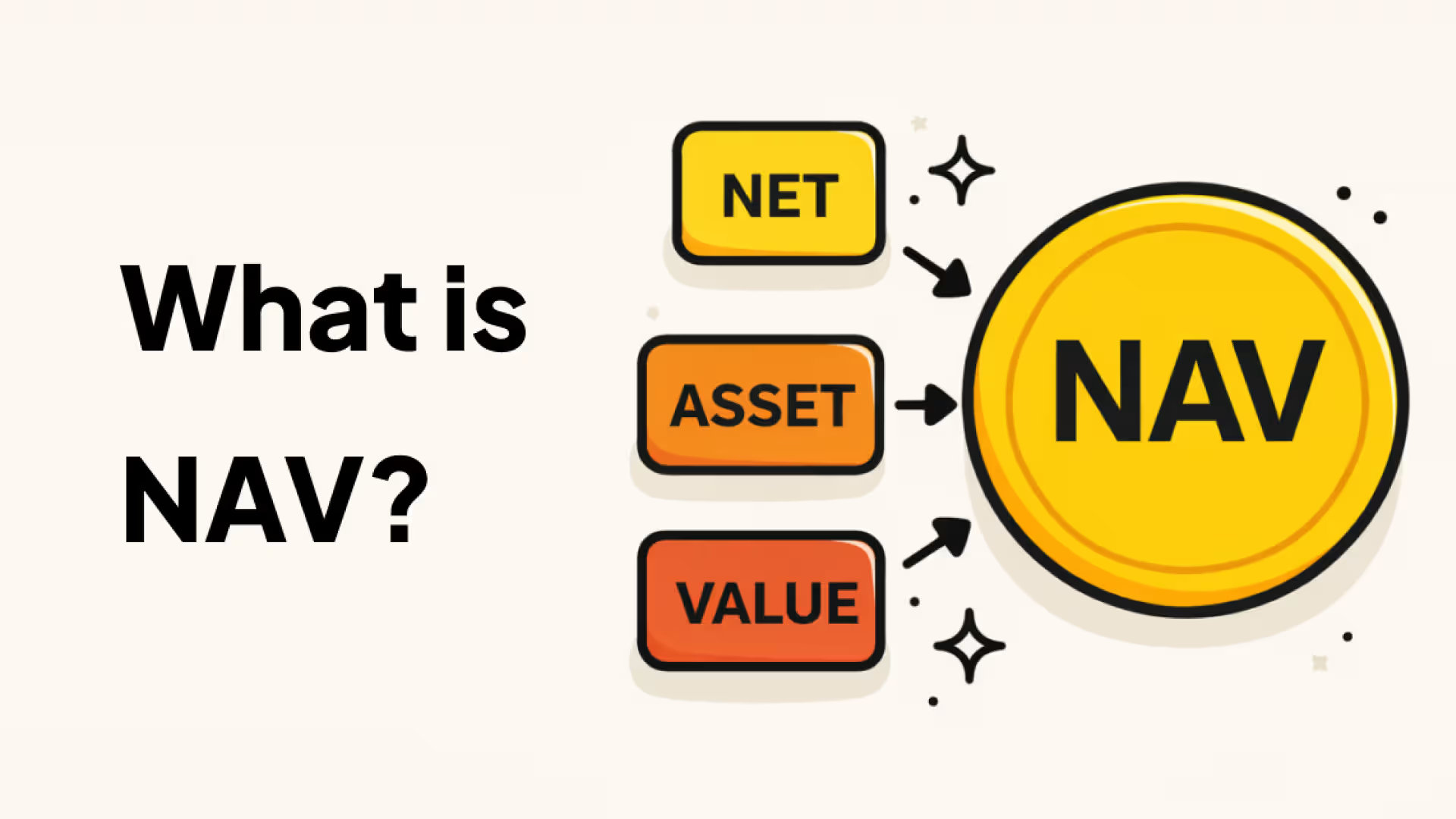
NAV stands for Net Asset Value. In crypto, it tells you what each share or token in an investment fund is worth at any given moment. It is calculated by taking the total value of everything the fund holds, subtracting any liabilities, and dividing by the number of tokens in circulation. When a fund performs well, NAV goes up. When it loses, NAV goes down. Understanding NAV is essential before depositing into any crypto fund or yield vault.
Introduction
If you have ever looked at a crypto investment product and seen the acronym NAV, you might have wondered what it actually means and why it matters. NAV is not a price you can directly buy or sell on an exchange. It is a calculated value that tells you the true underlying worth of your investment at a specific point in time.
The concept comes from traditional finance, where NAV has been used for decades to price mutual funds and ETFs. In crypto, the same logic applies to yield vaults, managed funds, and other pooled investment products. Once you understand how NAV works, you can track your investment performance clearly, understand how deposits and withdrawals are priced, and spot potential risks before they affect your capital.
What Does NAV Stand For?
NAV stands for Net Asset Value. Breaking the term down word by word makes it easier to understand.
- Net means after subtracting liabilities. You are looking at what is left over after debts and obligations are accounted for.
- Asset refers to everything of value the fund holds, including cash, tokens, open positions, and any other holdings.
- Value simply means the current market value of all those assets combined.
Put together, NAV is the true net worth of a fund, expressed as a value per token or share.
How Is NAV Calculated?
The formula is straightforward.
NAV per token = (Total Assets minus Total Liabilities) divided by Number of Tokens Outstanding
Here is a simple example. Imagine a yield vault that holds $500,000 worth of trading positions and cash. The vault has $10,000 in outstanding fees and obligations. There are 400,000 tokens in circulation.
NAV = ($500,000 minus $10,000) divided by 400,000 = $1.225 per token
If you hold 1,000 tokens, your investment is worth $1,225 at that moment.
The key word is moment. NAV is not fixed. It updates as the value of the fund's holdings changes. When the fund earns profits, total assets increase and NAV goes up. When the fund loses money, NAV goes down.
Why Does NAV Matter for Crypto Investors?
NAV matters for three practical reasons.
It determines what you pay when you deposit. When you deposit into a yield vault or crypto fund, you receive tokens priced at the current NAV. If NAV is $1.50 per token and you deposit $150, you receive 100 tokens.
It determines what you receive when you withdraw. When you redeem your tokens, you receive the NAV value per token multiplied by the number of tokens you hold. If NAV has grown to $2.00 since you deposited, your 100 tokens are now worth $200.
It is how you measure performance. Your profit or loss is driven by changes in NAV between entry and exit, multiplied by the number of tokens you hold.
Tracking Your Returns with NAV
Calculating your investment performance using NAV is simple.
Current Value = Number of tokens you hold multiplied by current NAV
Profit or Loss = Current Value minus Total amount you deposited
Return percentage = (Profit or Loss divided by Total deposited) multiplied by 100
Example. You deposit $1,000 into a vault when NAV is $1.00 per token. You receive 1,000 tokens. Six months later, NAV has risen to $1.35.
Current value = 1,000 tokens multiplied by $1.35 = $1,350
Profit = $1,350 minus $1,000 = $350
Return = 35 percent
If NAV had fallen to $0.85 instead, your 1,000 tokens would be worth $850, and you would have a loss of $150, or minus 15 percent.
On Backpack Exchange, Backpack Vault uses NAV to price BLT tokens in real time — when the vault profits, NAV rises and your BLT is worth more. When it loses, NAV falls.
What Is NAV Protection and Why Does It Exist?
In some structured yield vaults, NAV may be protected by mechanisms designed to reduce short-term pricing manipulation. One common approach is Time-Weighted Average Price, or TWAP.
Instead of relying only on the current spot NAV when processing deposits and withdrawals, the platform may compare spot NAV with a rolling average NAV calculated over a defined period, such as 24 hours.
For deposits, some vaults use the higher of the spot NAV or the average NAV. This can reduce the risk of users entering immediately after a sharp temporary drop at the expense of existing depositors.
For withdrawals, some vaults use the lower of the spot NAV or the average NAV. This can reduce the risk of users exiting after a short-lived spike that would dilute remaining depositors.
In stable market conditions, the difference between spot NAV and an average NAV is usually small. These mechanisms primarily matter during periods of elevated volatility.
NAV Staleness: What Happens When NAV Is Outdated
NAV is only useful when it reflects current market conditions. If price data feeding into a vault has not been updated recently, the NAV figure may no longer represent the true value of the fund.
Some platforms implement automatic safeguards that temporarily pause deposits and withdrawals if NAV data has not been refreshed within a predefined time window. This prevents users from transacting at an outdated price.
If you encounter a message that transactions are temporarily paused, it may be due to such safety mechanisms. Activity typically resumes once updated pricing data is recorded.
NAV in Yield Vaults vs. NAV in Crypto ETFs
You may encounter NAV in two different crypto contexts, and it is worth understanding the difference.
In a crypto ETF or Bitcoin trust, NAV represents the total value of the fund's cryptocurrency holdings divided by the number of shares. ETF shares can trade at a premium or discount to NAV depending on supply and demand in the secondary market. This means you might pay more or less than the true underlying value when buying or selling ETF shares on an exchange.
In many yield vault structures, deposits and withdrawals occur directly at NAV rather than at a separate market price. Vault tokens typically do not trade independently on a secondary market, meaning their value is tied directly to the underlying NAV calculation.
For beginners, the yield vault structure is simpler to understand because there is a direct one-to-one relationship between token value and NAV. What you see is what you get.
Common Questions About NAV
Can NAV go below my entry price? Yes. If the fund experiences losses, NAV decreases. There is no guaranteed floor unless explicitly stated by the product, which is uncommon in performance-based vaults. This is one of the key risks of investing in a yield vault compared to lending, where your principal is generally stable.
Is a higher NAV better? Not necessarily. A higher NAV reflects cumulative performance since inception. What matters more is the direction NAV is moving during your holding period, not the absolute number.
Does NAV include fees? Management and performance fees are generally reflected in NAV over time, as fees reduce total net assets. Always review the specific fee structure of a product before investing.
How often is NAV updated? Update frequency varies by platform and product design. Some update continuously based on real-time positions, while others update at defined intervals. More frequent updates give you a more accurate picture of your current investment value.
What happens when new depositors join? When new users deposit at the current NAV, total assets and total tokens both increase proportionally. Under normal circumstances, this means existing holders are not diluted and NAV per token remains unchanged immediately after the deposit.
Summary
NAV, or Net Asset Value, is the core metric used to measure the value of a fund or yield vault. It determines how much each token is worth, how returns are calculated, and the price at which investors enter and exit.
NAV rises when the fund generates profits and falls when it incurs losses. Deposits and withdrawals in many vault structures occur directly at NAV, making pricing transparent. Some platforms also implement additional safeguards such as time-weighted pricing or transaction pauses to ensure fair processing for all depositors.
Understanding NAV is essential before allocating capital to any crypto fund or yield vault product. Backpack Exchange is one platform building a unified environment where staking, lending, and vault products work together in a single balance, making it straightforward to track performance across different yield strategies without moving funds between services.
Learn more about Backpack
Exchange | Wallet | Twitter | Discord | Reddit
Disclaimer: This content is presented to you on an “as is” basis for general information and educational purposes only, without representation or warranty of any kind. It should not be construed as financial, legal or other professional advice, nor is it intended to recommend the purchase of any specific product or service. You should seek your own advice from appropriate professional advisors. Where the article is contributed by a third party contributor, please note that those views expressed belong to the third party contributor, and do not necessarily reflect those of Backpack. Please read our full disclaimer for further details. Digital asset prices can be volatile. The value of your investment may go down or up and you may not get back the amount invested. You are solely responsible for your investment decisions and Backpack is not liable for any losses you may incur. This material should not be construed as financial, legal or other professional advice.