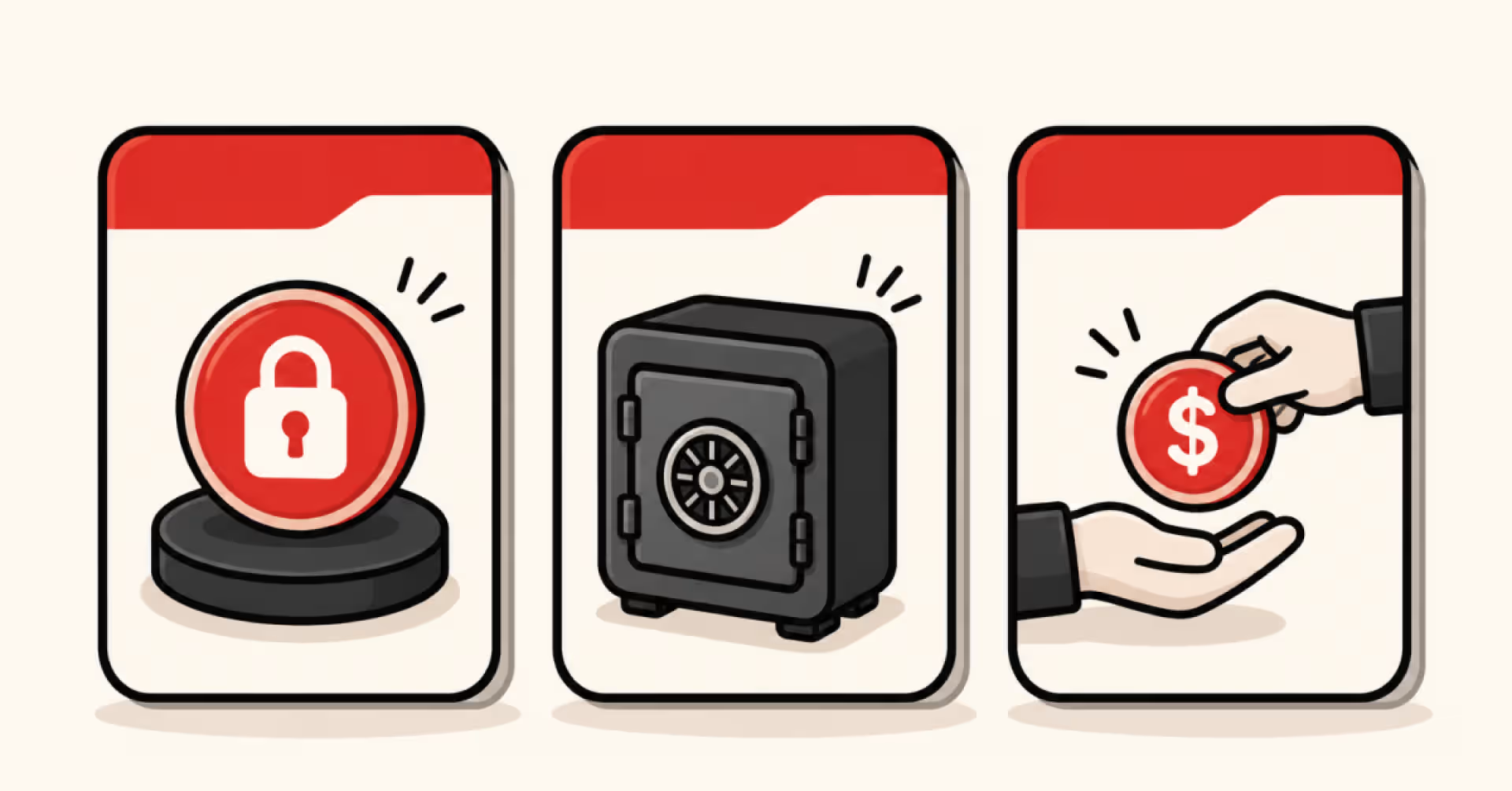
Staking, lending, and yield vaults all generate returns on your crypto, but they work in completely different ways. Staking earns protocol rewards for securing a network. Lending earns interest from borrowers. Yield vaults earn returns from professional trading strategies. The right choice depends on your risk tolerance, how quickly you need liquidity, and how much return variability you can accept.
Introduction
If you hold crypto and want to put it to work, you have three main options: staking, lending, or depositing into a yield vault. Each one generates returns, but the mechanics, risks, and return profiles are fundamentally different.
Many investors pick one without fully understanding the others. This guide breaks down how each product works, compares them directly across the metrics that matter, and helps you decide which one fits your situation.
How Each Product Works
Staking
Staking means locking up your crypto to participate in a proof-of-stake blockchain's consensus mechanism. In return, the protocol rewards you with newly minted tokens for helping validate transactions and secure the network.
Key characteristics:
- Your capital is typically locked for a fixed period or subject to an unbonding period before you can access it
- Returns come from protocol emissions, which are new tokens created and distributed as rewards
- The yield is relatively predictable in token terms but variable in USD terms because the token price fluctuates
- You bear full exposure to the underlying asset's price movement
Staking works well when you already hold a token long term and want to earn additional yield on a position you plan to hold regardless. It does not make sense for capital you might need quickly or for assets you are not already committed to holding.
Lending
Lending means depositing your crypto into a lending protocol or exchange lending pool, where borrowers can borrow it in exchange for paying interest. You earn that interest on a continuous basis.
Key characteristics:
- Returns are interest-based and expressed as APY, which fluctuates based on borrower demand and pool utilization
- Your principal is generally stable
- Withdrawals are typically instant or near-instant, subject to available liquidity in the pool
- The asset you lend is the same asset you get back, plus accrued interest
Lending works well when you want relatively predictable yield, need to keep liquidity available, and want to avoid trading risk. The main risk is protocol risk rather than performance risk.
Yield Vaults
A yield vault is an investment product where your capital is pooled with other depositors and managed by a professional trader or automated strategy. You receive liquidity tokens representing your share of the vault. The value of those tokens goes up or down based on how well the trader performs.
Key characteristics:
- Returns come from active trading, which can include futures positions, funding rate capture, spread trading, and similar strategies
- Your token value fluctuates with NAV, the Net Asset Value of the vault
- Withdrawals require a redemption delay, meaning you submit a request and wait for it to be processed
- There is no guaranteed return and no capital protection
Yield vaults work well when you want exposure to active trading strategies, are comfortable with variable returns including the possibility of losses, and do not need immediate access to your capital.
Direct Comparison
Which Earns More?
This is the question everyone asks and the honest answer is: it depends on the time period and market conditions.
Staking tends to offer stable token rewards in the range of 4% to 8% annually for major proof-of-stake assets like Solana, though this varies by network. The real return in USD terms depends heavily on whether the staked token appreciates or depreciates during the period.
Lending returns fluctuate based on borrower demand. Stablecoin lending rates typically range from 2% to 8% APY under normal market conditions. During periods of very high borrowing demand in bull markets, rates can spike significantly higher, though this is not the norm. The advantage is that your principal is stable and you are not exposed to token price risk if you lend stablecoins.
Yield vaults have the highest return potential but also the widest variance. A skilled trader running a vault can significantly outperform lending rates during favorable conditions. However, a vault can also post negative returns during difficult periods. There is no average to point to because performance depends entirely on the specific trader and strategy.
The question to ask is not which earns more in absolute terms, but which earns more on a risk-adjusted basis given your specific situation. Understanding what APY means in crypto and how it is calculated across different products is a useful starting point before comparing numbers across platforms.
Risk Comparison
Understanding the different types of risk in each product matters as much as understanding the returns.
Staking risks. The main risk is price exposure to the underlying token. If you stake SOL and SOL drops 40%, your staking rewards do not offset that loss. There is also slashing risk on some networks, where validators can lose a portion of staked funds for misbehavior, though this is rare with reputable validators. Unbonding periods mean you cannot exit immediately if conditions change.
Lending risks. Protocol risk is the primary concern. A smart contract exploit or a liquidity crisis could affect your ability to withdraw. Utilization risk means that if the pool is fully borrowed out, withdrawals may be temporarily delayed. If you lend volatile assets rather than stablecoins, you also carry price exposure.
Yield vault risks. Performance risk is the core concern. NAV can decrease if the trader has losing positions. Liquidity risk comes from the redemption delay, meaning you cannot exit the same day you decide to. Counterparty risk means you are trusting the vault operator's infrastructure and the trader's risk management. Concentration risk applies if all your yield-seeking capital is in a single vault.
Which One Fits Your Situation?
Choose staking if you are already holding a proof-of-stake token for the long term, you are comfortable with the token's price volatility, and you want to earn additional yield on a position you plan to hold regardless. Staking is not a yield strategy on its own. It is a way to earn on an existing conviction.
Choose lending if you want relatively predictable yield without trading risk, you need the ability to access your capital quickly, and you prefer stable principals. Stablecoin lending in particular offers yield without token price exposure, which is useful for capital you want to preserve while still earning.
Choose a yield vault if you want exposure to professional trading strategies without managing positions yourself, you are comfortable with variable returns including the possibility of negative periods, and you do not need immediate access to your capital. Yield vaults are best suited for capital you can commit for a meaningful period.
Consider combining all three if you want to diversify your yield sources. Keeping a portion in staking for long-term token positions, a portion in lending for stable predictable yield, and a portion in a vault for higher potential returns creates a balanced approach across different risk profiles.
A Note on Fees
Each product has a different fee structure that affects your net return.
Staking fees come from validator commissions, typically ranging from 5% to 10% of rewards. If a validator takes a 7% commission and the gross staking yield is 7% APY, your net yield is closer to 6.5%. Some platforms pass through 100 percent of staking rewards with zero commission, which meaningfully improves net returns over time.
Lending fees are generally built into the spread between the borrowing rate and the lending rate. The protocol takes a cut of the interest paid by borrowers before passing the remainder to lenders.
Yield vault fees typically include a management fee, which is a percentage of assets under management charged annually, and a performance fee, which is a percentage of profits.
Performance fees create alignment between the trader and depositors but can significantly affect net returns over time. Always check the specific fee structure of a vault before depositing.
Conclusion
Staking, lending, and yield vaults each serve a different purpose in a crypto portfolio. Staking rewards long-term token conviction. Lending provides relatively predictable yield with faster liquidity. Yield vaults offer exposure to professional trading strategies with higher return potential and higher variance.
The best choice is not the one with the highest headline APY. It is the one that fits your time horizon, liquidity needs, and comfort with variance. For most investors, combining all three in different proportions produces better outcomes than concentrating entirely in one product.
Backpack is one platform that covers all three products in one place. The Backpack Wallet supports SOL staking directly through the Mad Validator with zero commission fees, as well as liquid staking through bpSOL for users who want to keep their capital flexible while still earning. On the exchange side, Backpack offers a lending product and Backpack Vault — an exchange-native trading vault where depositors receive BLT tokens and earn returns from active market-making strategies — allowing users to split capital across different risk profiles without moving funds between services.
Learn more about Backpack
Exchange | Wallet | Twitter | Discord | Reddit
Disclaimer: This content is presented to you on an “as is” basis for general information and educational purposes only, without representation or warranty of any kind. It should not be construed as financial, legal or other professional advice, nor is it intended to recommend the purchase of any specific product or service. You should seek your own advice from appropriate professional advisors. Where the article is contributed by a third party contributor, please note that those views expressed belong to the third party contributor, and do not necessarily reflect those of Backpack. Please read our full disclaimer for further details. Digital asset prices can be volatile. The value of your investment may go down or up and you may not get back the amount invested. You are solely responsible for your investment decisions and Backpack is not liable for any losses you may incur. This material should not be construed as financial, legal or other professional advice.