The Solana ecosystem has grown into one of the fastest and most cost-efficient blockchains in crypto. With low transaction fees, high throughput, and an expanding DeFi landscape, Solana has become a prime hub for lending and borrowing protocols.
In this guide, we’ll explore what Solana lending protocols are, how they work, the best platforms in 2026, and the risks & opportunities you need to know before depositing your assets.
What is a Solana Lending Protocol?
A Solana lending protocol is a decentralized financial application (dApp) that lets users lend and borrow cryptocurrencies directly on the Solana blockchain without needing banks or intermediaries. These platforms are powered by smart contracts, which automatically manage deposits, loans, and interest payments in a trustless way.
Key benefits:
- Earn passive income: Deposit idle assets and receive interest.
- Instant liquidity: Access funds without selling your crypto.
- No credit checks: Borrowing is based only on crypto collateral.
- Transparent interest rates: Rates are set by supply and demand in real time.
How Do Solana Lending Protocols Work?
At their core, Solana lending protocols are liquidity markets managed by smart contracts. Instead of matching individual lenders with borrowers, all assets go into a shared pool, and the protocol automatically sets rules for interest, borrowing, and risk.
- Liquidity Pools: When users deposit assets (like USDC or SOL), they don’t lend to one specific person. Their tokens join a pool that many borrowers can access.
- Interest Rates: The protocol uses algorithms to balance supply and demand. If more people borrow, interest rates rise; if more people lend, rates fall.
- Collateral System: Borrowers must provide crypto collateral worth more than the loan (overcollateralization). This protects lenders from defaults.
- Liquidations: If collateral value drops below a safe threshold, smart contracts automatically sell part of it to repay the loan and secure the pool.
In short: Lenders earn yield for supplying liquidity, borrowers unlock funds by posting collateral, and smart contracts ensure fairness and safety for both sides.
Best Solana Lending Protocols in 2026
Kamino Finance
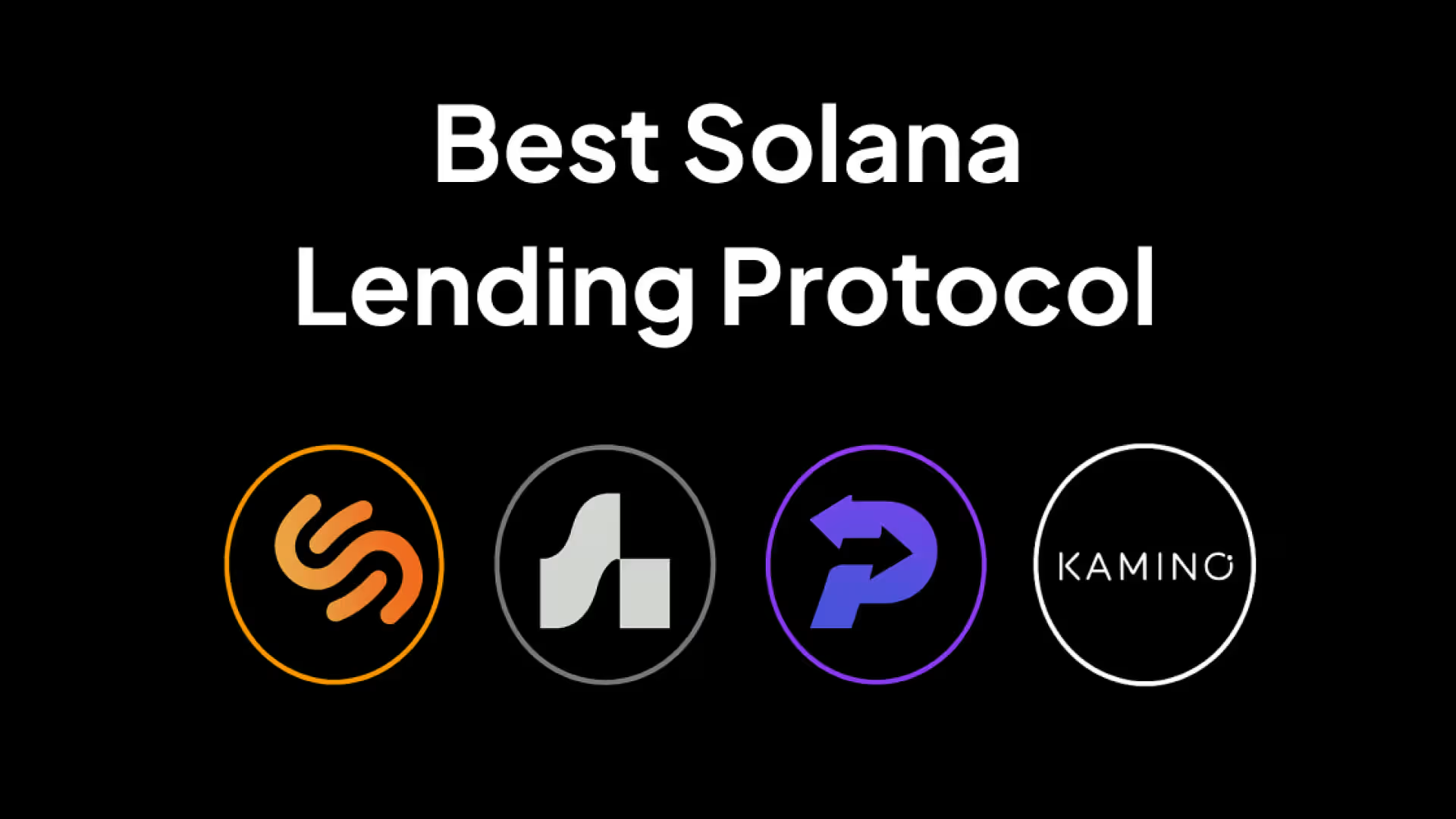
Kamino Finance is the largest lending protocol on Solana by total value locked. Its ecosystem includes K-Lend, automated liquidity vaults, and leveraged yield strategies. Kamino's TVL peaked near $2.8 billion in Q3 2025 and has since pulled back with the broader market to roughly $1.5 billion as of September 2026, still the largest lending pool on Solana by a wide margin. Key innovations include kTokens (yield-bearing LP tokens usable as collateral) and Elevation Mode, which allows higher LTV borrowing with correlated assets. In late 2025, Kamino also pushed into institutional products, including fixed-rate loans and a private credit vault targeting real-world assets. Kamino’s automation and efficiency make it a standout for users seeking all-in-one DeFi workflows.
Jupiter Lend
Jupiter Lend is the lending market built by Jupiter, Solana's largest DEX aggregator, and has grown into one of the network's top lending protocols by deposits. In August 2026, Jupiter launched Lend v2, adding Smart Collateral and Smart Debt features that let supplied and borrowed assets simultaneously earn DEX trading fees on top of lending interest, alongside a Lifetime PnL tracker. As of the v2 launch, Jupiter Lend held roughly $1.9 billion in deposits and around $823 million in active loans across USDC, USDT, SOL, and JupSOL. Its integration with Jupiter's broader trading stack — swaps, perpetuals, and the JupUSD stablecoin — makes it a natural fit for users who already trade on Jupiter and want idle capital to keep working.
Save (formerly Solend)
Save, the 2024 rebrand of Solend, remains one of the most established lending platforms on Solana. It once reached $400M+ in TVL, but that figure has fallen substantially since, with recent data putting Save's TVL in the roughly $75–85 million range as of September 2026. The protocol supports major assets like SOL, USDC, and wrapped BTC, and the rebrand introduced products such as a native stablecoin (sUSD) and a liquid staking token (saveSOL). Save has held onto an active user base thanks to isolated pools covering long-tail assets that larger lenders like Kamino and Jupiter Lend don't list, and an audit history dating back to 2021.
Marginfi
Marginfi is built for advanced DeFi users and institutional-style strategies. Its architecture features Global Markets with interconnected assets, Isolated Markets with independent risk parameters, and a Native Stake Market for liquid staking collateral. The protocol’s in-house risk engine constantly monitors liquidity and works with liquidators to maintain system health. Marginfi grew rapidly in 2023 before plateauing after team turnover in early 2024, and its TVL today is a fraction of Kamino's or Jupiter Lend's. It remains a relevant option for traders who want more granular control over risk and capital efficiency rather than the largest pool.

Note: Port Finance, previously featured in this guide, has seen its total value locked fall to roughly $1.8 million as of September 2026 and is no longer among Solana's actively used lending venues. It has been replaced above with Jupiter Lend, which now ranks among Solana's largest lending protocols by deposits.
Risks of Using Solana Lending Protocols
- Smart contract risk: Bugs or exploits in the code can lead to loss of funds, with no insurance safety net.
- Liquidation risk: If collateral value drops, loans may be automatically liquidated.
- Market risk: Solana’s volatility and network issues can affect rates and collateral health.
- Liquidity risk: Smaller pools may not have enough funds for quick withdrawals.
- Regulatory risk: Future rules could change how protocols operate or restrict access.
Always manage risks by diversifying, keeping safe collateral ratios, and monitoring market conditions.
How to Choose the Right Protocol
With several strong lending protocols on Solana, the best choice depends on your goals, risk tolerance, and experience level. Here are the main factors to consider:
- Security and audits: Check if the protocol has been independently audited and has safeguards against exploits. Established names like Save bring more trust.
- Liquidity and adoption: A higher total value locked (TVL) usually means deeper liquidity, lower withdrawal risk, and more reliable rates. Kamino and Jupiter Lend lead in this area as of 2026.
- Supported assets: Some protocols focus on core tokens like SOL and USDC, while others also support staked assets, wrapped BTC, or niche tokens. Pick a platform that fits the assets you want to lend or borrow.
- Features and strategies: Marginfi, Kamino, and Jupiter Lend offer advanced options like leverage, fixed-rate lending, and combined lending/trading yield. Beginners may prefer simpler platforms.
- Community and governance: A strong, transparent community and active governance are signs of long-term reliability. Check how decisions are made, whether proposals are voted on, and if the team communicates openly.
Step-by-Step Guide: How to Use a Solana Lending Protocol
1. Set up a Solana wallet.
Install a wallet like Phantom, Solflare, or Backpack. Back up your recovery phrase securely.
Tip: Backpack Solana Wallet has an “Explore” feature that lets you directly browse and connect to DeFi protocols like Kamino, Jupiter, and Save without leaving the wallet.
2. Fund your wallet.
Buy SOL or USDC on an exchange and transfer them to your wallet. Keep a little SOL for fees.
3. Choose a protocol.
Go to a trusted platform such as Kamino, Jupiter Lend, Save, or Marginfi. If you’re using Backpack, you can discover and launch these dApps directly from the Explore tab.
4. Deposit tokens.
Select the token (e.g., SOL or USDC), enter the amount, and approve the transaction. Your assets move into the lending pool and start earning yield.
5. Confirm your position
After confirmation, the dashboard should show your Supplied balance (and sometimes a receipt position). APY is variable and can change with supply/demand.
6. (Optional) Optimize
If the protocol offers incentives (rewards/points) or auto-compounding, enable them if they match your risk tolerance. Set alerts or use a portfolio tracker to monitor yield.
7. Withdraw when you need
Use Withdraw/Redeem to take funds back, subject to pool liquidity. If utilization is very high, you may need to wait for available liquidity.
The Future of Solana Lending
The Solana lending ecosystem is evolving quickly. Key trends to watch include:
- Capital efficiency: Protocols like Kamino, Jupiter Lend, and Marginfi are pushing efficiency with features such as auto-compounded liquidity, liquid staking collateral, combined lending-and-trading yield, and higher loan-to-value (LTV) strategies.
- Hybrid CeFi + DeFi approaches: Backpack Exchange isn’t a DeFi protocol, but it borrows DeFi-like mechanics. Its Auto-Lend feature earns yield on deposits while keeping them margin-ready, and its Borrow-Lending Market provides pooled liquidity for traders and lenders. Paired with the Backpack Wallet’s Explore feature for easy access to Solana dApps, it shows how centralized and decentralized models are converging.
- Real-world assets (RWAs): Kamino's institutional push into fixed-rate loans and private credit vaults, alongside broader tokenized treasury and bond products from issuers like BlackRock and VanEck, is bringing traditional finance closer to Solana DeFi.
- Smarter risk management: Expect better liquidation systems, AI-driven monitoring, and cross-chain solutions to create safer lending markets.
These developments suggest Solana lending will become more efficient, more accessible, and increasingly relevant for both retail and institutional users.
Conclusion
Solana lending protocols like Kamino, Jupiter Lend, Save, and Marginfi give users powerful ways to earn yield and borrow without selling their assets. At the same time, CeFi platforms such as Backpack Exchange are adding DeFi-like features, showing how centralized and decentralized models are converging.
The opportunities are exciting, but risks such as liquidations, smart contract bugs, and liquidity shortages mean users should always start small and manage collateral wisely. Looking ahead, Solana lending will likely become more efficient, accessible, and diverse, welcoming both beginners and institutions.
Want to get started? Download the Backpack Wallet, use its Explore feature to discover Solana lending dApps, and take your first step into the Solana DeFi ecosystem.
Learn more about Backpack
Exchange | Wallet | Twitter | Discord | Reddit
Disclaimer: This content is presented to you on an “as is” basis for general information and educational purposes only, without representation or warranty of any kind. It should not be construed as financial, legal or other professional advice, nor is it intended to recommend the purchase of any specific product or service. You should seek your own advice from appropriate professional advisors. Where the article is contributed by a third party contributor, please note that those views expressed belong to the third party contributor, and do not necessarily reflect those of Backpack. Please read our full disclaimer for further details. Digital asset prices can be volatile. The value of your investment may go down or up and you may not get back the amount invested. You are solely responsible for your investment decisions and Backpack is not liable for any losses you may incur. This material should not be construed as financial, legal or other professional advice.