
If you hold MON, staking is one way to put those tokens to work. By delegating MON to a validator, you contribute to the security of the Monad network and earn a share of the rewards generated through validator participation.
Delegated MON is locked under the protocol’s staking rules until you complete the undelegation and withdrawal process. This guide explains how MON staking works, what to consider when choosing a validator, and how to stake in a few taps through Backpack Wallet with Backpack Validator.
What Is MON Staking?
MON staking is the process of delegating MON to a validator that helps secure the Monad network. In return, delegators earn a share of the rewards that validator generates, proportional to their stake and after any applicable commission.
You do not need to run validator infrastructure or maintain a node to participate. Instead, you delegate MON to a validator without transferring custody of your tokens to that validator.
Delegated MON is locked in the staking system and cannot be transferred or spent while staked. To access it again, you must undelegate and complete the protocol's withdrawal process.
How Does MON Staking Work?
Staking MON on Monad follows a delegation flow that runs on epoch boundaries. You choose a validator, delegate MON to it, and begin earning rewards once the delegation becomes active at an epoch boundary.
The process generally works as follows:
- Choose a validator. Compare factors such as commission, reliability, delegated stake, and operational track record.
- Delegate MON. Submit a delegation transaction to assign your MON to the selected validator through Monad’s staking system.
- Wait for activation. Staking changes take effect at epoch boundaries rather than immediately. Depending on when the transaction is submitted, a delegation may activate in the next epoch or the one after it.
- Earn rewards. Rewards accumulate through the validator’s participation in network consensus. The amount received by each delegator is proportional to their active stake, after any validator commission.
- Claim or compound rewards. Withdraw accumulated rewards to your available balance, or compound them by adding them to your delegated stake.
- Undelegate and withdraw. To stop staking, submit an undelegation request. After the protocol’s withdrawal delay has passed, withdraw the MON back to your available balance.
Monad organizes staking activity into epochs of approximately 5.5 hours, and most delegation and compounding changes become active at the beginning of a new epoch. Undelegated MON must wait one additional epoch before it can be withdrawn, so the total time from unstake request to available balance depends on when the request is submitted within the current epoch.
How to Choose a Monad Validator
Validator commission
Validators typically charge a commission on the rewards they distribute to delegators. A lower commission means you keep a larger share of the staking rewards, although commission should not be the only factor when choosing a validator.
Reliability and uptime
Validators are responsible for participating in network consensus. When a validator misses blocks or goes offline, its delegators earn less during that period. Consistently high uptime translates directly to more consistent rewards over time.
Delegated stake
Delegated stake reflects how much MON token holders have entrusted to a validator. While a larger delegated stake does not guarantee higher rewards, it can be a signal that other MON holders have found the validator credible.
Reputation and operator experience
Look for validators with a proven operational track record, transparent communication, and long-term commitment to the Monad ecosystem. Experienced operators are generally better prepared to maintain reliable validator infrastructure.
Backpack Validator charges 0% validator commission, meaning it does not deduct a validator commission from the staking rewards allocated to delegators. It is the largest validator on Monad by delegated stake. Delegation is available directly through Backpack Wallet's in-app staking flow, as well as through other Monad staking interfaces.
How to Stake MON with Backpack Wallet
Backpack Wallet lets you delegate MON to Backpack Validator without leaving the wallet. The staking flow is non-custodial, meaning your keys stay in your wallet and you approve every transaction yourself. Staking MON through Backpack Wallet offers an estimated APY of around 13%.
To stake MON with Backpack Wallet:
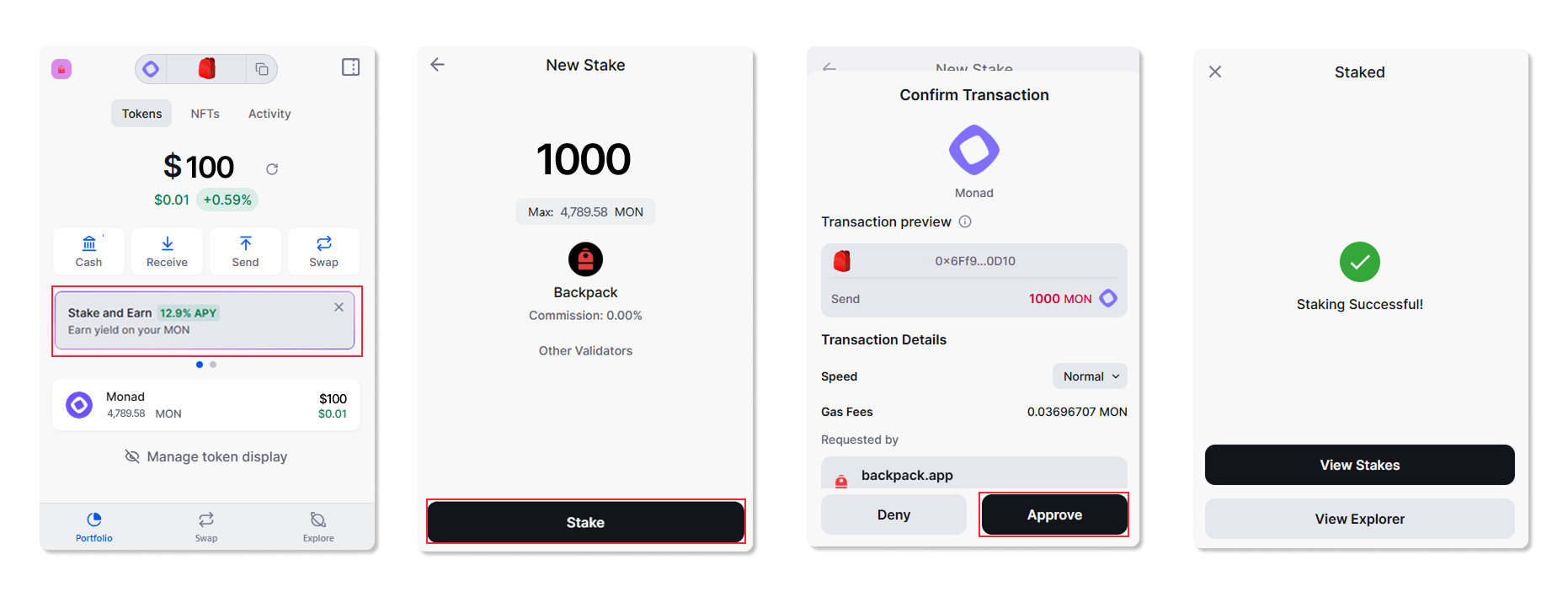
Step 1: Select Stake and Earn
Open Backpack Wallet and switch to the Monad network. From the Portfolio screen, select the Stake and Earn banner.
Step 2: Enter the Amount
Enter the amount of MON you want to delegate. Backpack Validator is selected by default and charges 0% commission.
Do not stake your full balance, as you will need some MON available for network fees.
Step 3: Review and Approve the Transaction
Select Stake, then review the delegation amount, gas fee, and transaction details.
Select Approve to submit the staking transaction onchain.
Step 4: Confirm Your Stake
Once the transaction is confirmed, Backpack Wallet will show a Staking Successful message.
Select View Stakes to review and manage your staking position, or View Explorer to view the transaction onchain.
Your delegation will not become active immediately. Depending on when it is submitted relative to the next boundary block, it will activate in the following epoch or one additional epoch later.
Conclusion
MON staking allows token holders to support the security and consensus of the Monad network while earning staking rewards. By delegating MON to a validator, users can participate without operating validator infrastructure themselves.
Backpack Wallet brings the full MON staking flow into one place, allowing users to stake, monitor rewards, and unstake from the same app they use for other Monad activity. Staking MON through Backpack Wallet offers an estimated APY of around 13%, and Backpack Validator charges 0% validator commission.
Users looking for a more flexible alternative can also hold MON on Backpack Exchange with auto-lend enabled to earn combined staking and lending yield of around 7% APY. MON remains liquid and can continue earning yield while being used for spot or perpetual trading, or as collateral, within the same unified account.
Learn more about Backpack
Exchange | Wallet | Twitter | Discord | Reddit
Disclaimer: This content is presented to you on an “as is” basis for general information and educational purposes only, without representation or warranty of any kind. It should not be construed as financial, legal or other professional advice, nor is it intended to recommend the purchase of any specific product or service. You should seek your own advice from appropriate professional advisors. Where the article is contributed by a third party contributor, please note that those views expressed belong to the third party contributor, and do not necessarily reflect those of Backpack. Please read our full disclaimer for further details. Digital asset prices can be volatile. The value of your investment may go down or up and you may not get back the amount invested. You are solely responsible for your investment decisions and Backpack is not liable for any losses you may incur. This material should not be construed as financial, legal or other professional advice.