
Many high-performance blockchains improve speed by introducing a different programming environment or execution model. Monad takes another route: it preserves EVM compatibility while redesigning the core systems beneath it.
Consensus, execution, and data storage are reworked, while Solidity, familiar developer tools, and the Ethereum RPC interface remain in place. That design shapes both what the network can deliver and what it still needs to prove.
This guide explains how Monad’s architecture works, what MON does on the network, and where the ecosystem stands today.
What Is Monad?
Monad is an Ethereum-compatible Layer 1 blockchain designed for high transaction capacity and fast finality. It supports EVM bytecode and Ethereum JSON-RPC APIs, allowing developers to reuse many Solidity contracts, development tools, and infrastructure components with less re-engineering.
Monad is an independent Layer 1, not a Layer 2. It does not settle to Ethereum or inherit Ethereum's validator set or security, and it is secured by its own validators and its own token. Compatibility is at the level of code and tooling, not at the level of trust.
For users, Monad follows familiar Ethereum conventions, including 0x wallet addresses. However, Monad and Ethereum are separate networks, so assets on one chain do not automatically exist on the other. Transferring assets between the two networks requires a supported bridge.
How Does Monad Work?
Monad improves performance by changing the systems beneath the EVM interface rather than replacing the interface itself. Its architecture addresses three main bottlenecks: how blocks reach agreement and move across the network, how transactions are executed, and how blockchain state is stored.
Consensus and Block Transmission
MonadBFT allows validators to agree on block ordering and finality, while RaptorCast distributes block data through erasure-coded chunks instead of requiring the block proposer to send a full copy directly to every validator. Together, they reduce communication bottlenecks across the validator network.
Transaction Execution
Monad separates consensus from execution so validators can agree on transaction ordering without waiting for the previous block to finish executing. Independent transactions can then be processed optimistically in parallel, while conflicting transactions are re-executed to preserve the result expected from sequential EVM execution. Just-in-time compilation also reduces the computational overhead of repeatedly executing contract bytecode.
State Storage
MonadDB is a purpose-built database for Ethereum state. It uses asynchronous input and output so reads and writes do not unnecessarily block transaction execution, helping the network process transactions in parallel more efficiently.
Monad Mainnet at a Glance
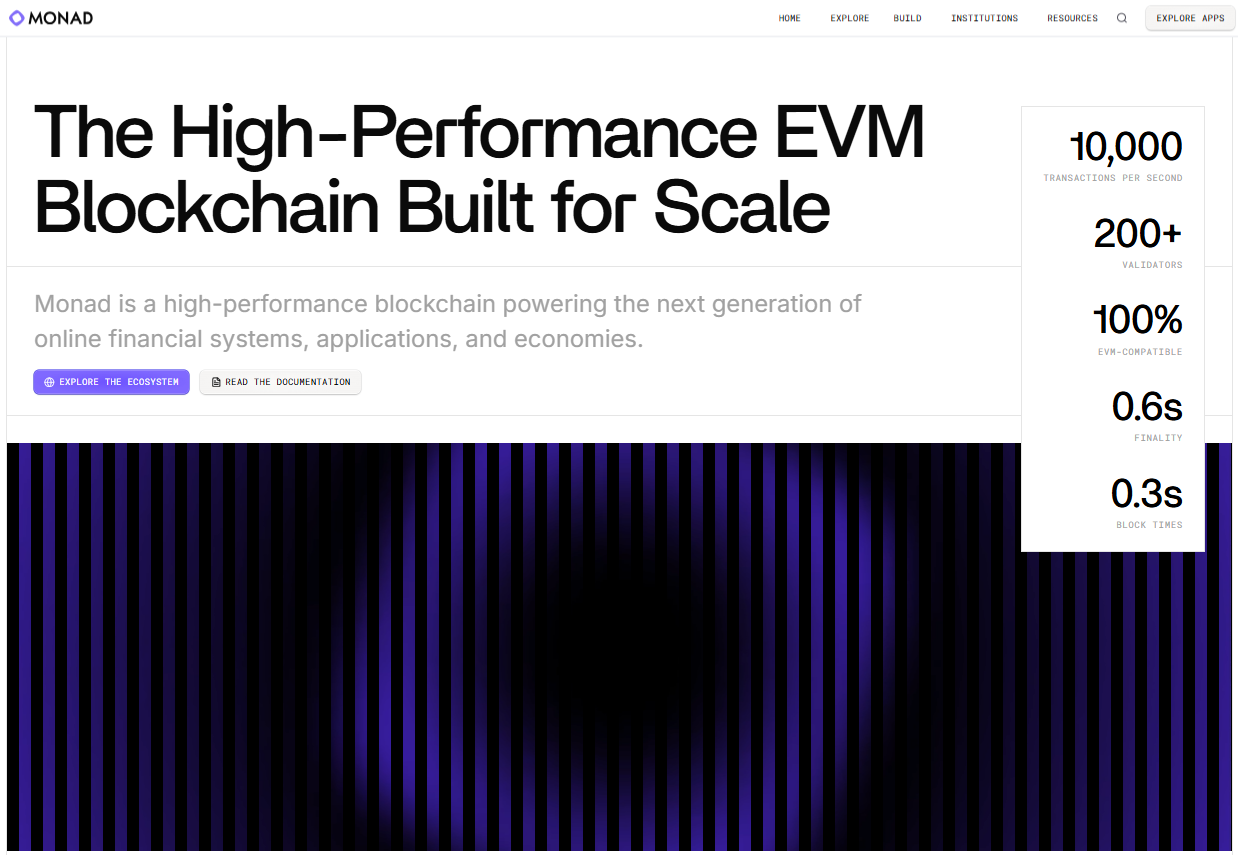
Monad’s 10,000 TPS figure describes the throughput the network is designed to support rather than the number of transactions it processes continuously. The block time, finality, and compatibility figures describe the protocol itself, while the validator count may change as operators enter or leave the active set.
MON Token and Tokenomics
MON is the native token of the Monad network. It is used within the protocol in several ways:
- Transaction fees: MON is required to pay gas when transferring assets or interacting with applications on Monad.
- Validator staking: Validators stake MON to participate in consensus and help secure the network.
- Delegation: MON holders can delegate tokens to validators and receive a share of staking rewards.
- Fee burning: The base-fee portion of each transaction fee is permanently burned, while the priority-fee portion is not included in the burn mechanism.
- No governance rights: MON does not carry onchain governance rights, and Monad's white paper states there are no current plans to introduce them. Protocol changes are coordinated as scheduled upgrades tied to client releases rather than by token vote.
Supply and Issuance
MON launched with an initial supply of 100 billion tokens. This is not a fixed maximum supply, as new MON enters supply through block rewards paid to validators and delegators.
The initial supply is allocated as follows:
- Ecosystem Development: 38.5%
- Team: 27%
- Investors: 19.7%
- Public Sale: 7.5%
- Category Labs Treasury: approximately 4%
- Community Airdrop: 3.3%
Team tokens are locked for one year after Mainnet launch and vest over the following three years. Investor and Treasury allocations follow a four-year lock-up with a one-year cliff and monthly vesting thereafter.
MON therefore combines inflationary issuance through block rewards with deflationary pressure from base-fee burns. Whether total supply expands or contracts depends on the balance between new issuance and network activity.
What Can You Do on Monad?
Monad Mainnet supports applications across decentralized finance, payments, staking, tokenized assets, and consumer products. The available applications continue to change as new teams deploy and existing products expand.
- Trade and use DeFi: Users can swap tokens, provide liquidity, lend or borrow assets, trade onchain markets, and access yield products through supported applications. Monad’s official app portal includes DeFi markets, staking, and curated yield vaults.
- Use stablecoins and payments: Monad supports stablecoin transfers, fiat onramps, payment applications, remittance services, and infrastructure for card-based spending and business payouts.
- Stake MON: MON holders can delegate tokens to validators to help secure the network and earn staking rewards, subject to validator performance and the network’s staking and withdrawal rules.
- Access tokenized assets: Applications can issue or provide access to tokenized credit, fixed-income products, and other real-world assets that settle on Monad.
- Explore consumer applications: The ecosystem also includes social, NFT, gaming, and other consumer-facing applications, although DeFi, payments, and tokenized finance now represent a larger part of Monad’s Mainnet activity.
Applications on Monad are operated by independent teams. Before connecting a wallet or depositing assets, users should review the application’s contracts, fees, liquidity, permissions, and security risks.
How to Access Monad With Backpack
Backpack Wallet supports Monad Mainnet on desktop and mobile, allowing users to manage MON and other Monad assets, sign transactions, and connect to applications from a self-custodial wallet.
- Create or import a wallet: Open Backpack Wallet and create a new wallet or import an existing one. Select Monad from the available networks.
- Confirm the network: Make sure Monad Mainnet is selected. Monad Testnet is a separate development environment, and Testnet MON has no market value or transfer path to Mainnet.
- Fund the wallet: Receive MON through Monad Mainnet or acquire it through a supported exchange. Keep some MON available to cover transaction fees.
- Bridge supported assets: Use a supported bridge to move eligible assets from another network to Monad. Review the source network, destination network, address, fees, and expected amount before confirming.
- Connect to applications: Open a supported Monad application and connect Backpack Wallet. Review token approvals and transaction details before signing.
Monad uses the familiar 0x address format associated with Ethereum-compatible networks, but assets and balances remain separate on each blockchain. Sending an asset through the wrong network may make recovery difficult or impossible.
Learn more about Backpack
Exchange | Wallet | Twitter | Discord | Reddit
Disclaimer: This content is presented to you on an “as is” basis for general information and educational purposes only, without representation or warranty of any kind. It should not be construed as financial, legal or other professional advice, nor is it intended to recommend the purchase of any specific product or service. You should seek your own advice from appropriate professional advisors. Where the article is contributed by a third party contributor, please note that those views expressed belong to the third party contributor, and do not necessarily reflect those of Backpack. Please read our full disclaimer for further details. Digital asset prices can be volatile. The value of your investment may go down or up and you may not get back the amount invested. You are solely responsible for your investment decisions and Backpack is not liable for any losses you may incur. This material should not be construed as financial, legal or other professional advice.


