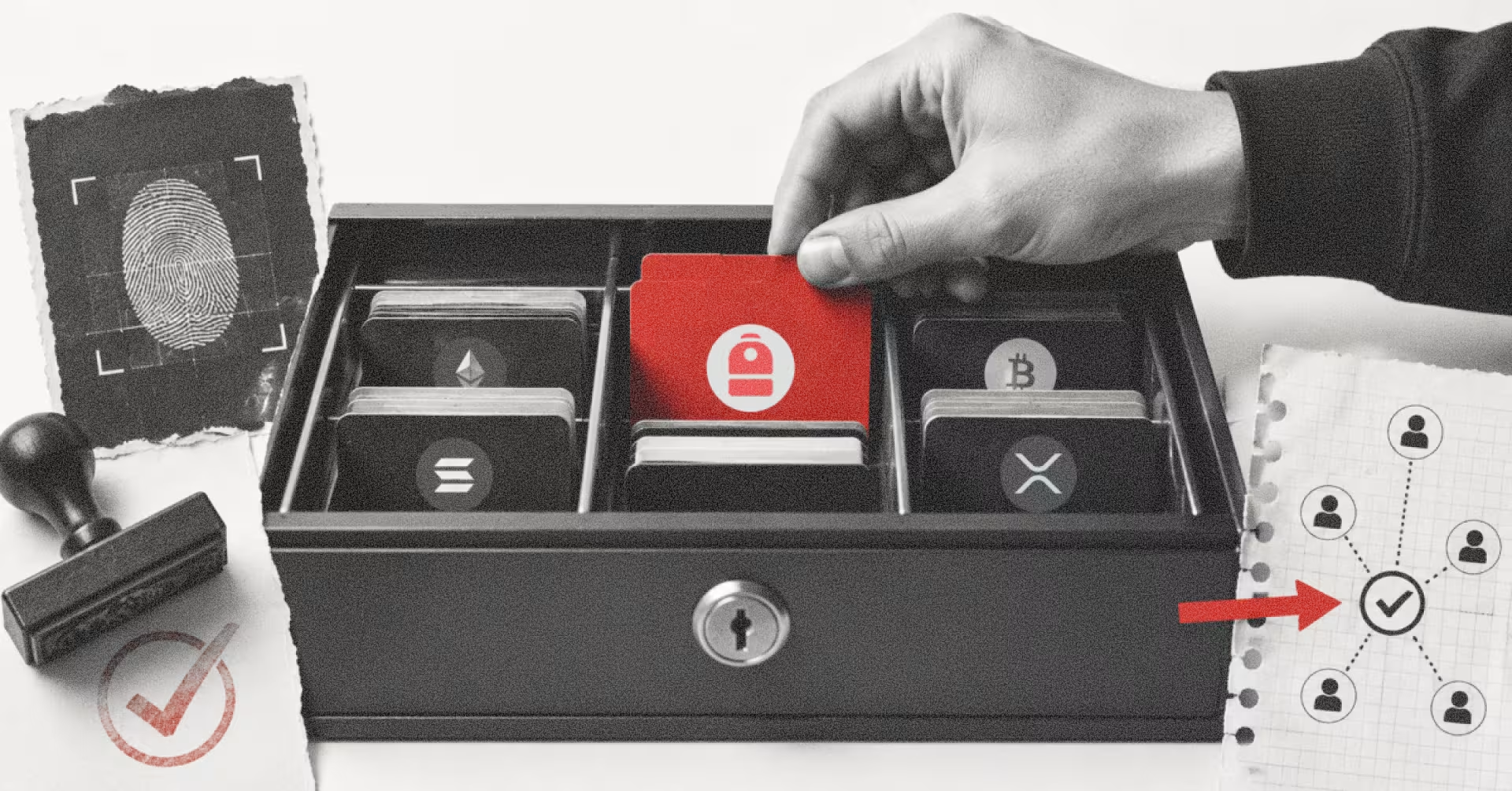
Backpack Exchange publishes daily proof of reserves, holds regulatory licenses across multiple jurisdictions, and segregates user assets from platform funds. Every claim on this page can be independently verified.
When you deposit assets into an exchange, are the numbers shown in your account actually backed by assets being held somewhere, or are they merely records in a database? This is a question worth asking seriously.
Backpack's answer is a verifiable mechanism, not a statement
What is asset security in a crypto exchange?
The security of crypto assets comes down to transparency. The numbers in a user's account have to match what the platform actually holds. Regulators have to be able to constrain how the platform operates. And the system has to hold up when markets are at their most volatile.
Backpack Exchange provides externally verifiable answers across all three layers.
Key Facts
- Backpack Exchange publishes proof of reserves daily, independently verified by OtterSec, a blockchain security firm. The industry standard is monthly.
- Any user can verify their balance against onchain assets at backpack.exchange/reserves.
- Backpack Exchange holds a Dubai VARA license, an EU CySEC MiFID II license, and is registered as a Money Services Business with FinCEN in the U.S.
- Backpack Exchange is a member of the DTCC Industry Working Group, alongside BlackRock, Goldman Sachs, Charles Schwab, and Citadel Securities.
- User assets are segregated from platform assets, subject to requirements across multiple regulatory frameworks.
- The matching engine and risk systems were designed for high-volatility market conditions from the ground up.
Proof of Reserves: What You See Is What Exists Onchain
Backpack Exchange publishes proof of reserves every day, independently verified by OtterSec, a blockchain security firm. Most exchanges publish monthly. Backpack publishes daily, with internal reconciliation running every 10 minutes.
The system uses zero-knowledge proofs to confirm that total user balances match the platform's actual onchain holdings, without exposing individual account details. Coverage includes spot balances, margin positions, and unrealized PnL.
Anyone can view the latest verification at backpack.exchange/reserves and confirm their account is included.
Regulatory Licenses: Which Jurisdictions Oversee Backpack Exchange
Backpack Exchange holds regulatory standing across multiple jurisdictions, including:
- Dubai VARA. Exchange Services License (VL/23/07/001), issued by the Dubai Virtual Assets Regulatory Authority, authorizing virtual asset trading services in the UAE.
- EU CySEC MiFID II. License issued by the Cyprus Securities and Exchange Commission, covering compliant derivatives services across the European Union.
- U.S. FinCEN. Registered with the U.S. Treasury's Financial Crimes Enforcement Network as a Money Services Business, with licenses held in multiple U.S. states.
These requirements govern how the platform operates, how funds are handled, and how user assets must be segregated, all subject to periodic regulatory review.
Backpack Exchange is also a member of the DTCC Industry Working Group, alongside BlackRock, Goldman Sachs, Charles Schwab, and Citadel Securities, contributing to the development of U.S. equity tokenization infrastructure. DTCC is the central clearing institution for U.S. securities markets. Membership in this working group represents a form of institutional-level trust recognition that goes beyond regulatory compliance.
System Stability: How Backpack Exchange Handles Market Volatility
Security also includes how a system performs under pressure. An exchange that holds assets correctly but fails during a liquidation event is not fully protecting its users.
Crypto markets are characterized by concentrated volatility and sudden stress events. The moment a trader most needs to exit or add to a position is often the most chaotic. Backpack Exchange's matching engine and risk management systems were designed from the start for these conditions, with the goal of keeping the liquidation mechanism functional under high load.
Three Dimensions, One Complete Picture
No single mechanism fully accounts for exchange security.
Proof of reserves answers whether assets genuinely exist. Regulatory licenses answer whether the platform operates under external constraints. System architecture answers whether it holds up under pressure. Each addresses a distinct failure mode.
Backpack Exchange has built verifiable mechanisms across all three. Users can check any of them at any time
Learn more about Backpack
Exchange | Wallet | Twitter | Discord | Reddit
Disclaimer: This content is presented to you on an “as is” basis for general information and educational purposes only, without representation or warranty of any kind. It should not be construed as financial, legal or other professional advice, nor is it intended to recommend the purchase of any specific product or service. You should seek your own advice from appropriate professional advisors. Where the article is contributed by a third party contributor, please note that those views expressed belong to the third party contributor, and do not necessarily reflect those of Backpack. Please read our full disclaimer for further details. Digital asset prices can be volatile. The value of your investment may go down or up and you may not get back the amount invested. You are solely responsible for your investment decisions and Backpack is not liable for any losses you may incur. This material should not be construed as financial, legal or other professional advice.