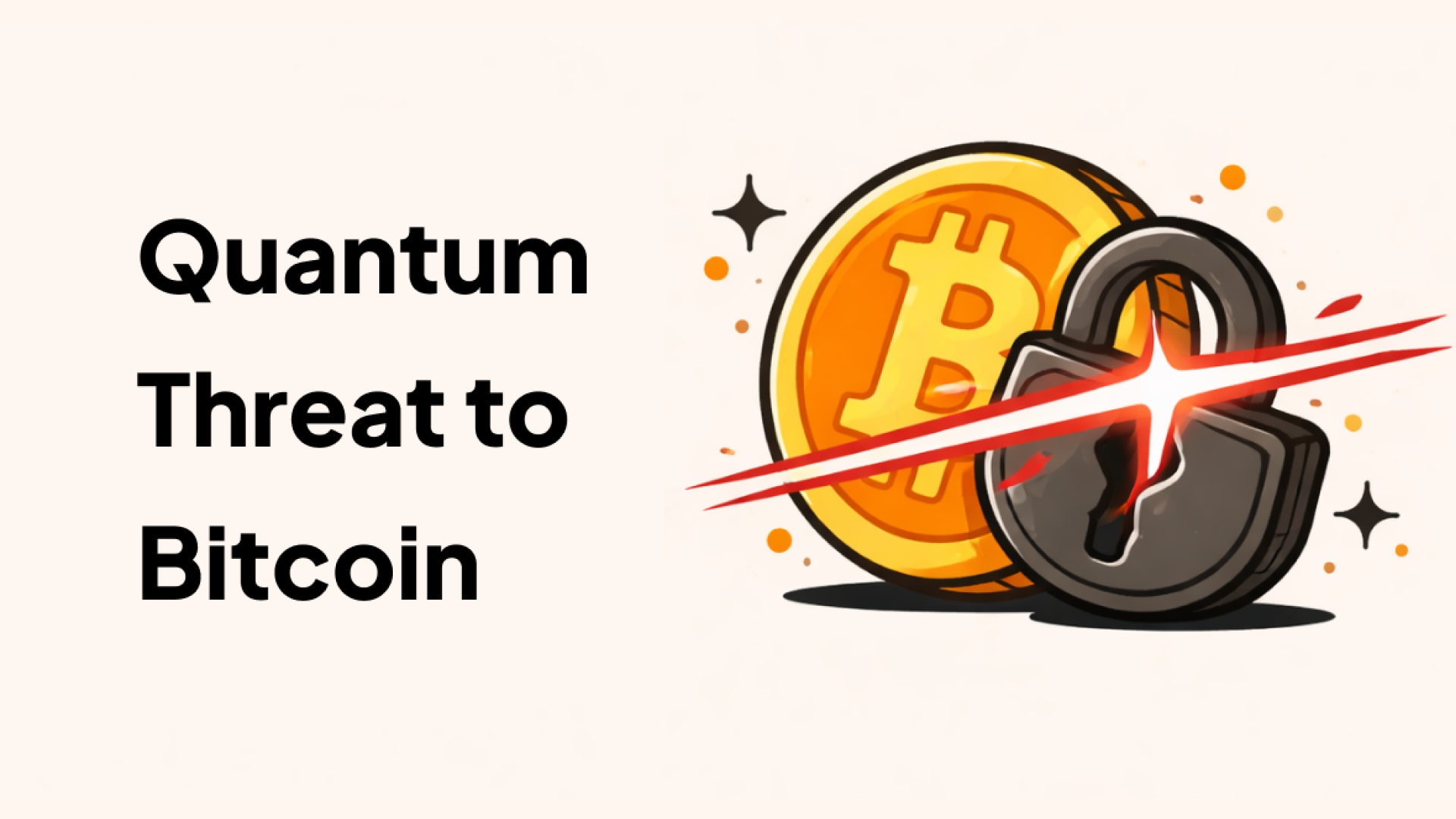
In February 2026, quantum computing emerged as one of the most discussed risk factors in the Bitcoin market. On-chain analyst Willy Woo argued that rising quantum awareness is already suppressing Bitcoin's valuation relative to gold. Jefferies strategist Christopher Wood cut Bitcoin from his model portfolio entirely, rotating into gold instead.
But what is the actual threat? How close is it? And what can be done about it?
The Core Vulnerability
Bitcoin's security relies on elliptic curve cryptography (specifically ECDSA over the secp256k1 curve). This is the mathematical system that links public keys to private keys — and makes it computationally infeasible for anyone with a public key to derive the corresponding private key.
A classical computer would require trillions of years to brute-force a Bitcoin private key from its public key. But a sufficiently powerful quantum computer running Shor's algorithm could theoretically perform this calculation in a much shorter timeframe.
This hypothetical breakthrough is referred to as "Q-Day" — the point at which quantum computers become powerful enough to break current public-key cryptography.
The 4 Million BTC Problem
The most discussed risk isn't that active Bitcoin users would be immediately compromised. It's about the estimated 4 million BTC that are considered "lost" — coins whose private keys are presumed permanently inaccessible.
These 4 million coins make up approximately 25–30% of Bitcoin's total supply. Their public keys are visible on-chain, which means they would be the first targets if quantum computing advances to the point where private keys can be derived from public keys.
If those coins re-entered circulation, it would undermine one of Bitcoin's core value propositions: its fixed supply cap of 21 million. As Willy Woo noted, this 4 million BTC supply overhang is equivalent to roughly eight years of corporate accumulation — since 2020, corporations and ETFs have collectively accumulated approximately 2.8 million BTC.
Is This Already Being Priced In?
According to Woo, yes. He argued in February 2026 that Bitcoin's 12-year uptrend relative to gold has broken, and that rising quantum awareness is a key factor.
"BTC should be valued a LOT HIGHER relative to gold. Should be. IT'S NOT. The valuation trend broke down once QUANTUM came into awareness," Woo wrote on X.
Charles Edwards, founder of Capriole Investments, provided supporting data: Google search interest for "Quantum Computing Bitcoin" peaked simultaneously with Bitcoin's October 2025 price high, suggesting that quantum risk evaluation contributed to the subsequent sell-off.
Woo estimates Q-Day is still 5 to 15 years away, but emphasized that markets price in tail risks well before they materialize.
Could Bitcoin Freeze the Lost Coins?
One proposed solution is for the Bitcoin network to implement a hard fork that freezes coins associated with exposed public keys before quantum computers can access them.
Woo estimates a 25% probability that the network would agree to such a freeze. The remaining 75% probability is that the coins would eventually be released into circulation, creating structural sell pressure.
A freeze would be deeply controversial. It would require the Bitcoin community to override the principle that valid private keys should always grant access to funds — a foundational rule of the protocol. This would likely provoke a sharp divide between proponents of backward-compatible solutions and those willing to rewrite network rules to protect the supply cap.
What Is the Bitcoin Community Doing?
Developers have emphasized that there is no emergency. A phased roadmap for post-quantum migration is being developed, including proposals like BIP-360, which addresses quantum-resistant key formats.
Michael Saylor announced a Bitcoin security program focused on quantum threats in early February 2026. The broader blockchain community has also been discussing the topic more actively, including at the Quantum Bitcoin Summit and the LONGITUDE Hong Kong 2026 conference.
The general developer consensus is that Bitcoin can transition to quantum-resistant cryptography well before Q-Day arrives, but the transition requires coordination and lead time.
How Close Are We to Q-Day?
Current quantum computers are not close to breaking Bitcoin's cryptography. The most advanced quantum systems have fewer than 2,000 qubits, while estimates suggest that cracking Bitcoin's elliptic curve would require millions of stable, error-corrected qubits.
Most experts place a credible Q-Day timeline at 5–15 years, with significant uncertainty. The threat is not imminent, but it is also not purely theoretical — it sits in a risk category that institutional investors are increasingly monitoring.
What Does This Mean for Investors?
Quantum computing is not an immediate operational risk to Bitcoin holders. Your funds are not in danger today.
However, it is becoming a valuation risk — a factor that influences how institutional investors compare Bitcoin to alternative stores of value like gold. Gold has no cryptographic attack surface, which gives it a structural advantage on this specific dimension.
Key takeaways:
- The threat is real but distant (5–15 year horizon)
- Markets are already partially pricing it in as a structural discount
- Bitcoin's developer community is actively working on post-quantum solutions
- The biggest open question is whether the network would freeze ~4 million lost coins through a hard fork
- This is a risk to monitor, not a reason to panic
Conclusion
Quantum computing represents one of the few existential-level risks to Bitcoin's long-term security model. While the technology is not yet capable of threatening the network, the growing awareness of this risk is already influencing market behavior and institutional positioning.
For Bitcoin to maintain its long-term store-of-value narrative, the community will need to demonstrate a credible, coordinated transition to quantum-resistant cryptography well before the threat materializes. The window to prepare is measured in years, not months — and the clock is running.
Learn more about Backpack
Exchange | Wallet | Twitter | Discord | Reddit
Disclaimer: This content is presented to you on an “as is” basis for general information and educational purposes only, without representation or warranty of any kind. It should not be construed as financial, legal or other professional advice, nor is it intended to recommend the purchase of any specific product or service. You should seek your own advice from appropriate professional advisors. Where the article is contributed by a third party contributor, please note that those views expressed belong to the third party contributor, and do not necessarily reflect those of Backpack. Please read our full disclaimer for further details. Digital asset prices can be volatile. The value of your investment may go down or up and you may not get back the amount invested. You are solely responsible for your investment decisions and Backpack is not liable for any losses you may incur. This material should not be construed as financial, legal or other professional advice.