Solana is preparing for the most significant upgrade in its history. Alpenglow is a complete overhaul of the blockchain's consensus architecture, replacing both Proof of History (PoH) and Tower BFT with two new protocol components designed to reduce transaction finality from approximately 12.8 seconds to 100–150 milliseconds, a roughly 100x improvement.
The upgrade was approved by community governance vote in September 2025 with 98.27% voting in favor and approximately 52% of staked tokens participating. Mainnet deployment is expected in early to mid-2026.
Here's what's changing, how it works, and what it means for the Solana ecosystem.
Why Does Solana Need This Upgrade?
Solana has always been built around speed. But its current consensus mechanism has limitations that Alpenglow is designed to address:
Slow deterministic finality. While users typically see 2–3 second confirmations through optimistic developer settings, true finality when transactions become irreversible and takes approximately 12.8 seconds under the current Tower BFT system.
On-chain vote overhead. Solana's current model requires validators to publish their votes on-chain. This creates operational cost for validators and bloats the ledger with vote transactions, which account for a significant portion of Solana's total transaction volume.
Variable block propagation. The existing Turbine gossip network relies on multi-hop relays with variable latency, creating unpredictable delays in block distribution among validators.
What Is Alpenglow?
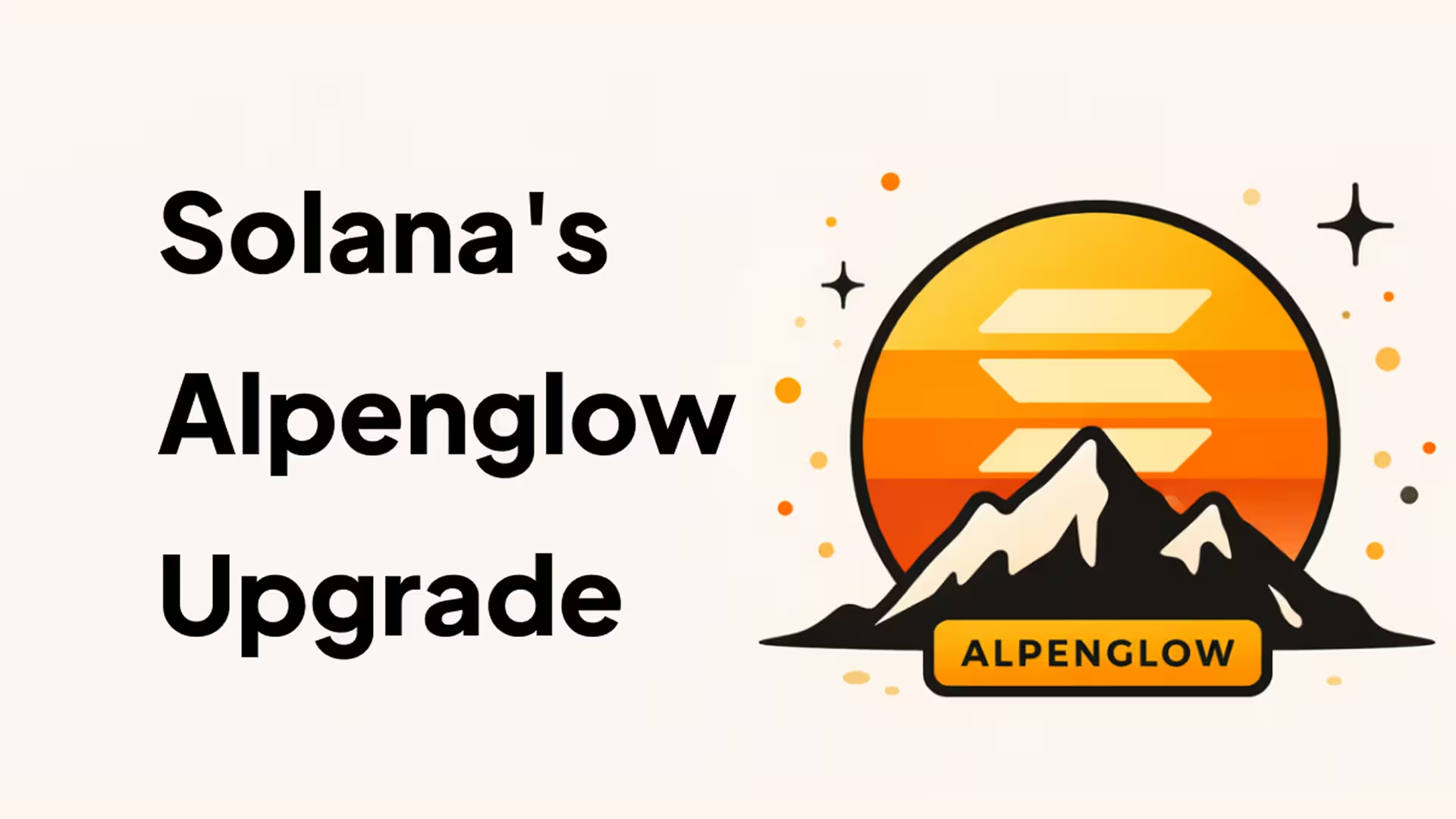
Alpenglow is a consensus architecture upgrade developed by Anza, an engineering team spun off from Solana Labs. The name comes from the German word "Alpenglühen," referring to the light that appears on mountain peaks at sunrise and sunset , symbolizing both an ending and a beginning for Solana's technical identity.
The upgrade introduces two core components: Votor and Rotor.
Votor: The New Consensus Protocol
Votor replaces Tower BFT's incremental voting system with a lightweight vote aggregation model. The key changes:
Off-chain voting. Validators sign vote certificates using BLS signatures and distribute them off-chain, rather than publishing votes on-chain. This eliminates a major source of ledger bloat and reduces validator operating costs.
Dual-path finality. Votor achieves finality through two parallel paths that run simultaneously:
- Fast path: When a proposed block receives over 80% of total staked weight support in the first round, it triggers immediate finalization, approximately 100 milliseconds
- Slow path: If first-round support is between 60% and 80%, a second voting round is triggered, requiring over 60% to achieve finality, approximately 150 milliseconds
The network takes whichever path reaches consensus first. This means blocks finalize in one to two rounds maximum, compared to the multi-round incremental process under Tower BFT.
No more epochs or tower lockouts. Votor eliminates the epoch system and tower lockouts, removing the risks of slashing due to missed or skipped slots and enabling continuous, uninterrupted consensus.
Rotor: The New Data Propagation Layer
Rotor restructures how block data is distributed across the network, replacing the existing Turbine propagation system.
Stake-weighted relay paths. Instead of multi-hop relays with variable latency, Rotor introduces deterministic relay assignments based on validator stake. Validators with high stake and reliable bandwidth serve as core relay points, prioritizing bandwidth efficiency.
Erasure coding. Rotor uses erasure coding to divide block data into fragments shared among validators. This ensures block data can be reconstructed even when some nodes fail or miss parts of the transmission.
Speed: Simulations show that under typical bandwidth conditions, block propagation can be completed in as little as 18 milliseconds, dramatically faster than the existing Turbine system.
What Gets Replaced?
Alpenglow replaces two of Solana's original defining technologies:
- Proof of History (PoH): The timestamping mechanism that was central to Solana's original whitepaper and identity. PoH is removed from the consensus process under Alpenglow.
- Tower BFT: The Byzantine Fault Tolerance consensus mechanism that used PoH's timing proofs to enforce vote lockout periods. Replaced entirely by Votor.
- Turbine: The block propagation network. Replaced by Rotor.
This is a significant departure from Solana's founding architecture. The fact that the community voted overwhelmingly in favor reflects confidence that the performance gains justify the change.
Who Benefits?
Users: Near-instant transaction confirmations mean decentralized applications can function with the responsiveness typically associated with centralized services. For traders, this means faster settlement and reduced slippage risk.
Developers: Faster finality unlocks new application categories, real-time gaming, high-frequency DeFi, and payment systems that rival traditional finance in speed.
Validators: Off-chain voting reduces the complexity and cost of participation. Validators no longer need to pay for on-chain vote transactions, and the simplified consensus reduces operational overhead.
The broader ecosystem: Increased block speed means greater total capacity on-chain, which could further reduce transaction fees while generating more fee revenue for validators.
Competitive Implications
If Alpenglow delivers on its targets, Solana's finality would be faster than virtually every competing Layer 1 blockchain:
- Ethereum: ~12 minutes (full finality)
- Avalanche: ~1–2 seconds
- Cosmos chains: ~6–7 seconds
- Solana (current): ~12.8 seconds
- Solana (Alpenglow): ~100–150 milliseconds
This puts Solana in a position to compete not just with other blockchains, but with centralized exchanges and traditional payment rails on execution speed.
Timeline
- May 2025: Alpenglow unveiled by Anza
- August 2025: SIMD-0326 proposal published on Solana developer forums
- September 2025: Governance vote passed (98.27% in favor)
- Late 2025: Testnet deployment
- Early–Mid 2026: Expected mainnet rollout (gradual)
Risks and Open Questions
- Implementation complexity: Replacing core consensus components is one of the most difficult upgrades a blockchain can undertake. Bugs or edge cases could delay the rollout.
- Centralization concerns: Stake-weighted relay paths in Rotor could disproportionately benefit large validators, potentially increasing centralization pressures.
- Migration risk: The transition from PoH/Tower BFT to Votor/Rotor must be seamless. Any disruption during the upgrade could affect user confidence and network stability.
Conclusion
Alpenglow represents a bold bet by the Solana community: replace the blockchain's founding technologies in pursuit of performance that no other decentralized network currently offers. If successful, 100–150ms finality would make Solana the fastest major blockchain by a significant margin and open the door to application categories that were previously impractical on-chain.
For traders, developers, and ecosystem participants, this is the most important Solana upgrade to track in 2026.
Learn more about Backpack
Exchange | Wallet | Twitter | Discord | Reddit
Disclaimer: This content is presented to you on an “as is” basis for general information and educational purposes only, without representation or warranty of any kind. It should not be construed as financial, legal or other professional advice, nor is it intended to recommend the purchase of any specific product or service. You should seek your own advice from appropriate professional advisors. Where the article is contributed by a third party contributor, please note that those views expressed belong to the third party contributor, and do not necessarily reflect those of Backpack. Please read our full disclaimer for further details. Digital asset prices can be volatile. The value of your investment may go down or up and you may not get back the amount invested. You are solely responsible for your investment decisions and Backpack is not liable for any losses you may incur. This material should not be construed as financial, legal or other professional advice.