Key Takeaways
- A stock portfolio tracker aggregates holdings from one or more accounts and shows current value, cost basis, gains and losses, and asset allocation in a single view.
- The three main types are manual spreadsheets, standalone tracking apps that sync via account connections, and trackers built directly into a brokerage or trading platform.
- The US Securities and Exchange Commission's investor education office notes that portfolio analysis helps investors check diversification and decide whether to rebalance, which many professionals suggest reviewing every six to twelve months.
- Some platforms also let you follow institutional portfolios disclosed in quarterly SEC Form 13F filings, not just your own holdings.
What Is a Stock Portfolio Tracker?
A stock portfolio tracker is a tool that consolidates all of your investment holdings in one place and monitors their value, performance, and allocation over time. Trackers range from simple spreadsheets to dedicated apps and broker-integrated dashboards. Investors use them to see total returns across accounts, spot concentration risk, and decide when to rebalance, rather than checking each brokerage or exchange separately.
What does a stock portfolio tracker do?
A stock portfolio tracker records the stocks and ETFs you own, updates their market prices, and calculates portfolio-level metrics from that data. Core outputs typically include total portfolio value, unrealized and realized gains and losses against your cost basis, dividend income, and the percentage weight of each position and sector.
The practical value is aggregation. An investor holding stocks at one broker, ETFs at another, and crypto on an exchange has no single native view of their wealth. A tracker rebuilds that view, either manually (you enter each trade) or automatically (the tool syncs with your accounts or the platform already holds your assets).
Why should investors track their portfolio?
Tracking exists to answer two questions: how am I performing, and is my risk still where I want it to be. According to the SEC's Office of Investor Education, market movements can push holdings out of alignment with your goals. A portfolio that started at 60% stocks can drift to 80% after a rally, changing your risk level without a single new trade. The SEC's guidance also notes that many financial experts recommend reviewing and rebalancing at a regular interval, such as every six or twelve months.
Without a tracker, this drift is invisible. With one, rebalancing becomes a data-driven decision: you can see exact weights, compare them to your target allocation, and act on the gap.
What types of portfolio trackers exist?
There are three broad categories, and the right one depends on how many accounts you hold and how much manual work you accept.
Built-in trackers have one structural advantage: the data is first-party. There is no sync lag, no broken account connection, and no manual entry, because the platform that executes your trades is the same one displaying your positions.
Can you track other investors' portfolios?
Yes, for large institutional investors in US equities. Under SEC rules dating to 1975, institutional investment managers with at least $100 million in US equity assets must disclose their long positions quarterly on Form 13F, filed within 45 days of each quarter's end. This makes the holdings of firms like Berkshire Hathaway public data that anyone can follow.
Some trading platforms now turn these filings into a tracking feature. Backpack, for example, offers Popular Portfolios, which tracks 36 institutional portfolios from 13F filings and shows each position's portfolio weight and quarter-over-quarter change. The 45-day filing lag applies to all 13F-based tools, so these portfolios show where institutions were positioned at quarter-end, not where they are today.
Common misconceptions about portfolio trackers
A tracker improves your returns. It does not. A tracker is a measurement tool. It can surface problems like concentration or drift, but the returns come from your allocation and the assets themselves.
Portfolio tracking is only for active traders. The opposite is closer to true. Long-term investors arguably benefit most, because allocation drift compounds silently over years, and the SEC's rebalancing guidance is aimed at exactly this group.
13F-based portfolio tracking shows real-time institutional trades. It cannot. Form 13F discloses quarter-end long positions up to 45 days after the quarter closes, and it excludes short positions entirely.
You need a paid app to track properly. Many brokerages and exchanges include full position tracking natively, and a spreadsheet covers the basics for a single-account portfolio.
What should you look for in a stock portfolio tracker?
Evaluate a tracker on five criteria:
- Coverage of your actual assets. If you hold both equities and crypto, a stocks-only tracker leaves half your portfolio invisible. Fewer investors' portfolios fit inside a single asset class than tracker designs assume.
- Data accuracy and freshness. First-party data from the platform holding your assets is the gold standard; synced third-party connections can lag or break.
- Cost basis and P&L logic. The tracker should handle deposits, withdrawals, and dividends correctly, or your return figures will be wrong.
- Allocation and weight views. Percentage weights per position and per asset class are what make rebalancing decisions possible.
- Research context. Features like institutional portfolio data give you reference points beyond your own holdings.
How Backpack combines portfolio tracking with trading
Backpack approaches the problem from the other direction: instead of stitching together fragmented accounts, it removes the fragmentation. Through Backpack Securities, real US-listed stocks and ETFs trade from the same account as crypto, held as security entitlements, so both sit in a single portfolio with no separate brokerage login.
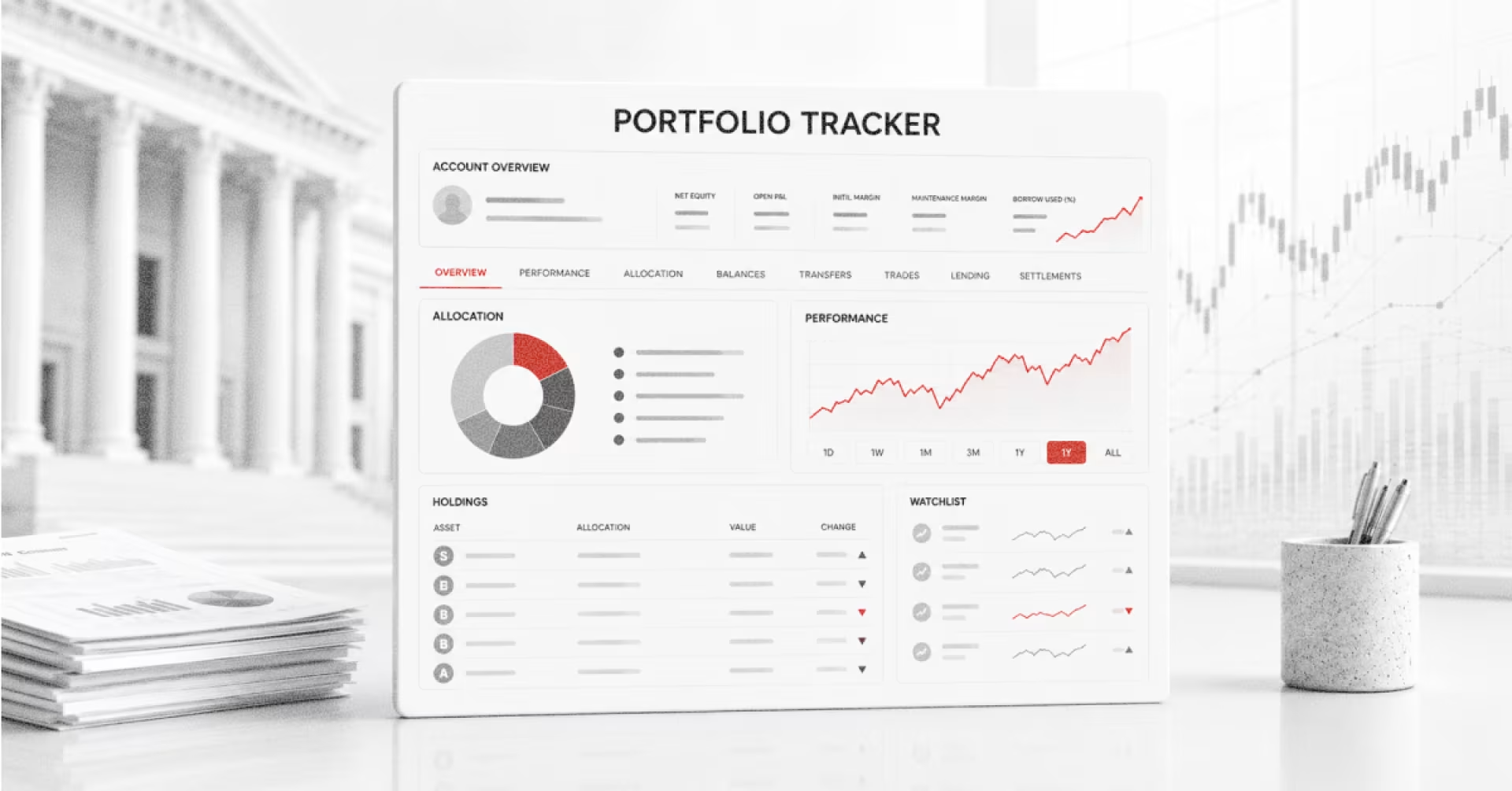
The platform covers the core functions of a dedicated tracker natively:
- Account overview with net equity and open PnL updated in real time.
- Performance and allocation tabs showing returns over time and how capital is distributed.
- Balance filters that separate crypto and stock holdings, or display them together as one portfolio.
- Watchlist for following stocks before buying, so research and portfolio monitoring sit in the same interface.
- Statements for tax and record-keeping purposes.
- Subaccounts that let investors track separate strategies or goals independently, each with its own balance and history.
Where select assets trade beyond regular market hours, portfolio values update accordingly rather than freezing at the closing bell. For research context, the Popular Portfolios feature adds 13F-based tracking of 36+ institutional portfolios alongside your own holdings. For assets held on the platform, there is nothing to sync, import, or reconcile. The platform is the tracker.
Learn more about Backpack
Exchange | Wallet | Twitter | Discord | Reddit
Disclaimer: This content is presented to you on an “as is” basis for general information and educational purposes only, without representation or warranty of any kind. It should not be construed as financial, legal or other professional advice, nor is it intended to recommend the purchase of any specific product or service. You should seek your own advice from appropriate professional advisors. Where the article is contributed by a third party contributor, please note that those views expressed belong to the third party contributor, and do not necessarily reflect those of Backpack. Please read our full disclaimer for further details. Digital asset prices can be volatile. The value of your investment may go down or up and you may not get back the amount invested. You are solely responsible for your investment decisions and Backpack is not liable for any losses you may incur. This material should not be construed as financial, legal or other professional advice.