
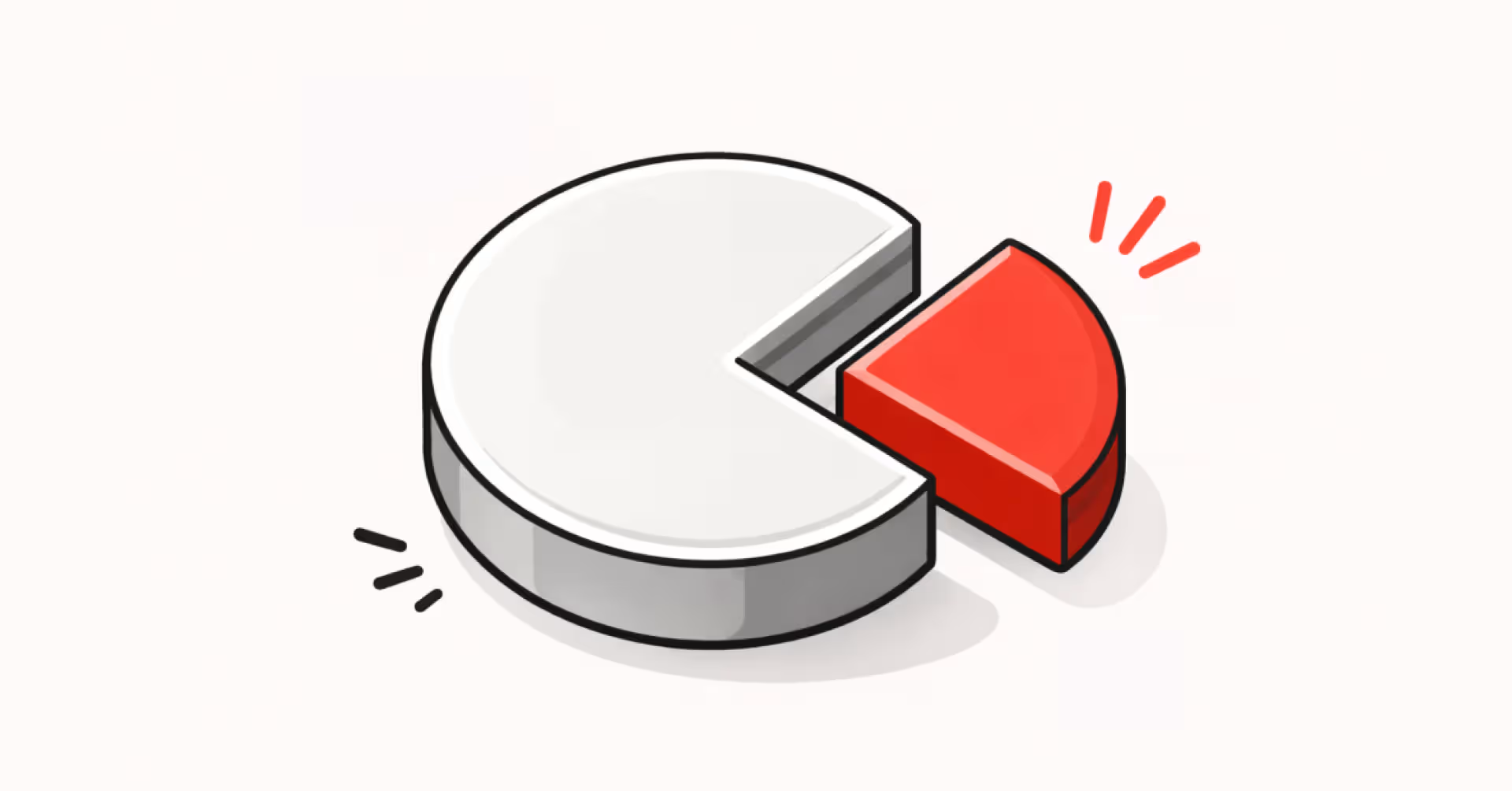
Quick Answer: A fractional share is a portion of a full share of a stock or ETF. Instead of buying a whole share at its full price, you invest a specific dollar amount and receive the equivalent fraction. Returns, price movements, and dividends are all proportional to the fraction you own.
Most people assume you need hundreds, or even thousands, of dollars to start investing in stocks like Apple, Amazon, or Tesla. That assumption used to be true. Today, fractional shares have changed how investing works. You no longer need to buy a full share to participate in the market. Instead, you can invest any amount and own a proportional slice of a company.
But while fractional shares make investing more accessible, they come with trade-offs that are often overlooked.
Key Takeaways
- A fractional share is a portion of one full share of a stock or ETF
- You invest by dollar amount, not by share count, and the platform converts that into the corresponding fraction
- Returns, price movements, and dividends all scale proportionally with the fraction you hold
- Fractional shares can also arise from stock splits, mergers, and dividend reinvestment plans
- Voting rights for fractional shareholders vary by broker and may not apply at all
- Fractional shares are typically non-transferable between brokers and must be sold before moving accounts
- Stock trading, including fractional shares, remains limited to exchange hours, unlike crypto markets
What Is a Fractional Share?
A fractional share is any quantity of stock that is less than one full share.
When you invest a dollar amount that is less than the price of a full share, you receive the proportional fraction that amount represents. That fraction behaves exactly like a full share. It rises and falls with the stock price, and it earns dividends if the underlying company pays them.
For example:
Stock price: $1,000 Your investment: $100 → You own 0.1 shares
If the stock rises 10%, your 0.1 holding rises 10%. If it falls 10%, your holding falls 10%. The math is proportional in both directions. The concept applies equally to exchange-traded funds. A fractional share of an index fund or ETF works the same way.
How Do Fractional Shares Work?
Fractional shares are offered through broker platforms that support dollar-based investing.
Instead of entering how many shares you want, you choose how much money to invest. The platform converts that amount into a fractional quantity based on the current market price. Behind the scenes, the broker holds full shares in custody and records your ownership as a fraction of those shares. Fractional shares are not directly traded on the exchange. They exist within the platform's internal accounting system. This has real consequences for transferability and execution, which are covered below.
How Are Fractional Shares Created?
Fractional shares arise in two distinct ways.
Broker-enabled fractional trading is the most common method. The broker purchases whole shares on the exchange, divides them internally, and allows customers to buy and sell fractions by dollar amount. Your ownership is recorded within the platform's internal accounting system. Fractional shares are not traded directly on the exchange.
Corporate events can also produce fractions as a side effect, including stock splits, mergers and acquisitions, and dividend reinvestment plans (DRIPs) that automatically reinvest cash dividends into additional shares.
Do Fractional Shares Pay Dividends?
Yes. If the underlying stock pays dividends, fractional shareholders receive a proportional payment.
Dividend per share: $2.00 Your holding: 0.3 shares → You receive $0.60
Dividends are typically paid as cash into the brokerage account, though some platforms allow automatic reinvestment into additional fractional shares. One exception: if the fractional holding is small enough that the dividend entitlement falls below the broker's minimum payment threshold, the payment may not be credited at all. This is a platform-specific policy and varies by broker.
Benefits of Fractional Shares
Lower barrier to entry. High-priced stocks become reachable for any investor regardless of account size, including investors outside the US accessing American markets for the first time.
Full capital deployment. Every dollar goes to work. Without fractional shares, the gap between your balance and the share price sits idle as uninvested cash.
Easier diversification. You can spread capital across multiple companies regardless of their individual share prices.
More consistent dollar-cost averaging. A fixed regular contribution is fully invested each time, rather than accumulating unused cash between purchases.
Limitations of Fractional Shares
Non-transferability. Fractional positions are typically not transferable between brokers. Moving accounts usually requires selling fractional shares first, which may trigger a taxable event.
Voting rights may not apply. Some platforms aggregate fractional share votes and submit them through proxy voting at the broker level. Others do not extend voting rights to fractional holders at all.
Restricted to market hours. Unlike crypto markets, stock markets operate on fixed hours: 09:30 to 16:00 Eastern Time on weekdays. Fractional share trading follows the same schedule.
Fractional Shares vs Full Shares
Fractional Shares in Simple Terms
- You invest a dollar amount instead of buying a full share
- You receive a proportional fraction of a stock or ETF at the current market price
- Returns and dividends scale with the fraction you own
- Transfers and voting rights depend entirely on the platform
- Trading is still limited to traditional market hours, unlike crypto
Conclusion
Fractional shares removed one of investing's oldest barriers: the price of a single share. They allow anyone to start building a portfolio without needing large amounts of capital, and they make diversification easier from day one. Understanding their limitations, particularly around transferability, voting rights, and trading hours, is what separates investors who use the feature confidently from those who discover the fine print later.
Learn more about Backpack
Exchange | Wallet | Twitter | Discord | Reddit
Disclaimer: This content is presented to you on an “as is” basis for general information and educational purposes only, without representation or warranty of any kind. It should not be construed as financial, legal or other professional advice, nor is it intended to recommend the purchase of any specific product or service. You should seek your own advice from appropriate professional advisors. Where the article is contributed by a third party contributor, please note that those views expressed belong to the third party contributor, and do not necessarily reflect those of Backpack. Please read our full disclaimer for further details. Digital asset prices can be volatile. The value of your investment may go down or up and you may not get back the amount invested. You are solely responsible for your investment decisions and Backpack is not liable for any losses you may incur. This material should not be construed as financial, legal or other professional advice.
.png)
