Real-world assets — commonly referred to as RWAs — are one of the most discussed narratives in crypto heading into 2026. The concept is straightforward: take assets that exist in the traditional financial world and represent them as tokens on a blockchain.
This article explains what RWAs are, why they matter, and what the current state of tokenization looks like.
What Are RWAs?
RWAs are tokens that represent ownership or claims on assets outside the blockchain. These assets can include:
- Government bonds: Tokenized U.S. Treasuries have been one of the fastest-growing RWA categories, allowing on-chain holders to earn yield from government debt
- Real estate: Fractional ownership of properties, represented as tokens that can be traded or used as collateral
- Commodities: Gold, silver, oil, and other physical commodities represented on-chain
- Private credit: Loans and debt instruments tokenized for broader access and transparency
- Equities: Tokenized representations of stocks and shares
- Art and collectibles: Fractional ownership of high-value physical items
The common thread is that each token is backed by — or represents a claim on — something that exists in the physical or traditional financial world.
How Does Tokenization Work?
Tokenization is the process of creating a digital token on a blockchain that represents a real-world asset. The process typically involves:
1. Asset selection and valuation. The underlying asset is identified and valued — for example, a portfolio of U.S. Treasury bills worth $100 million.
2. Legal structuring. A legal entity (often a special purpose vehicle or SPV) holds the underlying asset. The tokens issued on-chain represent shares or claims on this entity's holdings.
3. Token issuance. Smart contracts on a blockchain mint tokens that correspond to the underlying asset. Each token represents a specific fraction of ownership or a specific claim.
4. Compliance and access controls. Most RWA tokens include compliance features such as KYC/AML requirements, transfer restrictions, and jurisdiction-based access controls. This distinguishes them from most DeFi tokens, which are typically permissionless.
5. Redemption. Token holders can typically redeem their tokens for the underlying asset or its cash equivalent, depending on the terms of the issuance.
Why Do RWAs Matter?
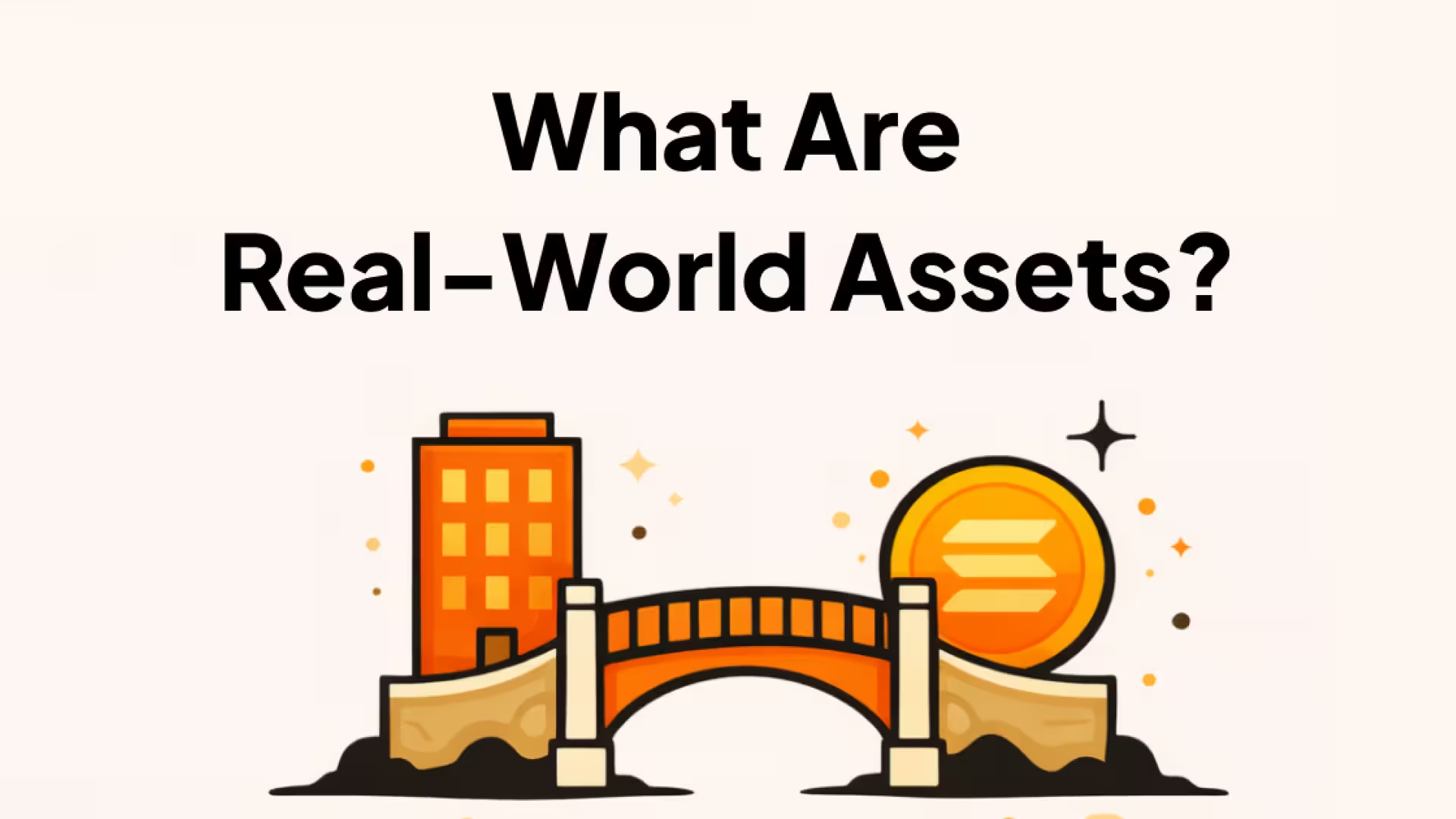
The RWA narrative is significant because it represents a bridge between traditional finance (TradFi) and decentralized finance (DeFi).
Access. Tokenization can make previously illiquid or high-minimum-investment assets accessible to a broader range of investors. Instead of needing $100,000 to invest in a bond fund, you might be able to buy $100 worth of tokenized Treasuries.
24/7 markets. Traditional financial markets operate on limited hours with settlement delays. Tokenized assets on a blockchain can trade around the clock with near-instant settlement.
Composability. On-chain RWAs can interact with DeFi protocols. For example, tokenized Treasuries can be used as collateral in lending protocols, or tokenized real estate can be used in structured products — all executed through smart contracts.
Transparency. Blockchain-based ownership records are publicly verifiable, reducing the opacity that characterizes many traditional asset classes.
Efficiency. Removing intermediaries and automating processes through smart contracts can reduce costs associated with issuance, custody, transfer, and settlement.
Current State of the RWA Market
As of early 2026, the RWA sector has been one of the best-performing narratives in crypto, even during broader market weakness. Several factors are driving this:
Institutional participation. Major financial institutions including BlackRock, Franklin Templeton, and JPMorgan have launched or expanded tokenized asset programs. BlackRock's BUIDL fund (tokenized Treasuries on Ethereum) has been one of the most prominent examples.
Yield in a high-rate environment. With interest rates elevated, tokenized Treasuries and other yield-bearing RWAs offer attractive returns that pure crypto assets generally cannot match. This has drawn capital from DeFi protocols into RWA products.
Regulatory clarity. The GENIUS Act (passed in 2025) and broader regulatory developments have provided clearer frameworks for tokenized securities, reducing uncertainty for issuers and investors.
Narrative rotation. During periods of market weakness, capital tends to rotate from speculative assets (like memecoins) into fundamentals-driven narratives. RWAs, backed by real yield and institutional adoption, have been a primary beneficiary of this rotation in early 2026.
Key Categories of RWAs
Tokenized Treasuries. The largest RWA category by assets under management. Products from BlackRock (BUIDL), Franklin Templeton, Ondo Finance, and others offer on-chain exposure to U.S. government debt with daily yield accrual.
Private credit. Protocols like Maple Finance and Centrifuge connect on-chain lenders with real-world borrowers, offering higher yields than Treasury products but with corresponding credit risk.
Tokenized real estate. Platforms offering fractional ownership of properties, though this category is still relatively early due to legal complexity and jurisdictional variation.
Commodities. Gold-backed tokens like PAXG and XAUT have been established for several years and serve as on-chain alternatives to physical gold exposure.
Tokenized equities. Representations of traditional stocks on blockchain, allowing 24/7 trading and fractional ownership. This category is growing but faces the most complex regulatory environment.
Risks and Limitations
RWAs are not without challenges:
- Counterparty risk: Unlike purely on-chain assets, RWAs depend on a custodian or issuer to hold the underlying asset. If the custodian fails, token holders may face losses regardless of what the blockchain shows.
- Regulatory complexity: Tokenized securities are subject to securities laws, which vary by jurisdiction. Compliance requirements can limit accessibility and increase costs.
- Oracle dependency: Price feeds and asset verification for RWAs typically rely on oracles — off-chain data sources that feed information to smart contracts. Oracle failures can create discrepancies between token values and underlying assets.
- Liquidity: Many tokenized assets have thin secondary markets compared to their traditional counterparts. Low liquidity can lead to price dislocations, especially during periods of market stress.
- Legal enforceability: The legal standing of tokenized ownership is still being tested in many jurisdictions. Owning a token may not always carry the same legal protections as owning the underlying asset directly.
RWAs on Different Blockchains
RWA activity is concentrated on a few chains:
- Ethereum: The dominant chain for institutional RWA products, including BlackRock's BUIDL fund
- Solana: Growing RWA ecosystem with focus on speed and low transaction costs
- Polygon: Used by several RWA protocols for lower gas costs
- Avalanche: Positioned for institutional tokenization through its Spruce subnet
Conclusion
RWAs represent one of the most practical use cases for blockchain technology: bringing the transparency, efficiency, and composability of on-chain systems to assets that already have established value in the real world.
The sector is still early. Most tokenized asset markets lack the liquidity and regulatory clarity of their traditional counterparts. But the direction of travel is clear — major institutions are entering the space, regulatory frameworks are developing, and the infrastructure is maturing.
For anyone looking to understand where crypto intersects with traditional finance, RWAs are one of the most important categories to follow.
Learn more about Backpack
Exchange | Wallet | Twitter | Discord | Reddit
Disclaimer: This content is presented to you on an “as is” basis for general information and educational purposes only, without representation or warranty of any kind. It should not be construed as financial, legal or other professional advice, nor is it intended to recommend the purchase of any specific product or service. You should seek your own advice from appropriate professional advisors. Where the article is contributed by a third party contributor, please note that those views expressed belong to the third party contributor, and do not necessarily reflect those of Backpack. Please read our full disclaimer for further details. Digital asset prices can be volatile. The value of your investment may go down or up and you may not get back the amount invested. You are solely responsible for your investment decisions and Backpack is not liable for any losses you may incur. This material should not be construed as financial, legal or other professional advice.