Key Takeaways
- GoPro (NASDAQ: GPRO) is the action camera company behind the HERO series, founded by Nicholas Woodman and trading on the Nasdaq since June 2014.
- On September 1, 2026, GoPro announced a definitive merger agreement with Starman Optical that would pay shareholders $1.14 per share in cash, leave them with roughly 10% of the combined company, and expand GoPro into optical technology for AI data centers and defense.
- Days earlier, an SEC filing revealed that YouTuber Markiplier had built an 8.5% passive stake in GoPro's Class A shares, sending the stock up 46% on August 31, its biggest single-day gain on record.
- The underlying business is still declining: revenue fell to $651.5 million in 2025, and GoPro has disclosed substantial doubt about its ability to continue as a going concern.
- The merger requires regulatory and shareholder approval and is expected to close by year-end 2026. It is not yet done.
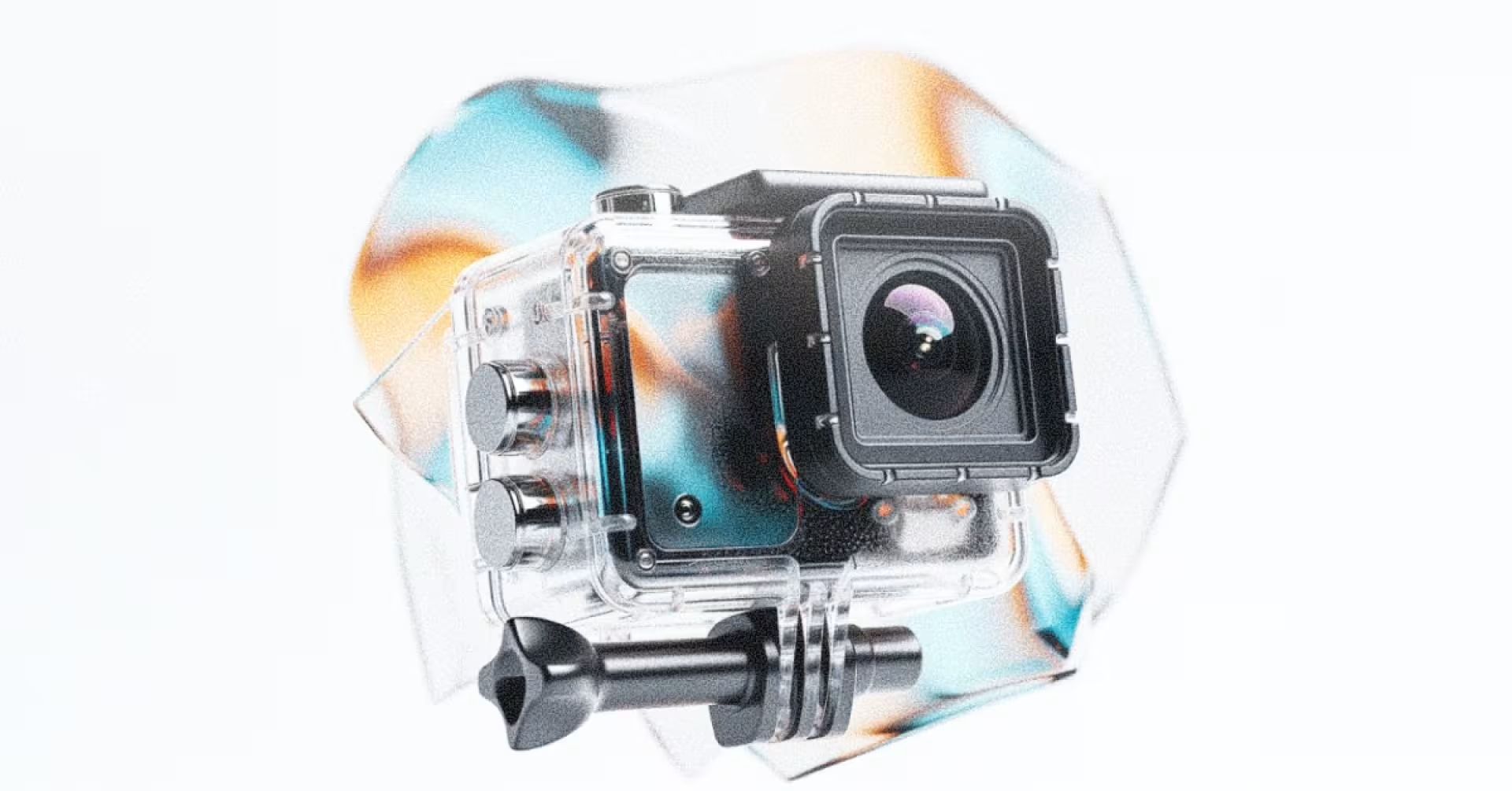
GoPro, Inc. (NASDAQ: GPRO) is an American digital imaging company best known for its HERO line of action cameras. Founded by Nicholas Woodman and headquartered in San Mateo, California, GoPro sells cameras, mounts, and accessories, along with a subscription business that now makes up a growing share of its revenue. GoPro began trading on the Nasdaq under the ticker GPRO on June 26, 2014.
GoPro has been under financial strain through 2026: falling camera sales, mounting losses, a going-concern warning, and a board looking for a buyer. In the final days of August and the first day of September, two pieces of news sent the stock sharply higher.
What does GoPro do?
GoPro designs and sells cameras, accessories, and subscription services for capturing and sharing video content. It operates as a single reportable segment.
Its business has four main parts:
- Cameras. The HERO series of action cameras, led by the flagship HERO13 Black, plus LIT HERO, the MAX and MAX2 360 cameras, and the MISSION 1 Series of cinema cameras that began shipping in May 2026. The series expanded in July with creator kits, a new Media Mod, and the Volta 2 battery grip, and includes the MISSION 1 PRO ILS, which pairs a 50MP 1-inch sensor with an interchangeable Micro Four Thirds lens mount.
- Mounts and accessories. Helmet, handlebar, chest, and tripod mounts, lens Mods, the Fluid Pro AI gimbal, batteries, and filters.
- Subscriptions. GoPro Premium, Premium+, and Quik offer cloud storage, editing tools, damaged camera replacement, and discounts. Subscriptions are GoPro's highest gross margin product.
- Applications and lifestyle gear. The Quik mobile app, desktop plugins including GoPro Reframe, and a line of bags, cases, and apparel.
GoPro sells in over 100 countries through retailers such as Amazon, Best Buy, Target, and Walmart, through roughly 65 distributors, and directly on GoPro.com. In 2025, retail accounted for 74% of revenue and GoPro.com for 26%.
Why did GPRO stock suddenly move?
Two separate catalysts hit within 48 hours.
August 31, 2026: the Markiplier disclosure. A Schedule 13G filed with the SEC on August 20 revealed that Mark Fischbach, the YouTuber known as Markiplier, holds 13,500,000 shares of GoPro Class A common stock, an 8.5% stake, with sole voting and dispositive power. The filing lists July 13, 2026 as the date he crossed the 5% reporting threshold. A Schedule 13G is the form used for passive stakes, so Fischbach is an investor in GoPro rather than someone with control over it. After the story circulated over the weekend, GPRO rose about 46% on Monday, August 31, its largest single-day percentage gain on record, on volume of roughly 148 million shares.
September 1, 2026: the Starman Optical merger. GoPro announced a definitive merger agreement the next morning. The stock rose again and traded well above the $1.14 per share cash consideration in the deal.
What is the GoPro and Starman Optical merger?
On September 1, 2026, GoPro entered a definitive merger agreement with Starman Optical, Inc., a privately held US optical-photonics company.
Deal terms:
- GoPro shareholders receive an aggregate cash payment of $285 million, or $1.14 per share, subject to adjustment based on net working capital at closing.
- Shareholders retain approximately 10% of the outstanding shares of the company.
- GoPro's outstanding debt of roughly $92 million is repaid in full at closing, leaving a substantially debt-free balance sheet.
- GoPro remains publicly listed on the Nasdaq.
Structurally, Starman is a wholly owned subsidiary of Action Acquisitions LLC, and it merges into GoPro. GoPro survives as the operating company and becomes a subsidiary of Action Acquisitions LLC.
What changes for the business:
- The merger adds Starman's US-manufactured optical transceiver business, positioning the combined company for AI data center infrastructure, government, defense, and aerospace markets.
- GoPro says it will continue supporting its existing consumer products and its subscription and cloud platform while investing in growth. This is an expansion into new markets, not an exit from cameras.
Both boards have approved the transaction. Closing is expected by year-end 2026 and is subject to regulatory approvals, approval by GoPro stockholders, and other customary conditions.
GPRO stock: key facts
- Ticker: GPRO (Class A common stock)
- Exchange: Nasdaq Global Select Market
- Headquarters: San Mateo, California
- Founder, CEO, and Chairman: Nicholas Woodman
- First day of trading: June 26, 2014, priced at $24.00 per share
- Share structure: Dual class. Class A carries one vote, Class B carries ten votes.
How is GoPro performing financially?
GoPro's revenue is shrinking and the company is operating at a loss.
Full year 2025:
- Revenue was $651.5 million, down from $801.5 million in 2024
- Operating loss was $83.3 million, compared with an operating loss of $135.0 million in 2024
- Gross margin was 33.6%
- The subscriber base declined 7% year over year to 2.36 million
Q2 2026 (quarter ended June 30, 2026, reported August 10, 2026):
- Revenue was $105 million, down 31% year over year
- Camera sell-through was approximately 291,000 units, down 38% year over year
- Subscription and service revenue was $29 million, up 11% year over year, reaching 28% of total revenue
- Subscriber attach rate hit a record 69%, up from 54% a year earlier
- Non-GAAP net loss was $36 million, or $0.21 per share
- Adjusted EBITDA was negative $29 million
Q2 results included a $19 million benefit from tariff refunds, partly offset by a $15 million charge on component purchase commitments. Subscription revenue included $2 million from GoPro's AI content licensing program, an opt-in service launched in the third quarter of 2025 that lets US subscribers make their cloud content available for AI model training.
GoPro has also disclosed substantial doubt about its ability to continue as a going concern. In its Q2 2026 quarterly report, the company said it does not expect to have sufficient liquidity to meet its financing obligations based on current projections. The pending Starman merger is intended to address this, since roughly $92 million of GoPro's debt would be repaid at closing.
What to consider before buying GPRO
GPRO now trades largely on the merger rather than on quarterly business performance.
- Whether the merger closes. Regulatory approval and the shareholder vote are the dominant drivers. If the deal breaks, the $1.14 per share cash consideration goes with it.
- The premium over deal value. GPRO has traded above $1.14, pricing in the retained 10% stake and the Starman business, both hard to value because Starman is private.
- Nasdaq listing status. GoPro received a notice on July 21, 2026 for trading below the $1.00 minimum bid price, and has 180 days to regain compliance.
- The core business. Camera sales are still falling, competition from Insta360 and DJI is intense, and memory costs have risen as much as 80% year over year.
- Volatility. Recent moves have been amplified by retail interest and short covering, which can reverse quickly.
How to buy GPRO on Backpack
On Backpack, GPRO is available in two forms.
As a traditional stock:
- Real ownership. Stocks bought on Backpack are held as real security entitlements, governed by New York law under UCC Article 8, the same property rights you would have at a conventional broker.
- Instant, quote-based trading. Backpack shows a live quote, you confirm, and your balance updates. There is no order book to manage.
- One account. Your crypto, your stablecoins, and your stocks sit in the same account, so you are not moving money between a brokerage and an exchange to rebalance.
- Extended hours. Stocks trade across US market sessions well beyond the regular 9:30am to 4:00pm ET window. Fractional shares are available during regular hours only.
As a tokenized stock:
Backpack also offers tokenized GPRO on Solana. Tokenized shares can be transferred between compatible wallets, used in DeFi applications, and redeemed 1:1 for the corresponding shares through Backpack. Dividends on tokenized holdings are reinvested into additional tokenized shares.
Learn more about Backpack
Exchange | Wallet | Twitter | Discord | Reddit
Disclaimer: This content is presented to you on an “as is” basis for general information and educational purposes only, without representation or warranty of any kind. It should not be construed as financial, legal or other professional advice, nor is it intended to recommend the purchase of any specific product or service. You should seek your own advice from appropriate professional advisors. Where the article is contributed by a third party contributor, please note that those views expressed belong to the third party contributor, and do not necessarily reflect those of Backpack. Please read our full disclaimer for further details. Digital asset prices can be volatile. The value of your investment may go down or up and you may not get back the amount invested. You are solely responsible for your investment decisions and Backpack is not liable for any losses you may incur. This material should not be construed as financial, legal or other professional advice.
.avif)