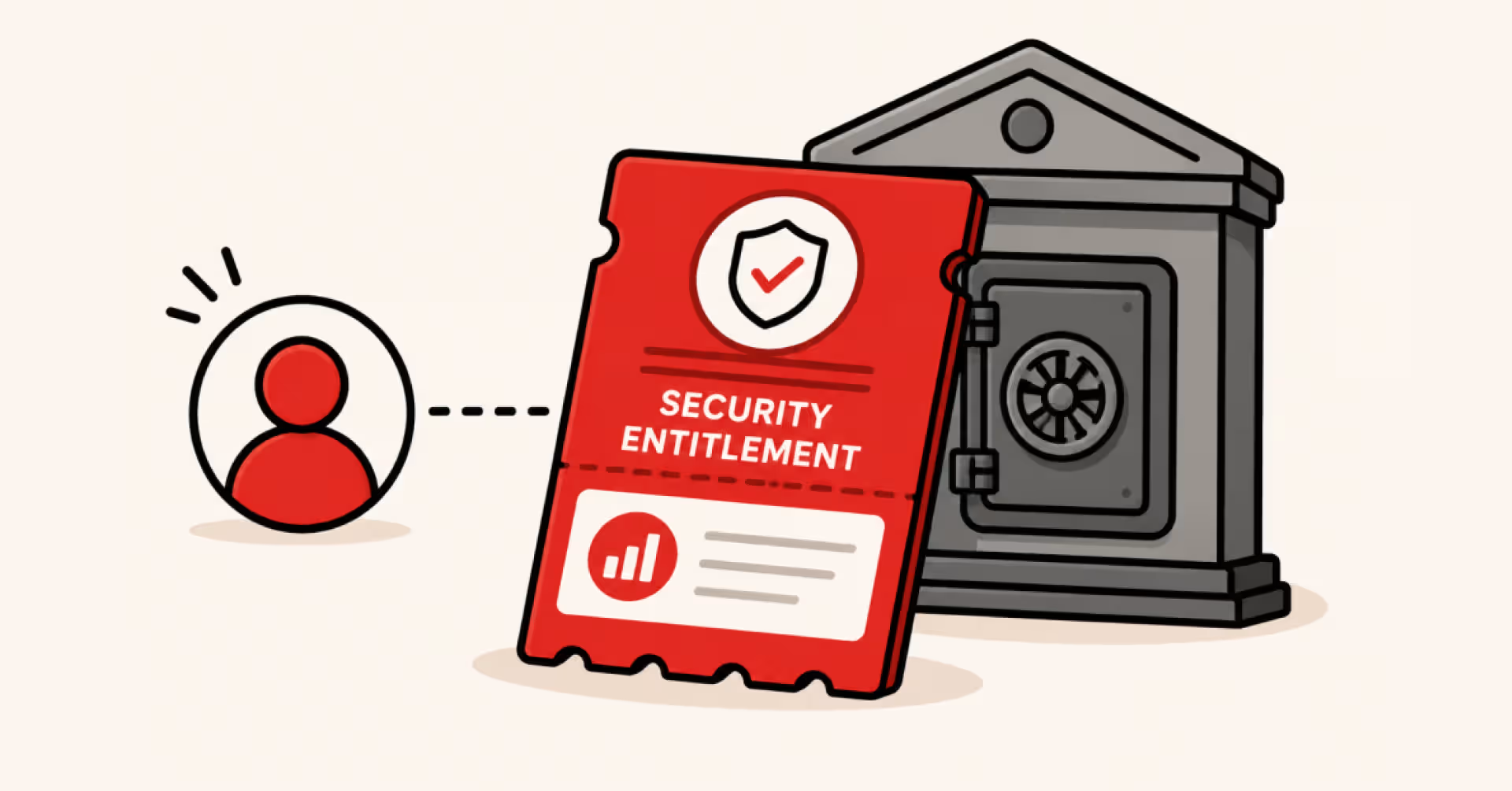
When you buy shares of Apple or Tesla through your brokerage account, you don't actually own the stock itself. What you own is something called a security entitlement: a legally protected bundle of rights against your broker, not direct ownership of the underlying shares.
This distinction surprises a lot of investors, but it's fundamental to how modern markets work. And as crypto platforms begin offering access to U.S. stocks, it's the legal concept that separates real ownership from synthetic exposure.
How We Ended Up With This System
Back in the late 1960s, Wall Street nearly choked on its own success. Trading volume had exploded, and the old system, physically delivering paper stock certificates for every trade, simply couldn't keep up. Settlement backlogs grew so bad that the New York Stock Exchange had to shut down every Wednesday just to let the back offices catch up on paperwork.
The solution was the creation of the indirect holding system. Instead of investors holding physical certificates, shares were deposited with a central custodian. Today, that's the Depository Trust Company (DTC), a subsidiary of DTCC. Legal title to the vast majority of publicly traded U.S. stocks sits in the name of DTC's nominee, Cede and Co. Brokers hold accounts with DTC, and customers hold claims against their brokers.
This system solved the paperwork crisis and enabled today's high-speed trading, but it created a layered chain of ownership that most retail investors never think about.
The Four Ways to Hold Securities Under U.S. Law
There are only four recognized ways to hold securities in the United States:
Bearer form: Ownership is determined solely by physical possession of the certificate. The issuance of new bearer securities has been largely banned in the U.S. since 1982 because of their association with tax evasion and illicit activities.
Certificated form. Traditional paper stock certificates issued in your name. Still legal, but rarely used for public companies anymore.
Uncertificated form. Direct registration on the company's books with no physical certificate. You have clean, direct ownership, but it's cumbersome if you own shares in many different companies, since each transfer requires registering directly with that company's shareholder register.
Security entitlements. The form under which the vast majority of Americans hold stocks today. You don't appear on the company's shareholder register. Instead, you hold a security entitlement through your broker.
What UCC Article 8 Actually Says
UCC Article 8 is the part of the Uniform Commercial Code that governs investment securities. It has been adopted in all 50 U.S. states. The modern version, significantly updated in 1994, was written specifically to reflect the reality of the indirect holding system.
Under Article 8, a security entitlement is defined as the rights and property interest of an investor (the "entitlement holder") in a financial asset held through a securities intermediary, usually your broker (UCC § 8-102(a)(17)).
Importantly, this isn't just a contractual claim. It's treated as a form of property. That means if your broker goes bankrupt, those assets are generally protected from the broker's creditors (UCC § 8-503). This protection, alongside SEC segregation rules and SIPC coverage, is what kept Lehman Brothers' brokerage customers whole in 2008.
What Rights Do You Actually Have?
As an entitlement holder, you're entitled to:
- Receive dividends and distributions
- Have voting rights and corporate actions passed through to you
- Instruct your broker to sell or transfer the securities
- Claim protection against the broker's general creditors, as long as the intermediary holds sufficient assets
You have these rights against your broker, not directly against Apple or Tesla.
Direct Ownership vs. Security Entitlement
If you hold securities through direct registration with a transfer agent, your name actually appears on the company's shareholder list. That's true direct ownership, and you have a direct legal relationship with the issuer.
Most investors don't hold securities this way. They prefer the convenience of a brokerage account, which means they hold security entitlements instead.
Neither is inherently better in every situation. The indirect system gives us speed, low costs, and massive liquidity. Direct ownership gives you cleaner legal title and a more direct relationship with the company. They serve different purposes.
Why This Matters When Buying Stocks Through a Crypto Platform
As more crypto exchanges and fintech platforms offer exposure to U.S. stocks, investors need to pay closer attention to a fundamental question: what do you actually own?
Not all products are created equal. On January 28, 2026, the SEC's Divisions of Corporation Finance, Investment Management, and Trading and Markets issued a joint statement that drew a clear line between two distinct models:
- In the custodial model, real shares are held in custody by a regulated intermediary. The investor receives a genuine security entitlement: the same legal protection under UCC Article 8 that applies to traditional brokerage accounts.
- In the synthetic model, the investor gets only economic exposure to the referenced stock. There is no ownership interest or security entitlement in the underlying shares, just a contractual claim against the platform.
The difference is significant. The first model gives you a property right in the actual securities. The second gives you a derivative-like contractual claim, which carries additional counterparty risk.
In today's market, this isn't just a technical detail. It's the difference between having a real stake in a company and simply betting on its price movement.
The Bottom Line
The framework created by UCC Article 8 has served the markets well for decades. As more platforms offer access to U.S. stocks, the question worth asking hasn't changed: do you hold a property right in the underlying security, or a contractual claim against a platform?
Backpack Securities is built on real security entitlements under UCC Article 8, governed by New York law. The same legal infrastructure that protects every brokerage account in the United States.
Learn more about Backpack
Exchange | Wallet | Twitter | Discord | Reddit
Disclaimer: This content is presented to you on an “as is” basis for general information and educational purposes only, without representation or warranty of any kind. It should not be construed as financial, legal or other professional advice, nor is it intended to recommend the purchase of any specific product or service. You should seek your own advice from appropriate professional advisors. Where the article is contributed by a third party contributor, please note that those views expressed belong to the third party contributor, and do not necessarily reflect those of Backpack. Please read our full disclaimer for further details. Digital asset prices can be volatile. The value of your investment may go down or up and you may not get back the amount invested. You are solely responsible for your investment decisions and Backpack is not liable for any losses you may incur. This material should not be construed as financial, legal or other professional advice.