MRK is the New York Stock Exchange ticker for Merck & Co., Inc., the U.S. pharmaceutical company known as MSD outside the United States and Canada. Merck develops medicines, vaccines and animal-health products led by cancer drug Keytruda. MRK reached a record close on August 19, 2026 after positive Phase 3 melanoma data with Moderna.
One naming detail matters before going further. Merck & Co. is the company behind NYSE: MRK and Keytruda. It is separate from Merck KGaA, Darmstadt, Germany, an unaffiliated science and technology company that also uses the Merck name outside the United States and Canada. Search results can mix the two, so this article is specifically about Merck & Co. stock.
Key Takeaways
- MRK is the NYSE ticker for Merck & Co. The company is known as MSD outside the United States and Canada.
- Merck stock jumped 12.6% on August 19, 2026 and closed at a record $152.21 after Merck and Moderna reported positive topline Phase 3 melanoma results for intismeran autogene plus Keytruda.
- The same catalyst hit MRK and MRNA very differently. Moderna surged about 177%, while Merck's move was smaller because the trial represents a potentially transformative new product category for Moderna but an additional growth opportunity inside Merck's much larger business.
- Keytruda remains the center of Merck's financial story. Keytruda and Keytruda Qlex generated $8.4 billion of Merck's $16.6 billion in second-quarter 2026 sales.
- Merck pays a dividend. The company declared a quarterly dividend of $0.85 per share for the third quarter of 2026.
Why Did Merck Stock Jump in August 2026?
On August 19, 2026, Merck and Moderna reported positive topline results from INTerpath-001, a Phase 3 study of intismeran autogene, also known as mRNA-4157 or V940, combined with Merck's Keytruda in patients with high-risk melanoma after surgery.
The companies said the combination met the trial's primary recurrence-free-survival goal and improved the secondary measure of distant metastasis-free survival compared with Keytruda alone. Detailed Phase 3 efficacy numbers had not yet been released when the topline result was announced, so the size and durability of the benefit still require review of the full data.
The market reaction was immediate. Merck shares rose 12.6% and closed at a record $152.21. Moderna, whose smaller business is far more sensitive to the success or failure of its mRNA pipeline, rose roughly 177% on the same news.
The distinction matters: this was not a typical one-company drug-trial catalyst. It simultaneously validated Moderna's personalized mRNA platform and potentially strengthened the future of Merck's already dominant Keytruda franchise.
What Is the Merck-Moderna Personalized Cancer Vaccine?
Intismeran autogene is an individualized neoantigen therapy: Moderna uses information from a patient's tumor to design an mRNA treatment encoding tumor-specific targets. Keytruda is a PD-1 checkpoint inhibitor. The combination is intended to help the immune system recognize cancer-specific targets while reducing a brake on the immune response.
The Phase 3 result follows supportive five-year Phase 2b follow-up in high-risk resected melanoma. The broader intismeran program also includes studies in lung, kidney and bladder cancer.
Why Did MRK Rise Less Than MRNA on the Same News?
The percentage moves look radically different because the two companies started from very different places.
For Merck, the trial can create a new way to use one of the world's largest cancer franchises. For Moderna, it can change how investors value the company's entire technology platform. That asymmetry helps explain why both stocks celebrated the same result but moved by very different percentages.
The Setup Before Merck's Record High
MRK was already strong before the melanoma headline. The stock closed at $131.82 on July 28, 2026 and had pushed to another 52-week high by August 13.
The operating backdrop was also solid. Merck reported $16.6 billion of second-quarter 2026 sales, up 5% year over year, including $8.4 billion from Keytruda and Keytruda Qlex. Winrevair sales rose 75% to $588 million, and Merck raised and narrowed its 2026 sales outlook to $66.3 billion to $67.3 billion.
What Does Merck Do?
Merck operates across oncology, vaccines, cardiometabolic and respiratory medicines, infectious disease, immunology and animal health. Keytruda is its largest product; other important franchises include Gardasil/Gardasil 9, Winrevair and Capvaxive. For investors, the central question is whether that broader portfolio can reduce dependence on Keytruda over time.
How Dependent Is Merck on Keytruda?
Very dependent. In 2025, Keytruda sales represented 49% of Merck's total sales. Keytruda and Keytruda Qlex generated $31.7 billion for the full year, compared with $65.0 billion of total company sales.
That concentration is why every successful Keytruda combination matters, but it also creates a long-term risk. Merck's 2025 annual filing says it expects Keytruda sales to be materially affected by biosimilar competition between 2028 and 2029. The primary compound patent expires in December 2028, while other patents in the composition-of-matter family extend into 2029 and may be litigated.
Merck is trying to manage that transition through new formulations such as Keytruda Qlex, new combinations, acquisitions and products outside oncology. The personalized cancer-vaccine program matters partly because it could create another valuable use of Keytruda before and potentially around that transition.
Does Merck Pay a Dividend?
Yes. Merck declared a quarterly dividend of $0.85 per share for the third quarter of 2026, up from the $0.81 quarterly rate paid during much of 2025.
A dividend does not make a stock low risk, and the yield changes with the share price. But it is an important difference between MRK and many development-stage biotechnology stocks, including Moderna, which do not pay a dividend.
For a broader explanation, see Backpack Learn's guide to what a dividend is.
Key Risks for MRK Stock
Keytruda concentration and patent expiry. Nearly half of 2025 sales came from Keytruda, and biosimilar competition could begin around 2028-2029.
Clinical and regulatory risk. Positive programs can fail in later studies or face delays. The August 19 intismeran announcement was topline, so detailed efficacy, safety and subgroup data still matter.
Portfolio concentration. Gardasil sales fell sharply in 2025, partly because of weaker demand and inventory issues in China. Product- and country-specific disruptions can move results.
Execution and volatility. Acquisitions and R&D can create earnings charges without guaranteeing success, while trial, patent and regulatory events can move even a large pharmaceutical stock sharply.
How to Buy MRK Stock on Backpack
Backpack Securities gives eligible users in supported regions access to U.S.-listed stocks and ETFs from the same account used for crypto. MRK trades from Sunday evening through Friday evening, U.S. Eastern Time, so you can act on news like the August 19 announcement without waiting for the New York Stock Exchange to open.
To buy MRK on Backpack:
- Create and verify a Backpack account. Securities access is limited to eligible users and supported regions.
- Fund your USD balance. You can deposit USDC or send a USD wire transfer.
- Open Stocks and search for the ticker. Search for ‘MRK’ and confirm the company name is Merck & Co., Inc. before placing an order.
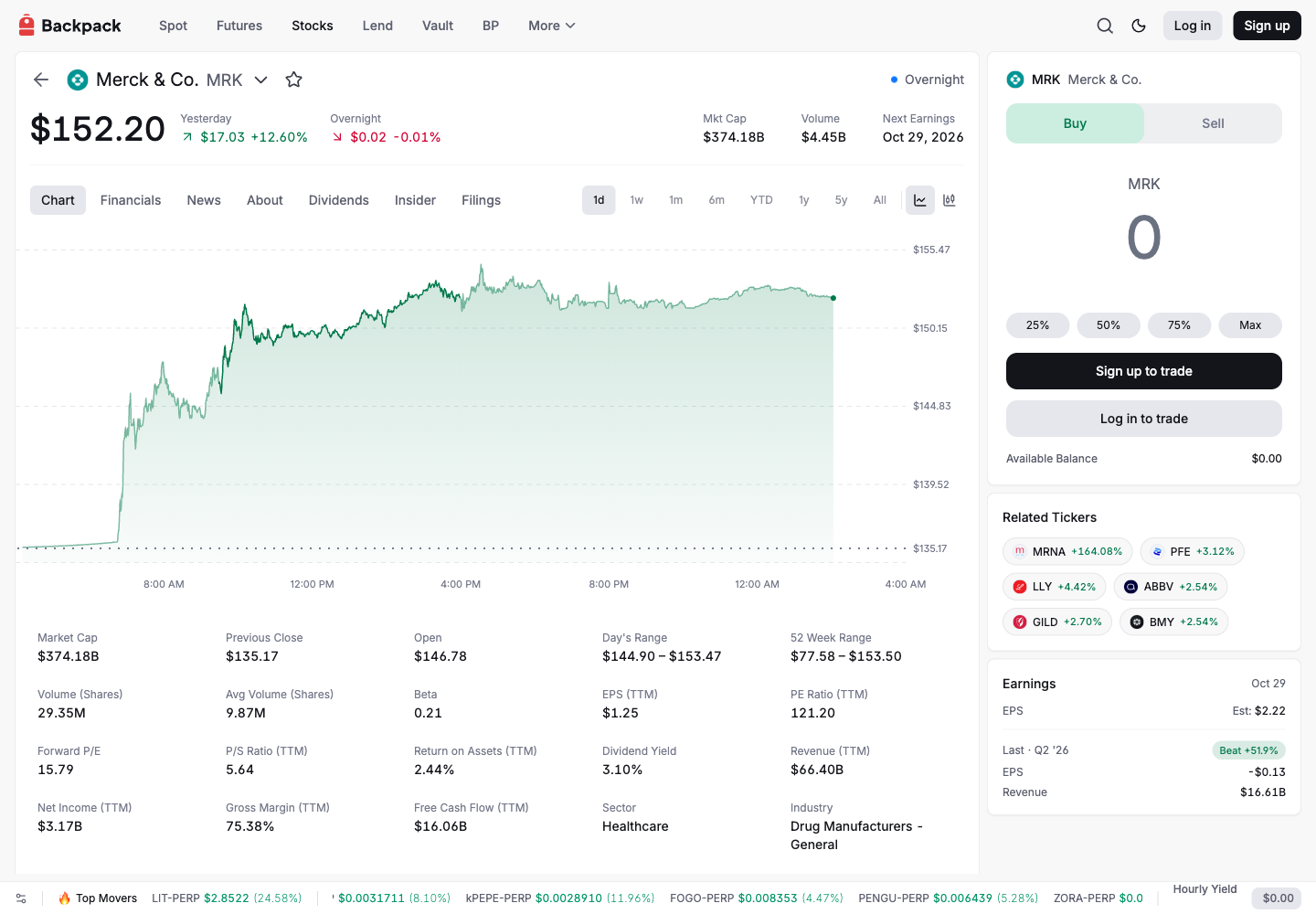
- Choose Buy and enter a quantity. First-time securities users may be asked to enable trading and acknowledge the applicable agreement.
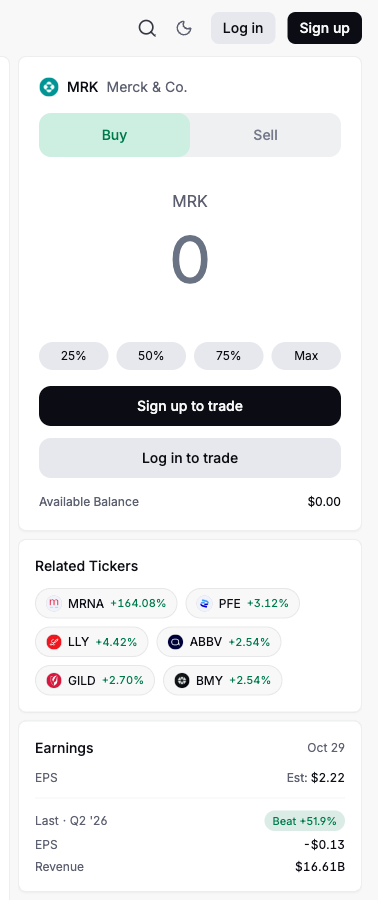
- Preview the quote and confirm. Check the displayed price, quantity and estimated total before submitting.
Is MRK Stock a Good Investment?
That depends on an investor's goals, time horizon and risk tolerance. The bull case includes a large and profitable commercial base, Keytruda's continued growth, newer products such as Winrevair, a dividend and a broad pipeline. The risks include heavy dependence on Keytruda, the approaching biosimilar window, clinical failures, acquisition execution and event-driven volatility.
The August 2026 melanoma result strengthens one part of the growth case, but it does not remove those risks. Full Phase 3 data and future regulatory decisions remain important milestones.
The Bottom Line
Merck's 12.6% move to a record close showed how much value investors assigned to the positive Phase 3 intismeran-Keytruda result. The longer-term MRK story is broader: Merck must use Keytruda's scale, new combinations, new formulations and products outside oncology to navigate a patent transition that becomes more important later this decade.
Learn more about Backpack
Exchange | Wallet | Twitter | Discord | Reddit
Disclaimer: This content is presented to you on an “as is” basis for general information and educational purposes only, without representation or warranty of any kind. It should not be construed as financial, legal or other professional advice, nor is it intended to recommend the purchase of any specific product or service. You should seek your own advice from appropriate professional advisors. Where the article is contributed by a third party contributor, please note that those views expressed belong to the third party contributor, and do not necessarily reflect those of Backpack. Please read our full disclaimer for further details. Digital asset prices can be volatile. The value of your investment may go down or up and you may not get back the amount invested. You are solely responsible for your investment decisions and Backpack is not liable for any losses you may incur. This material should not be construed as financial, legal or other professional advice.
.avif)