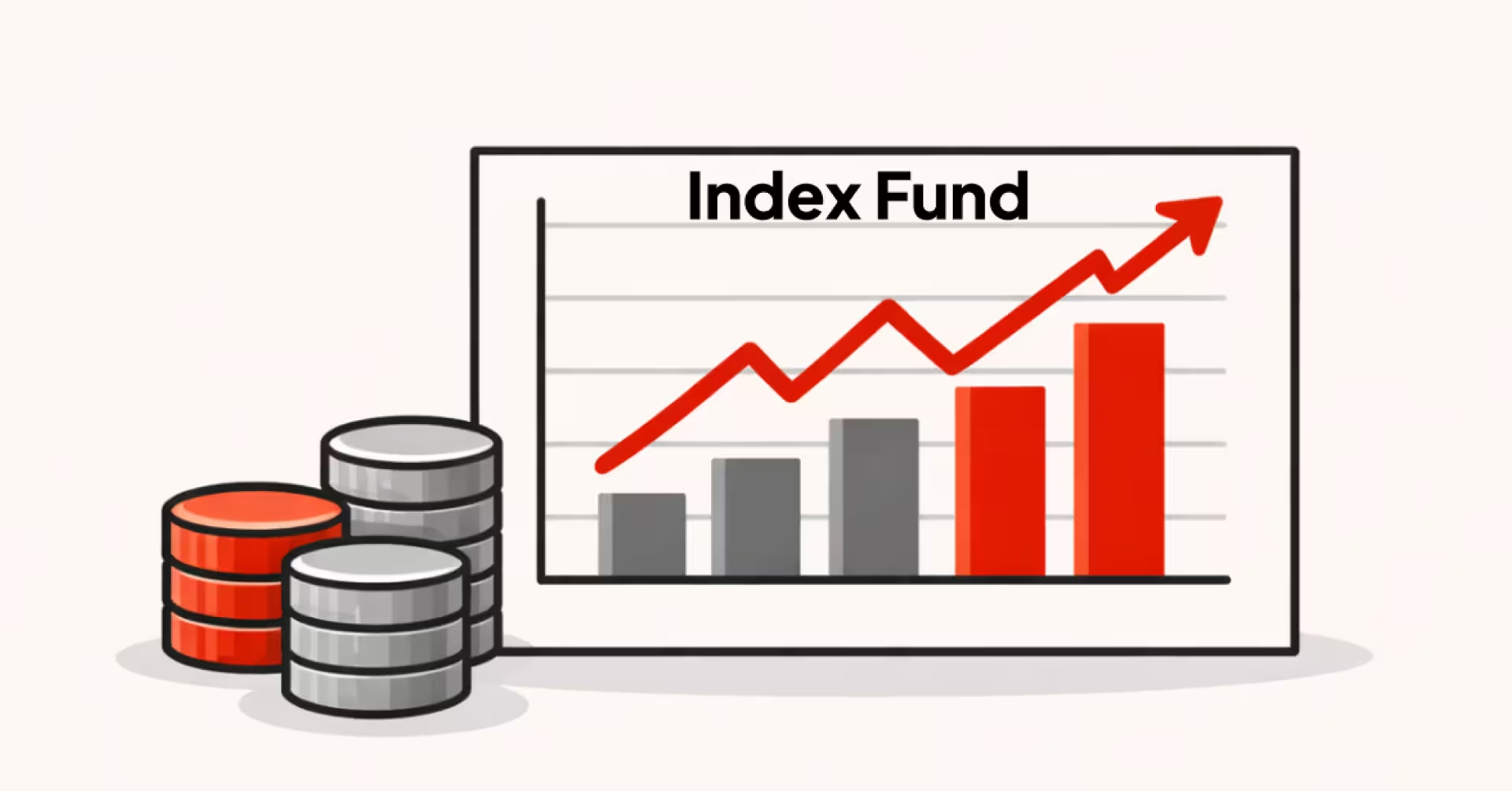

A balanced way to think about it is that index funds can work well as the foundation of a portfolio, while individual stocks can be added selectively if you want to research companies and accept the extra risk.
Is it better to invest in an index fund or individual stocks?
An index fund lets you invest in many companies at once. For example, an S&P 500 index fund tracks many large U.S. companies, while a Nifty 50 index fund tracks 50 major Indian companies.
An individual stock means buying shares of one company, such as Apple, Nvidia, Reliance, Infosys, or Tesla.
For many beginners, index funds are easier because they provide diversification, reduce the need for constant research, lower the risk of one company having too much impact, and support a simple long-term plan.
Individual stocks may be suitable for investors who want to study businesses, choose specific companies, and try to outperform the broader market. The trade-off is that poor stock selection can lead to larger losses than a diversified fund.
Which is better: index fund or stock?
Neither is automatically better in every situation. Index funds are often better for investors who want simplicity, diversification, and a lower-maintenance approach. Individual stocks may be better for investors who want more control, are willing to do detailed research, and can handle higher volatility.
The main difference is effort and risk. Index funds spread your money across many companies, while individual stocks concentrate your money in selected businesses. That concentration can help if your choices perform well, but it can hurt if they perform poorly.
Why do people still pick individual stocks?
People pick individual stocks because the potential upside can be much higher. A single successful stock can outperform a broad market index by a wide margin. Investors who bought companies such as Nvidia, Amazon, Apple, or Microsoft early and held them for years earned returns that were far above the market.
However, identifying those winners in advance is difficult. Many companies that look promising do not perform as expected. This is why some investors prefer to keep most of their portfolio diversified while using a smaller portion for individual stock ideas.
An index fund does not try to beat the market. It tries to track the market. The challenge for stock pickers is not finding one good idea once; it is doing so consistently over many years after costs, taxes, and mistakes.
Can you beat index funds without doing serious research?
It is possible, but it is difficult to do consistently. Buying individual stocks without research increases the risk of making decisions based on hype, short-term price moves, or incomplete information.
To evaluate a stock properly, investors usually need to understand the company's financials, business model, valuation, competition, industry trends, and risks. A useful test is this: if you cannot explain why you own a stock and what would make you sell it, it may be too risky to make it a large part of your portfolio.
What is the 7% rule in stocks?
The 7% rule is a risk-management rule used by some stock traders. It says that if an individual stock falls around 7% to 8% below your purchase price, you sell it to prevent a small loss from becoming a larger one.
This rule is mainly used for individual stocks, especially in active trading strategies. It is usually not applied the same way to long-term index funds because broad funds own many companies and are often held through normal market declines.
What does Warren Buffett say about index funds?
Warren Buffett has often spoken positively about low-cost index funds for most investors. His general view is that many people do not need to pick individual stocks to build wealth. Instead, they can own a broad group of businesses through a low-cost index fund and hold it for the long term.
This does not mean Buffett believes individual stock investing is impossible. His own career is based on selecting businesses. The point is that stock picking requires skill, discipline, and patience, while index funds offer a simpler route for investors who do not want to analyze individual companies.
Best beginner strategy
A practical beginner strategy is the core and satellite approach. This means using broad index funds as the main part of the portfolio and adding individual stocks only as a smaller portion if you want to learn or express specific investment views.
For example, an investor might keep most of the portfolio in index funds and use a smaller portion for selected individual stocks. This gives the portfolio diversification while still allowing room for stock picking. The exact split depends on your goals, risk tolerance, time horizon, and interest in researching companies.
Final Answer
For many beginners, index funds are a practical starting point because they are diversified and easier to manage. Individual stocks can also play a role for investors who are willing to research companies and accept higher risk.
A balanced approach is to start with a diversified base and add individual stocks gradually if they fit your goals and risk tolerance. Index funds offer simplicity and broad exposure, while individual stocks offer control and higher potential upside.
了解更多关于Backpack的信息
交易所 | 钱包 | Twitter | Discord | Reddit
免责声明:本内容按“原样”提供,仅供一般信息和教育目的,不作任何形式的陈述或保证。不应将其解释为财务、法律或其他专业建议,也不旨在推荐购买任何特定产品或服务。您应向适当的专业顾问寻求自己的建议。如果文章由第三方贡献者提供,请注意,所表达的观点属于该第三方贡献者,不一定反映 Backpack 的观点。请阅读我们的完整免责声明以获取更多详情。数字资产价格可能波动剧烈。您的投资价值可能上涨或下跌,您可能无法收回投资金额。您对自己的投资决策负全部责任,Backpack 对您可能遭受的任何损失概不负责。本材料不应被解释为财务、法律或其他专业建议。