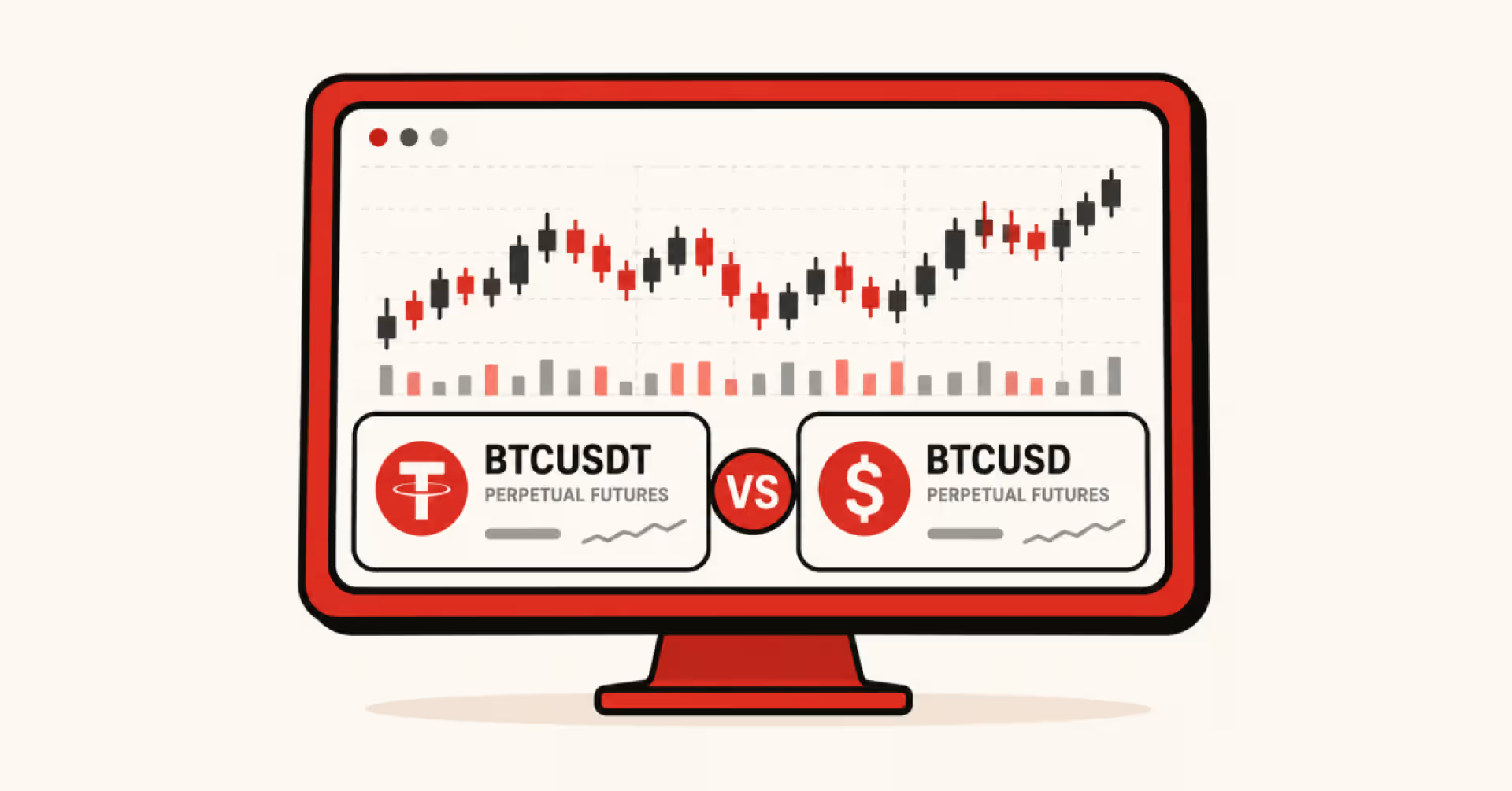
BTCUSDT and BTCUSD perpetual futures are two types of Bitcoin derivative contracts. BTCUSDT is margined and settled in Tether, a private stablecoin. BTCUSD is typically margined in Bitcoin itself. The key difference is how your collateral and profits are denominated, which affects your exposure to currency and counterparty risk.
What Is a BTC Perpetual Futures Contract?
A perpetual futures contract lets traders speculate on Bitcoin’s price with leverage — without ever owning the actual coin. Unlike traditional futures, perpetuals have no expiration date. You can hold a position for as long as you want, provided you maintain enough margin and don’t get liquidated.
The mechanism that keeps perpetual prices anchored to spot is the funding rate — a recurring payment exchanged between long and short traders every few hours. When the perp trades above spot, longs pay shorts. When it trades below, shorts pay longs. This is the economic substitute for contract expiry.
On most exchanges, BTC perpetuals come in two flavors: BTCUSDT (also called linear or USDT-margined) and BTCUSD (also called inverse or coin-margined). They track the same underlying asset — Bitcoin — but they work differently under the hood. Choosing between them affects your margin, your PnL, and your overall risk exposure.
Key Takeaways
- BTCUSDT is a linear perpetual contract — you post USDT as collateral, and your profit/loss is calculated in USDT.
- BTCUSD is an inverse perpetual contract — you post BTC as collateral, and your profit/loss is calculated in BTC.
- Linear contracts have straightforward PnL math. Inverse contracts have non-linear PnL — you earn progressively less BTC as price rises, and lose progressively more as it falls.
- BTCUSDT is better for traders who think in dollar terms and want predictable margin. BTCUSD is better for long-term BTC holders who want to keep exposure without converting to stablecoins.
- Both use the same funding rate mechanism to stay pegged to spot price. Most exchanges settle every 8 hours; Backpack settles hourly (24 times per day).
- BTCUSDT contracts generally have deeper liquidity on most exchanges because stablecoin-margined products dominate trading volume.
Understanding BTCUSDT vs BTCUSD Perpetuals
What “Linear” and “Inverse” Actually Mean
When exchanges label a contract BTCUSDT, they’re telling you it’s a linear (or USDT-margined) perpetual. Everything is denominated in USDT — your collateral, your margin, and your realized PnL. If you go long 1 BTC at $60,000 and close at $65,000, you make 5,000 USDT. Simple math.
BTCUSD is the inverse (or coin-margined) version. Here, Bitcoin is the collateral. The contract is denominated in USD face value, but settled in BTC. Each contract typically represents a fixed USD amount (for example, $100 on Binance, $1 on BitMEX). Your PnL is paid out in BTC, not dollars.
The Collateral Difference
This is the most practical distinction. With BTCUSDT, you need USDT in your futures account before you can trade. With BTCUSD, you need Bitcoin. That means BTCUSD traders have inherent price exposure to BTC even before they open a position — if Bitcoin’s price drops 20%, your collateral loses 20% of its dollar value.
For BTCUSDT traders, collateral value stays stable regardless of market direction. That makes risk management more predictable, especially during volatile periods.
The PnL Calculation
Linear PnL is straightforward: Profit = Position Size × (Exit Price − Entry Price). If you bought 1 BTC at $60,000 and sold at $65,000, you made 5,000 USDT. The math scales linearly in both directions.
Inverse PnL uses a reciprocal formula: Profit (in BTC) = Contract Size × (1/Entry Price − 1/Exit Price). This creates a non-linear payoff curve. As price rises, you earn progressively fewer BTC per dollar of movement. As price falls, you lose progressively more BTC per dollar of movement. The USD value of your gains is linear, but the BTC value is not.
How Each Contract Type Works
BTCUSDT (Linear Perpetual)
You deposit USDT. You trade BTC-denominated contracts priced in USDT. Your margin requirement, PnL, and liquidation price are all calculated in USDT. One contract usually represents 1 unit of BTC.
Because USDT is a universal settlement currency, you can use the same collateral pool to trade multiple pairs — BTC, ETH, SOL — without buying each underlying asset. This makes spot conversion unnecessary and improves capital efficiency.
BTCUSD (Inverse Perpetual)
You deposit BTC. Each contract has a fixed USD face value (commonly $1 or $100). When you enter a number of contracts, you’re specifying a dollar amount of exposure, not a BTC amount. The margin required depends on the current BTC price and your leverage.
All profits are paid in BTC. In a bull market, this creates a compounding effect — as price rises, your BTC profits are worth more in dollar terms too. In a bear market, the reverse happens: your collateral shrinks as the asset falls, amplifying losses.
BTCUSDT vs BTCUSD: Side-by-Side Comparison
Real-World Example: Long BTC at $60,000, Exit at $70,000
Suppose you go long on BTC at $60,000 and close at $70,000 using both contract types.
BTCUSDT (Linear): You bought 1 BTC worth of contracts. Profit = 1 × ($70,000 − $60,000) = 10,000 USDT. Clean and simple.
BTCUSD (Inverse): You bought $60,000 worth of contracts (600 contracts at $100 face value each). Profit in BTC = 600 × 100 × (1/60,000 − 1/70,000) = ~0.143 BTC. At the exit price of $70,000, that 0.143 BTC is worth roughly $10,000. The dollar profit is the same — but you received it in Bitcoin, not stablecoins.
The key difference: if BTC continues to rise after you close, your BTCUSD profit (held in BTC) appreciates further. If BTC drops, that profit shrinks in dollar terms. BTCUSDT profit stays locked at 10,000 USDT regardless.
How Do Funding Rates Work on BTC Perpetuals?
Funding rates function identically on both BTCUSDT and BTCUSD contracts. The mechanism exists because perpetuals don’t expire — so there’s no natural convergence with spot price. Funding solves this by making it expensive to hold the crowded side of the trade.
When the perpetual price trades above spot (bullish sentiment), the funding rate turns positive. Long holders pay short holders. When the perp trades below spot (bearish sentiment), shorts pay longs. Most exchanges settle funding every 8 hours — three payments per day. Backpack Exchange settles funding hourly (24 times per day), which keeps the perp price more tightly anchored to spot.
The only difference: on BTCUSDT contracts, funding is paid and received in USDT. On BTCUSD contracts, it’s paid and received in BTC. This matters during extended trending markets. In a prolonged bull run, positive funding on a BTCUSD long means you’re paying BTC — an appreciating asset — to maintain your position.
Which Should You Trade: BTCUSDT or BTCUSD?
The right contract depends on your goals and what you’re already holding.
Choose BTCUSDT if: You want simple PnL math. You think in dollar terms. You prefer stable collateral. You’re newer to derivatives. You want to trade multiple pairs from a single stablecoin balance.
Choose BTCUSD if: You hold BTC and don’t want to sell into stablecoins. You’re a miner hedging production revenue. You want to accumulate more BTC during a bull market. You’re running basis trades or arbitrage between perpetual and quarterly contracts.
Most retail traders default to BTCUSDT for its simplicity. It’s also where the deepest liquidity sits on major exchanges. Inverse contracts are more popular among institutional traders, miners, and long-term BTC maximalists who refuse to hold stablecoin exposure. If you’re new to crypto derivatives, starting with a linear contract is the safest way to learn. For traders looking to short crypto, both contract types support short positions with leverage.
How BTC Perps Work on Backpack Exchange
Backpack lists its Bitcoin perpetual as BTC/USD-PERP. Don’t let the USD naming confuse you — this is a linear contract. It is not an inverse, coin-margined perp like BTCUSD on Binance or Bybit. Backpack treats USD and USDC as the same thing at 1:1. All futures settle in USDC. You deposit USD or USDC, you trade the same contract, you get the same linear PnL.
Everything on Backpack runs through a single cross-margined account. Your USDC, USD, BTC, SOL, ETH — all of it counts as collateral across spot margin, futures, and borrow/lending. Turn on Auto Lend and those assets enter a peer-to-peer lending pool, earning yield while still backing your positions. Your USD and USDC balances both earn interest.
Funding settles every hour, not every 8 hours. PnL realizes automatically every 10 seconds through Auto Realize PnL — withdraw profits or redeploy them without closing your position. Backpack calls this Interest-Bearing Perpetuals: perpetual trading fused with a borrow-lending market so your capital is never sitting idle.
Want true inverse perps with BTC collateral, non-linear PnL, and BTC settlement? You’ll need Binance, Bybit, or BitMEX for that.
Trade perpetuals on Backpack: BTC/USD-PERP | ETH/USD-PERP | SOL/USD-PERP | All Markets
Is Trading BTC Perpetual Futures Risky?
Yes. Both contract types carry significant risk, especially when leverage is involved. Leverage amplifies both gains and losses — a 10x leveraged position only needs a 10% adverse move to wipe out your margin entirely.
Inverse contracts add an extra layer of risk: collateral volatility. Because your margin is denominated in BTC, a price crash hits you twice — your position loses value and your collateral loses value. This can accelerate liquidation. With linear contracts, at least your collateral (USDT) stays roughly the same dollar value through the drawdown.
Funding costs also compound over time. If you’re holding a long position during a period of consistently positive funding, those recurring payments eat into your profits — or deepen your losses. Always factor funding into your position’s total cost, not just the entry and exit price.
The Bottom Line
BTCUSDT and BTCUSD perpetuals both let you trade Bitcoin with leverage and no expiry — but they target different types of traders. Linear (USDT-margined) contracts are simpler, more liquid, and settle in stable value. Inverse (coin-margined) contracts let BTC holders trade and hedge without ever touching stablecoins. Understanding the mechanics of futures trading, how spot markets work, and the different types of futures contracts will help you pick the right tool for your strategy. To see everything you can trade on Backpack, check out the full platform overview.
Learn more about Backpack
Exchange | Wallet | Twitter | Discord | Reddit
Disclaimer: This content is presented to you on an “as is” basis for general information and educational purposes only, without representation or warranty of any kind. It should not be construed as financial, legal or other professional advice, nor is it intended to recommend the purchase of any specific product or service. You should seek your own advice from appropriate professional advisors. Where the article is contributed by a third party contributor, please note that those views expressed belong to the third party contributor, and do not necessarily reflect those of Backpack. Please read our full disclaimer for further details. Digital asset prices can be volatile. The value of your investment may go down or up and you may not get back the amount invested. You are solely responsible for your investment decisions and Backpack is not liable for any losses you may incur. This material should not be construed as financial, legal or other professional advice.