Key Takeaways:
- A futures contract is a standardized legal agreement to buy or sell a specific asset at a fixed price on a specified future date
- Futures markets are traded on regulated exchanges, with a clearing house guaranteeing each contract
- Initial margin is a performance deposit required to open a position, typically a small percentage of the total contract value
- Open positions are settled daily through a process called marking to market, with losses debited and gains credited each trading day
- Hedgers use futures to reduce price risk; speculators use futures to profit from price movements
- Futures contracts exist across commodities, financial indexes, currencies, and cryptocurrency
What Is Futures Trading?
Futures trading is the buying and selling of futures contracts: standardized legal agreements to buy or sell a specific asset at a predetermined price on a specified future date. The buyer and seller are each bound by the terms of the contract regardless of where the market price stands at expiration.
Unlike purchasing a stock or commodity directly, a futures contract does not transfer ownership of the underlying asset at the time of the trade. Instead, it creates a binding obligation to transact at the agreed price when the contract expires, making futures a distinct and more complex instrument than direct ownership.
Futures markets serve two primary functions: they allow businesses and institutions to manage price risk, and they provide a venue for traders to speculate on the direction of asset prices. Both functions are essential to how modern financial markets operate.
How Does Futures Trading Work?
Futures contracts are traded on regulated exchanges. The exchange acts as an intermediary, standardizing contract terms, matching buyers with sellers, and guaranteeing the performance of each futures contract through a clearing house.
The clearing house sits between every buyer and seller in the market. Rather than holding an obligation directly to the counterparty, each trader's obligation runs to the clearing house. This structure reduces the risk that the other party to a trade will default on their obligation.
To enter a futures position, a trader is required to deposit an amount known as the initial margin, a performance bond set by the exchange, typically a small percentage of the total contract value. This is not a down payment or a loan. It is a good-faith deposit that demonstrates the trader's ability to meet their financial obligations under the contract.
One of the defining features of futures trading is that open positions are settled on a daily basis, a process known as marking to market. At the end of each trading day, the exchange calculates the gain or loss on every open position based on that day's closing price and credits or debits each trader's margin account accordingly.
If losses cause a trader's account balance to fall below a required minimum, known as the maintenance margin, the trader receives a margin call and must deposit additional funds to bring the account back to the required level. Failure to meet a margin call may result in the position being closed by the broker, potentially locking in a loss.
Most futures contracts are closed before their expiration date. Traders exit their positions by entering an offsetting trade, where a buyer sells an equivalent contract and a seller buys one back. Only a small percentage of contracts result in physical delivery of the underlying asset.
What Is the Difference Between Hedging and Speculation in Futures?
Futures markets exist primarily to serve two distinct types of participants: hedgers and speculators.
Hedgers use futures to reduce exposure to price movements in assets they already own or expect to buy or sell. A wheat farmer might sell wheat futures to lock in a selling price before harvest, protecting against the risk that prices fall by the time the crop is ready. An airline company might buy oil futures to lock in fuel costs, protecting against the risk that energy prices rise. In both cases, the futures contract reduces uncertainty by fixing the price in advance.
Speculators take positions in futures markets based on their expectations of where prices will move. They do not intend to buy or sell the underlying asset. They aim to profit from price changes in the contract itself. A speculator who expects the price of crude oil to rise might buy oil futures. If the price increases, the contract gains value and can be sold at a profit. If the price falls, the speculator incurs a loss.
Speculators play an important role in futures markets by providing liquidity, as their willingness to take the other side of hedging trades ensures that markets function efficiently.
What Are the Types of Futures Markets?
Futures contracts exist across a wide range of asset classes.
Commodity futures are among the oldest and most established. They cover agricultural products such as wheat, corn, and soybeans, as well as energy products like crude oil and natural gas, and metals including gold, silver, and copper.
Financial futures include contracts on stock market indexes, government bonds, and interest rates. Index futures, such as those tied to the S&P 500 and the Nasdaq, allow investors and institutions to gain or hedge exposure to broad market movements without buying or selling individual stocks.
Currency futures allow participants to lock in exchange rates between currencies and are used by businesses with international operations to manage foreign exchange risk.
Cryptocurrency futures cover digital assets such as Bitcoin and Ethereum, with contracts available on major regulated exchanges as well as crypto-native platforms. Unlike traditional commodity or financial futures, cryptocurrency futures markets operate 24 hours a day, seven days a week, reflecting the continuous trading nature of underlying digital asset markets.
What Does Going Long or Short Mean in Futures?
Futures traders can take positions in either direction of the market.
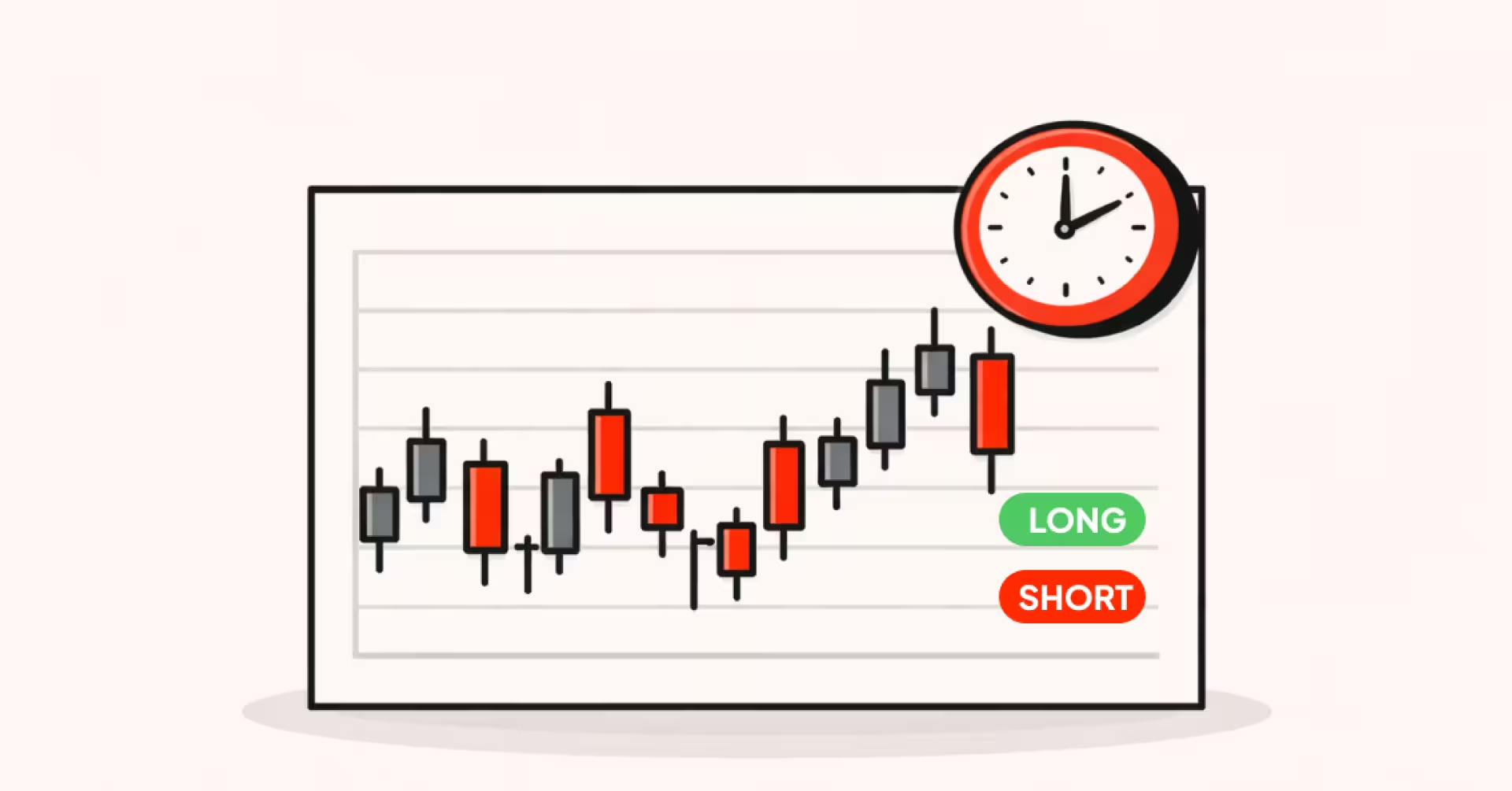
Taking a long position means buying a futures contract with the expectation that the price of the underlying asset will rise. If the price rises above the entry price before the position is closed, the trader profits.
Taking a short position means selling a futures contract with the expectation that the price will fall. If the price falls below the entry price before the position is closed, the trader profits. Unlike short selling stocks, which requires borrowing shares, shorting a futures contract does not involve borrowing, making short positions more straightforward to execute.
How Are Futures Markets Regulated?
Futures markets in the United States are regulated by the Commodity Futures Trading Commission (CFTC), an independent federal agency created by Congress in 1974 to regulate commodity futures and options markets, protect market participants from fraud and manipulation, and ensure the financial integrity of the clearing process.
What Are the Key Risks of Futures Trading?
Futures trading involves a level of risk that differs from buying and holding stocks or bonds directly.
Leverage is the primary source of amplified risk in futures markets. Because the initial margin requirement is typically a small fraction of the total contract value, a relatively small price movement can produce gains or losses that are large relative to the capital committed. Losses can exceed the initial margin deposited and, in some cases, the total amount in a trading account.
Margin calls can force positions to be closed at unfavorable times. If a position moves against a trader and the account balance falls below the maintenance margin, additional funds must be deposited quickly or the position may be liquidated, potentially locking in a loss.
Market volatility affects futures markets directly and can move prices rapidly, particularly in commodity markets driven by weather, geopolitical events, or supply disruptions.
Futures trading involves significant risk and is not suitable for all investors. Traders should fully understand the mechanics of margin, leverage, and contract settlement before entering the market.
The Bottom Line
Futures trading is the buying and selling of standardized contracts that obligate two parties to transact an asset at a fixed price on a future date. Futures markets serve two primary functions: managing price risk through hedging and providing a venue for speculators to take positions on price movements. Traders looking to access crypto futures can trade perpetual contracts on Bitcoin, Ethereum, and Solana on Backpack Exchange.
Learn more about Backpack
Exchange | Wallet | Twitter | Discord | Reddit
Disclaimer: This content is presented to you on an “as is” basis for general information and educational purposes only, without representation or warranty of any kind. It should not be construed as financial, legal or other professional advice, nor is it intended to recommend the purchase of any specific product or service. You should seek your own advice from appropriate professional advisors. Where the article is contributed by a third party contributor, please note that those views expressed belong to the third party contributor, and do not necessarily reflect those of Backpack. Please read our full disclaimer for further details. Digital asset prices can be volatile. The value of your investment may go down or up and you may not get back the amount invested. You are solely responsible for your investment decisions and Backpack is not liable for any losses you may incur. This material should not be construed as financial, legal or other professional advice.