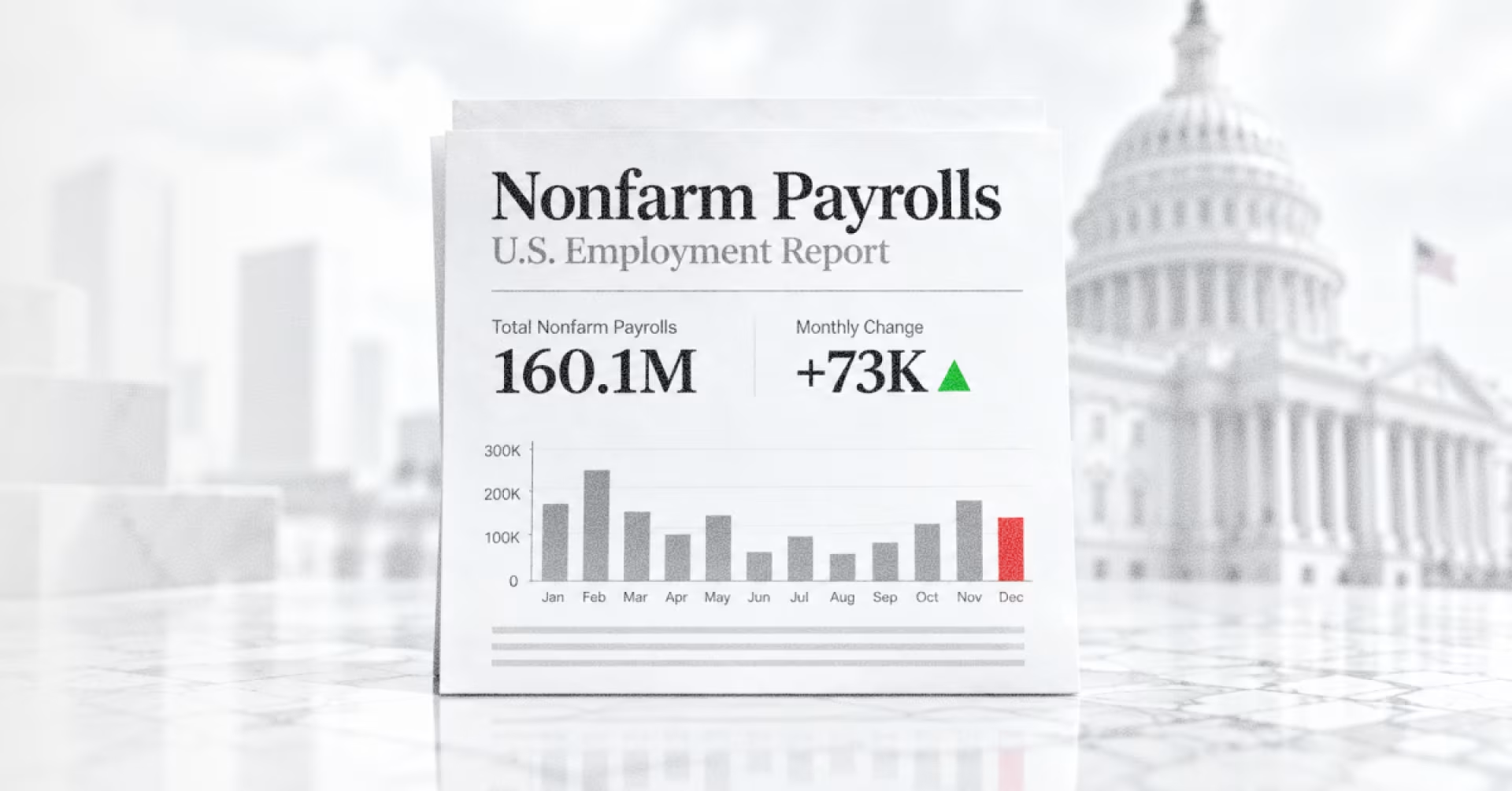
Nonfarm payroll (NFP) is the U.S. Bureau of Labor Statistics estimate of paid jobs at nonfarm establishments. Published in the monthly Employment Situation report, NFP is closely watched because it helps investors assess labor demand, economic growth, wage pressure, inflation, and the likely path of Federal Reserve policy.
Key Facts
- Nonfarm payroll data comes from the Bureau of Labor Statistics Current Employment Statistics (CES) survey of businesses and government agencies.
- NFP measures payroll jobs, not unique people, and excludes farm workers and several other categories.
- Markets read the payroll change against the consensus forecast, not against zero.
- BLS considers a monthly change of roughly 122,000 the threshold for statistical significance in the establishment survey, so smaller moves carry real sampling noise.
- The same payroll surprise can push markets in either direction, because it shifts growth expectations and interest-rate expectations at the same time.
What Is Nonfarm Payroll?
Nonfarm payroll, commonly abbreviated NFP, is the monthly estimate of jobs on U.S. nonfarm establishment payrolls. The Bureau of Labor Statistics produces the data through the Current Employment Statistics program.
CES employment counts people on establishment payrolls who received pay for any part of the pay period that includes the 12th day of the month. The survey includes full-time and part-time workers and also produces estimates for average hourly earnings and average weekly hours.
NFP measures payroll jobs rather than unique workers. A person with two payroll jobs can be counted twice in establishment data, which is one reason NFP differs from the separate household survey used to calculate the unemployment rate.
What Does Nonfarm Payroll Exclude?
The headline measure excludes farm employment, proprietors and the self-employed, unpaid family workers and volunteers, private household workers, and uniformed members of the armed forces. Government employment in the series covers civilian employees only.
The self-employed are counted by the household survey but not by the establishment survey. That difference in scope is one reason the two measures can move differently in the same month.
NFP is therefore broad but not universal. It is best understood as a high-frequency measure of employment across most U.S. businesses and government employers rather than a count of every working person.
How Is the U.S. Jobs Report Produced?
The CES program surveys approximately 119,000 U.S. businesses and government agencies each month, representing roughly 622,000 individual worksites nationwide. That sample covers about a quarter of total employment in the survey universe.
The sample alone cannot capture every job. New businesses take months to appear in the sampling frame, and firms that have closed usually stop responding before BLS can confirm they are gone. BLS applies a model-based net birth-death adjustment alongside the sample results to account for both.
The newest month is also preliminary because not every establishment responds before the first publication. BLS revises each month's estimate twice, in the two months that follow, as more responses arrive.
Once a year, BLS re-anchors the series to near-complete employment counts from unemployment insurance tax records, which cover close to 97 percent of nonfarm employment. This annual benchmark can revise the employment level across many months at once, which is why payroll history can change materially long after the initial release.
When Is Nonfarm Payroll Released?
The Employment Situation report is published monthly by the Bureau of Labor Statistics at 8:30 a.m. Eastern Time, most often on the first Friday of the month.
The date can shift because of holidays or BLS scheduling changes, so it is worth confirming the exact release date on the official BLS calendar ahead of each report. Because the report arrives at a fixed time and is widely followed, markets can move sharply within seconds of publication.
Why Does NFP Matter to Markets?
Employment sits at the start of a chain that markets price constantly. Payrolls drive household income, income drives consumer spending, and spending drives corporate revenue and pricing power. A weakening labor market runs the same chain in reverse.
Employment is also one half of the Federal Reserve's dual mandate, alongside price stability. That is what separates NFP from most macro releases. It is not simply an indicator the Fed watches, it is one of the two outcomes the Fed is tasked with delivering.
Payroll growth does not determine interest-rate decisions on its own, but combined with inflation and wage data it changes how investors price the path of policy. That connection to rates is why a single jobs report can move Treasury yields, the U.S. dollar, equities, commodities, and crypto at the same time.
How Do Traders Read the NFP Report?
Headline payroll change
The first number most traders watch is the monthly change in total nonfarm payroll employment. The market reaction often depends less on whether jobs increased and more on how the result compares with the consensus forecast.
Unemployment rate
The unemployment rate comes from a separate household survey and counts only people actively looking for work. It can fall when discouraged workers stop searching, not only when hiring improves. The participation rate, the share of the population working or looking for work, is what tells the two apart.
Average hourly earnings
Wage growth can matter as much as the payroll headline. Faster wage growth can support consumption but can also raise concerns about persistent inflation, depending on productivity and the broader economy.
Average weekly hours
Hours worked can reveal changes in labor demand before they appear in hiring. Companies may reduce hours before cutting headcount or increase hours before adding workers.
Revisions
Previous payroll readings are often revised. A strong current headline can look less positive if prior months are revised down, while a weak current number can look less negative if earlier months are revised higher.
What Happens When NFP Beats Expectations?
Suppose economists expect payroll employment to rise by 100,000, but the report shows a gain of 220,000 with firm wage growth and an unchanged unemployment rate.
Investors may read that as stronger economic momentum. Treasury yields could rise if traders expect the Federal Reserve to keep rates higher for longer. Rate-sensitive growth stocks could face pressure, while some cyclical sectors might benefit from stronger demand expectations.
The same surprise therefore pulls in two directions at once: stronger growth expectations on one side, tighter expected policy on the other. Which one dominates depends on the macro environment at the time.
What Happens When NFP Misses Expectations?
A downside surprise can increase concerns about slowing growth and reduce expectations for future interest rates. That can support bonds and, in some environments, rate-sensitive assets.
The relationship is not symmetrical with an upside surprise. A modest miss usually leaves lower rate expectations as the dominant force. A severe miss can flip that, because the same report now carries recession risk: earnings expectations fall, risk appetite falls, and lower expected rates read as a response to weakness rather than a catalyst for risk assets.
Why Can Markets Reverse After the Initial NFP Move?
The first move reflects the headline alone, because that is the only number available in the first seconds. Everything else in the report arrives at reading speed, not at algorithmic speed.
That gap is where reversals happen. A number that looked decisive on release can read differently once the supporting detail is priced in, and the initial direction is sometimes fully retraced.
This is why major macro releases can produce sharp reversals and wider spreads.
How Does NFP Affect Stocks?
Stocks react through two channels that can pull against each other: expected company earnings, and the rate used to discount those earnings.
The split shows up across sectors. Long-duration growth stocks are the most exposed to the discount rate. Banks can benefit from higher rates. Cyclicals track demand more closely than rates. A flat index on NFP day can hide large moves in opposite directions underneath
How Does NFP Affect Crypto?
Crypto trades globally and continuously, but U.S. macro data still matters because dollar liquidity, Treasury yields and Federal Reserve expectations shape global risk appetite.
Two structural differences change how the reaction looks. The report lands at 8:30 a.m. ET, roughly ninety minutes before the U.S. equity open, so crypto prices the number first while stock markets are still closed. And because releases fall on Fridays, crypto carries the repricing through a weekend that equities sit out.
The channels differ too. Stocks respond through both expected earnings and the discount rate. Crypto has no earnings channel, which leaves rate expectations doing more of the work.
The Bottom Line
Nonfarm payroll is one of the most influential monthly readings on the U.S. labor market. The headline job change matters, but investors should read it alongside wages, unemployment, hours, participation, industry details, and revisions. For markets, the central question is what the report changes about expectations for growth, inflation, and monetary policy.
Learn more about Backpack
Exchange | Wallet | Twitter | Discord | Reddit
Disclaimer: This content is presented to you on an “as is” basis for general information and educational purposes only, without representation or warranty of any kind. It should not be construed as financial, legal or other professional advice, nor is it intended to recommend the purchase of any specific product or service. You should seek your own advice from appropriate professional advisors. Where the article is contributed by a third party contributor, please note that those views expressed belong to the third party contributor, and do not necessarily reflect those of Backpack. Please read our full disclaimer for further details. Digital asset prices can be volatile. The value of your investment may go down or up and you may not get back the amount invested. You are solely responsible for your investment decisions and Backpack is not liable for any losses you may incur. This material should not be construed as financial, legal or other professional advice.