If you follow financial news long enough, you will hear "yields are rising" treated as a market event on its own. That is not an accident. The 10-year Treasury yield is arguably the single most-watched number in global finance, and May 2026 offered a sharp reminder of why. Yields surged to their highest levels in over a year, global bond markets moved in lockstep, and the effects landed on everything from your mortgage to Bitcoin's price. Here is what it all means.
What Is the 10-Year Treasury Yield?
The U.S. government borrows money by issuing debt through the Department of the Treasury. These securities come in different maturities: bills (under one year), notes (two to ten years), and bonds (twenty to thirty years). The 10-year note is the most traded and most referenced of all of them. The "yield" on that note is the annualized return an investor receives if they buy it and hold it until maturity.
How Treasury Notes Work
When the government issues a new 10-year note, it sets a fixed coupon rate. Buy a $1,000 note at a 4.5% coupon, and you receive $45 per year in interest payments for ten years. At maturity, you get your $1,000 principal back. The coupon never changes. What changes is the price that investors are willing to pay for that note in the secondary market, and that is where the yield comes from.
The Price-Yield Relationship
Bond prices and yields move in opposite directions. This is the foundational mechanic that most new investors get wrong.
Suppose you hold a note paying a 3% coupon. Market rates then rise to 4%. Newly issued notes now pay more. Your 3% note becomes less attractive, so its market price drops until its effective return matches the 4% that buyers can get on new issuances. When the price of an existing bond falls, its yield rises. When the price rises, the yield falls. The coupon is fixed; the yield adjusts to what the market demands.
Key Takeaways
- The 10-year Treasury yield is the annual return on a U.S. government note maturing in ten years and serves as the global benchmark for the risk-free rate.
- Bond prices and yields move in opposite directions. Investors selling bonds pushes prices down and yields up.
- The yield reflects two things at once: expectations for inflation and expectations for where the Federal Reserve will set interest rates.
- Rising yields increase borrowing costs across the economy, directly affecting mortgages, corporate loans, and government debt.
- Nominal yield and real yield are not the same. A 4.5% nominal yield shrinks in real terms if inflation is running at 3%.
- For traders, the 10-year yield represents the opportunity cost of risk. When a safe government bond pays close to 5%, every riskier asset has a higher bar to clear.
Understanding the Yield
Nominal Yield vs Real Yield
The figure quoted in headlines is the nominal yield: the raw interest rate before accounting for inflation. A 4.5% yield does not mean you are 4.5% richer in purchasing power if consumer prices are rising at 3%. Your real return is roughly 1.5%.
The U.S. Treasury also issues inflation-adjusted bonds called TIPS (Treasury Inflation-Protected Securities). The yield on a 10-year TIPS adjusts automatically for CPI changes, making it a true real return. The gap between the nominal 10-year yield and the 10-year TIPS yield is known as the breakeven inflation rate, the market's implied forecast for average inflation over the next decade. A rising nominal yield driven entirely by inflation expectations signals something very different from one driven by expectations of higher real growth.
Why the 10-Year Maturity?
The ten-year horizon hits a useful middle ground. It is long enough to reflect genuine expectations about the economic cycle, inflation, and monetary policy, but short enough to remain highly liquid and widely traded. Thirty-year bonds price in more speculative risk around fiscal sustainability. Two-year notes are dominated almost entirely by near-term Federal Reserve expectations. The 10-year captures the balance between the two, which is why it became the canonical benchmark.
What Moves Treasury Yields?
Inflation Expectations
When investors expect prices to rise faster, they demand higher yields to protect the real value of their returns. A bond returning $45 per year is worth less in real terms if goods cost significantly more by the time it matures. This is why inflation data releases, particularly the Consumer Price Index, move bond markets immediately and often sharply. In April 2026, the U.S. CPI rose 3.8% year-over-year, its highest annual rate since May 2023, according to the Bureau of Labor Statistics. That report, released May 12, was a direct catalyst for the bond market selloff that followed in the weeks after.
Federal Reserve Policy
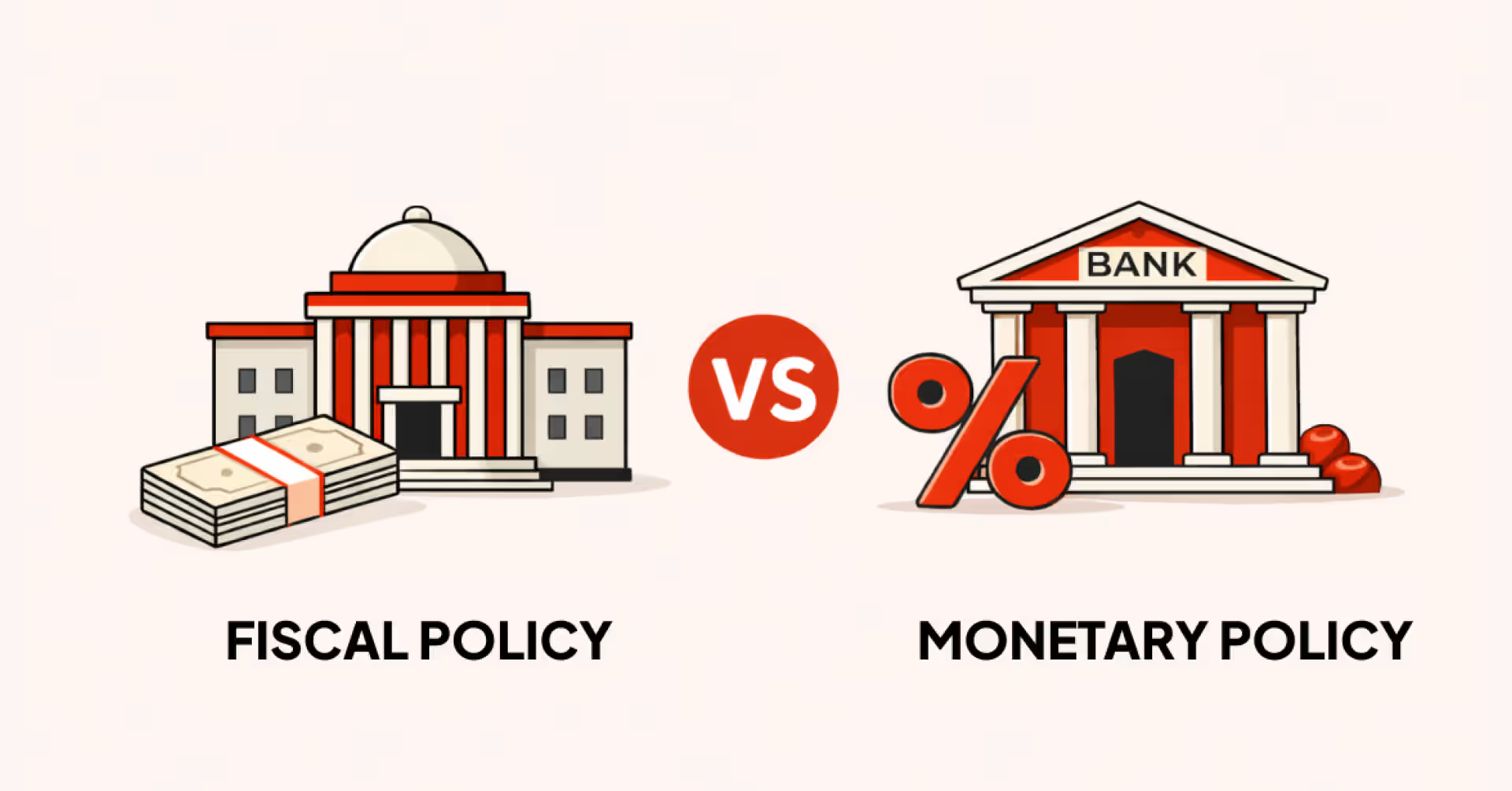
The Federal Reserve sets the federal funds rate, the overnight lending rate between banks. This anchors the short end of the yield curve directly. The 10-year yield is not set by the Fed, but it is heavily shaped by market expectations of where the Fed will take rates over time. When markets expect the Fed to keep rates higher for longer, longer-dated yields rise to reflect that path. Understanding the difference between fiscal and monetary policy helps clarify which lever is driving any particular move.
Bond Supply and Demand
Like any asset, Treasury prices respond to supply and demand. When the U.S. government runs large deficits, it issues more bonds to finance spending. More supply, all else equal, pushes prices down and yields up. Foreign demand matters too: when large holders reduce their Treasury exposure, the demand curve shifts. In periods of global stress, investors often treat Treasuries as a safe haven, which pushes prices up and yields down.
How Rising Yields Ripple Through Markets
The equity effect is not uniform. High-valuation growth stocks take the biggest hit because their value depends on cash flows far in the future, which are discounted more aggressively when rates rise. For traders using futures contracts to hedge rate exposure, the mechanics of how yields reprice across the curve are directly relevant to position sizing and collateral management.
Real-World Example: The May 2026 Bond Rout
In May 2026, the 10-year Treasury yield surged to its highest level in over a year, and the move sent shockwaves through global bond markets simultaneously.
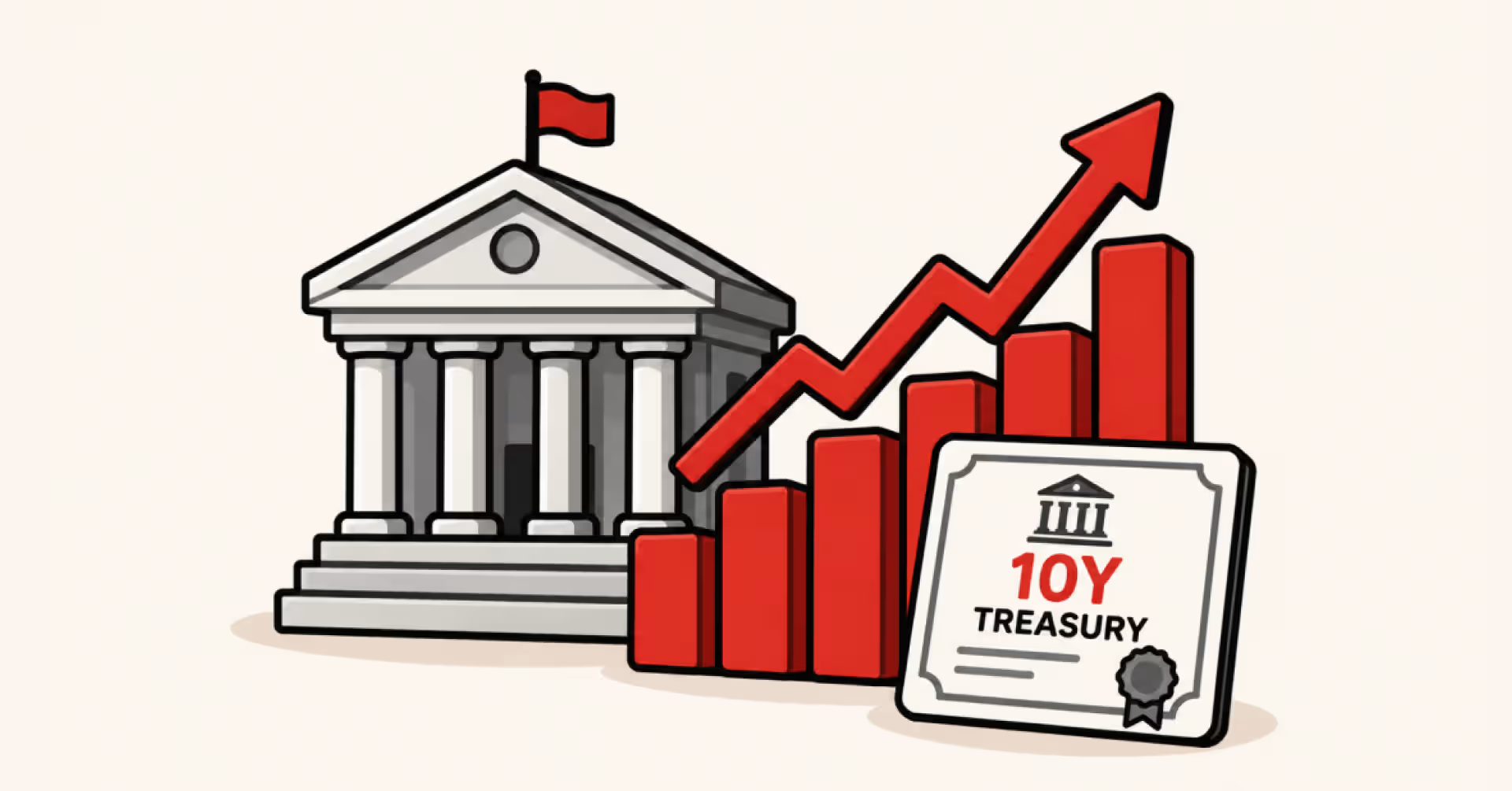
The 10-year yield closed at approximately 4.56% on May 22, 2026. Earlier in the month, the yield broke through 4.6% on May 18, hitting its highest level in 15 months, before climbing further toward 4.7% by mid-week as the selloff deepened. The 30-year yield peaked above 5.19% on May 19, its highest level since 2007. The move was not confined to the United States. Germany's 10-year bund reached its highest level since May 2011. Japan's 10-year JGB surged to its highest level since May 1997. The UK's 10-year Gilt reached its highest level since July 2008.
The catalyst was a combination of inflation pressure and geopolitical risk. April CPI rose 3.8% year-over-year, its highest annual rate since May 2023, according to the Bureau of Labor Statistics. The real-economy transmission was immediate: the 30-year fixed mortgage rate rose to 6.51% for the week of May 21, up from 6.36% the prior week, according to Freddie Mac's Primary Mortgage Market Survey. FOMC minutes from the period also showed policymakers keeping rate hike options open, further pressuring longer-dated yields. The episode illustrated a core principle: when the global risk-free rate moves, nothing is insulated.
What Does the 10-Year Yield Mean for Crypto?
For spot market crypto traders, the 10-year yield functions as an invisible weight on risk appetite. The logic is direct: when the safest asset in the world pays close to 5%, every riskier investment needs to offer a meaningfully higher return to justify the additional risk. Crypto, with its volatility, sits at the far end of that spectrum.
There is also a more specific channel through stablecoin and DeFi yields. If the risk-free rate is near 5%, a lending protocol offering 3-4% on stablecoins is not competitive with simply holding Treasuries. This compresses capital flows into DeFi and creates upward pressure on lending rates across the ecosystem, which in turn raises the cost of leverage. The 10-year yield sets a floor that the entire crypto yield market has to clear.
The dollar channel reinforces this. A higher 10-year yield generally strengthens the US dollar as investors move into dollar-denominated assets. A stronger dollar can make crypto more expensive for international investors, which dampens demand at the margin. None of this means crypto falls every time yields rise, but the 10-year yield is one of the clearest signals that the cost of risk across the broader economy is shifting.
The Bottom Line
The 10-year Treasury yield is not an obscure bond market statistic. It is the baseline cost of money in the global financial system, and it shapes the environment in which every asset competes for capital. When it moves sharply, the effects reach mortgages, equities, exchange rates, and crypto. May 2026 was a live demonstration of that transmission at scale.