Investing in stocks is one of the most reliable ways to build long-term wealth. The mechanics of buying a share, however, have changed more in the past two years than in the previous two decades. Trading hours are expanding beyond the traditional 9:30am to 4:00pm window, and funding rails now include stablecoins alongside bank transfers. This guide walks through how to invest in stocks from first principles, then shows what a modern brokerage account looks like in 2026 and why the differences matter.
What it means to invest in stocks
A stock represents partial ownership in a public company. When you buy one share of Apple, you own a claim on a small fraction of Apple's assets, earnings, and future cash flows. The share price rises and falls based on the market's collective view of what those future cash flows are worth. Some companies also pay a portion of profits back to shareholders as dividends.
Over long horizons, US equities have historically returned around 10% per year on average in nominal terms, or roughly 7% after adjusting for inflation, since 1928. Returns vary significantly year to year, and stocks can decline in value in any given period. Past performance does not guarantee future results.
Choose a stock broker
Opening a brokerage account is the entry point to stock investing. Five criteria matter most when choosing a broker in 2026.
1. Trading hours coverage. Regular trading hours are 9:30 a.m. to 4:00 p.m. Eastern Time (ET), Monday through Friday. Some brokers now offer 24/5 trading across overnight, pre-market, and after-hours sessions. In July 2026, Backpack Securities launched the first 24/7/365 market for select real US equities, extending trading through weekends and holidays.
2. Fractional shares. The ability to buy a portion of a full share, sometimes down to a dollar's worth. This matters when share prices for individual stocks range from single digits to several thousand dollars per share. Fractional shares let you build a diversified portfolio without needing large capital.
3. Funding methods. Traditional US brokers fund accounts via ACH bank transfer, which typically clears in one to three business days, or wire transfer, which moves faster. A newer generation of brokers accepts stablecoin funding, which settles in seconds and works globally without international wire complexity.
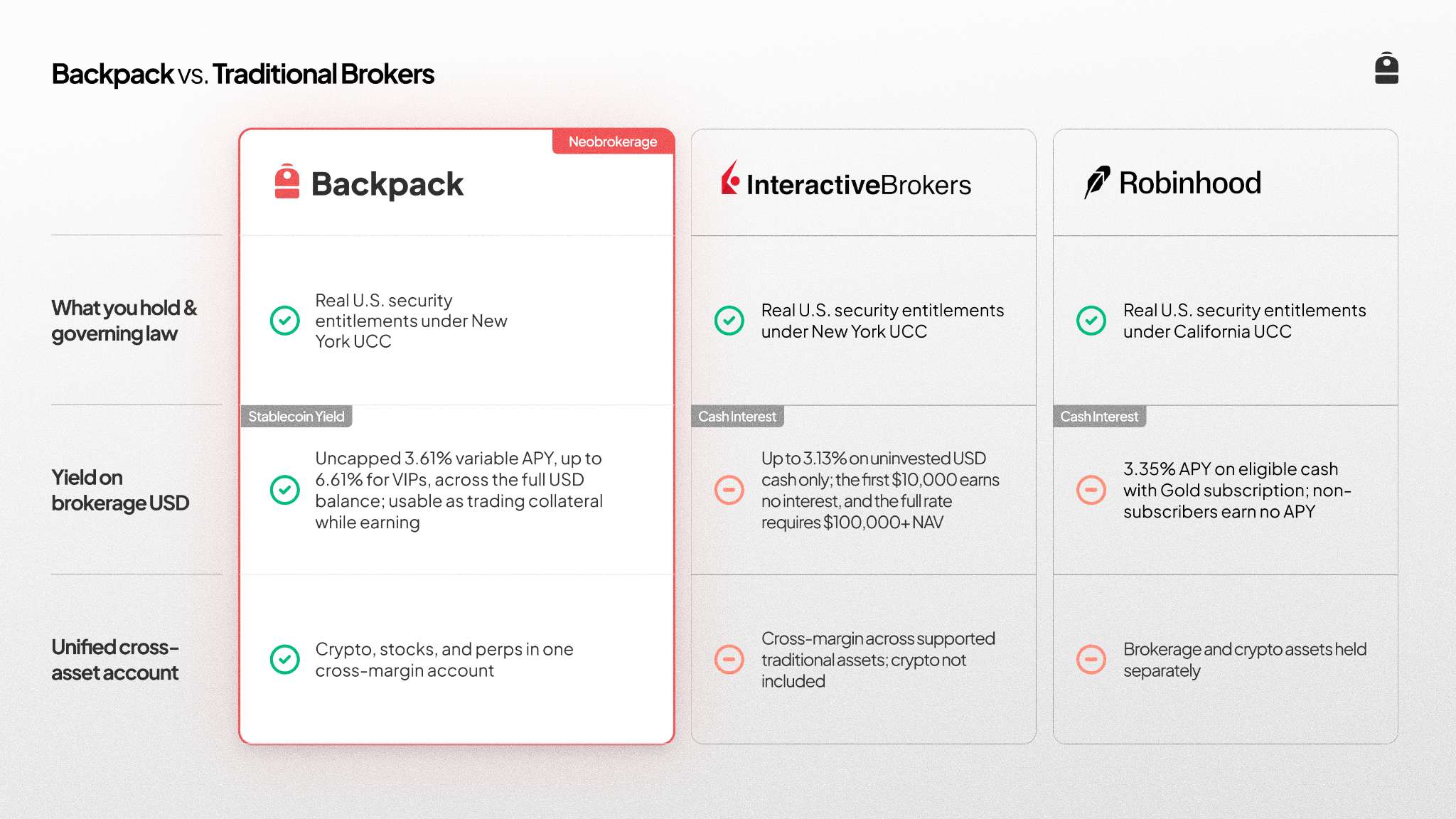
4. Yield on idle cash. Cash sitting in a brokerage account waiting to be invested is often overlooked. Some brokers pay near zero on default cash balances. Others offer higher rates through cash sweep programs, though these typically require opt-in or a premium tier. On Backpack Securities, idle USD earns up to 6.62% APY through Auto Lend, a feature that automatically generates yield on uninvested balances.
5. Real ownership structure. Real ownership gives you rights to dividends, corporate actions, and brokerage transferability. Synthetic exposure only tracks price. As more crypto-native platforms offer stock products, check whether the platform holds shares under a recognized legal framework such as New York UCC Article 8.
How major stock brokers compare in 2026
What to buy: individual Stocks or ETFs
Two main categories of stock investments are individual stocks and exchange-traded funds (ETFs).
Individual stocks are shares of specific companies (SpaceX, Micron, Sandisk). Higher potential returns but higher concentration risk if the company underperforms.
Exchange-traded funds hold baskets of stocks. An S&P 500 index fund, for example, holds all 500 companies in the index. Common tickers include VOO, SPY, and VTI. Lower concentration risk but returns track the broader index.
Both can be traded through the same brokerage account.
Depositing cash in your account
Brokerage accounts can be funded through several methods:
- ACH transfer from a linked bank account. Standard for US-based investors, typically clears in one to three business days.
- Wire transfer from a bank. Faster than ACH, useful for larger amounts.
- Stablecoin transfer (USDC) from a self-custody wallet or crypto exchange. Settles in seconds and costs less than wire transfers. Does not require a bank as an intermediary. Available on brokers that support crypto-native funding, including Backpack Securities.
Availability varies by broker. Check with your broker before depositing.
Place your first order
Once your account is funded, placing an order involves three steps.
Ticker and quantity. Every US stock has a unique ticker symbol (MU for Micron, SPCX for SpaceX, NVDA for Nvidia). Enter the ticker, then specify how many shares. If your broker supports fractional shares, you can enter a dollar amount instead.
Review the quote. Every broker shows a preview with the price, quantity, and total cost before final submission.
Confirm. Once you submit, trades typically fill within seconds during regular hours.
Trading hours: when you can actually place orders
Most stock brokers only operate during regular US market hours: 9:30am to 4:00pm Eastern, Monday through Friday. This creates real problems for investors who cannot watch the market during US business hours or who want to react to news that breaks overnight or on weekends.
The full US equities session structure now spans four windows on weekdays:
- Overnight: 8:00pm to 4:00am ET, Sunday through Friday morning
- Pre-market: 4:00am to 9:30am ET, Monday through Friday
- Regular hours: 9:30am to 4:00pm ET, Monday through Friday
- After-hours: 4:00pm to 8:00pm ET, Monday through Friday
Backpack Securities supports the full continuous session from Sunday 8:00 p.m. to Friday 8:00 p.m. ET, plus a weekend order book session for select equities from Friday 8:00 p.m. to Sunday 8:00 p.m. ET. For supported equities, this extends trading around the clock, seven days a week.
Learn more about Backpack
Exchange | Wallet | Twitter | Discord | Reddit
Disclaimer: This content is presented to you on an “as is” basis for general information and educational purposes only, without representation or warranty of any kind. It should not be construed as financial, legal or other professional advice, nor is it intended to recommend the purchase of any specific product or service. You should seek your own advice from appropriate professional advisors. Where the article is contributed by a third party contributor, please note that those views expressed belong to the third party contributor, and do not necessarily reflect those of Backpack. Please read our full disclaimer for further details. Digital asset prices can be volatile. The value of your investment may go down or up and you may not get back the amount invested. You are solely responsible for your investment decisions and Backpack is not liable for any losses you may incur. This material should not be construed as financial, legal or other professional advice.