What Is the Sui Ecosystem?
Sui is a Layer 1 blockchain developed by Mysten Labs, a company founded by former Meta engineers who worked on the Diem blockchain project. Unlike most blockchains that process transactions sequentially, Sui uses an object-centric data model that allows unrelated transactions to run in parallel. The result is sub-second finality and transaction throughput that scales with the number of validators, a design that directly addresses the congestion problems that plagued earlier networks.
The Sui ecosystem refers to every project, protocol, and token that runs on or integrates with this blockchain. Just as Ethereum has its own sprawling network of dApps and DeFi protocols, Sui has built a comparable and rapidly expanding ecosystem of builders. Its native programming language, Move (adapted from Facebook's original Diem Move), prioritizes asset safety and composability, making it attractive to developers building complex financial applications.
The ecosystem spans decentralized exchanges, lending markets, NFT collections, GameFi projects, stablecoins, and cross-chain bridges. Understanding what's built on Sui and how it competes with networks like Solana is increasingly important for crypto investors evaluating the next generation of Layer 1 blockchains.
Key Takeaways
- Sui is a high-speed Layer 1 blockchain that uses parallel transaction processing to achieve sub-second finality and high throughput, distinguishing it from sequential blockchains like older Ethereum iterations.
- The Sui ecosystem spans DeFi, NFTs, GameFi, and infrastructure, with hundreds of live projects as of 2026, covering everything from decentralized exchanges to real-world asset platforms.
- Key Sui ecosystem projects include Cetus, NAVI Protocol, SuiNS, and DeepBook, protocols that provide core liquidity, lending, naming services, and order-book infrastructure for the entire network.
- SUI token serves as the network's gas and staking currency, used to pay transaction fees, participate in proof-of-stake consensus, and vote on governance proposals.
- Sui's object model enables unique applications including programmable transaction blocks, zkLogin (allowing login with Google/Apple credentials), and sponsored transactions, features that lower the barrier to entry for non-crypto users.
- Comparing Sui to Solana reveals different architectural philosophies: Sui prioritizes object-level parallelism and developer-friendly asset safety, while Solana focuses on raw global throughput via its Proof of History mechanism.
Understanding the Sui Ecosystem
The Object-Centric Model
Most blockchains track balances in accounts; your wallet holds a number representing how much ETH or SOL you own. Sui takes a different approach: every asset is a discrete, programmable object with a unique ID. Your SUI tokens, your NFTs, and your LP positions in a DeFi protocol are all objects that can be independently owned, transferred, and manipulated by smart contracts. This distinction matters because objects with no shared dependencies can be processed simultaneously by different validators, which is the foundation of Sui's parallelism.
For developers, this model enables a cleaner programming paradigm. The Move language enforces that digital assets cannot be accidentally copied or destroyed; they must be explicitly transferred or consumed. This eliminates an entire class of bugs that have cost DeFi users billions of dollars in exploits on other chains. For ecosystem builders, it means safer, more composable code from day one.
Move Language and Developer Adoption
Sui Move is a modified version of the original Move language created for the Diem project. The language's core innovation is resource types, a category of data that the compiler guarantees can never be duplicated or implicitly discarded. In practice, this means a developer writing a token contract cannot accidentally create infinite supply or burn tokens without an explicit burn function. This safety-first design has attracted serious DeFi developers looking to avoid the pitfalls of Solidity. The Sui developer ecosystem has grown substantially since mainnet launch, with tooling, SDKs, and documentation maturing through 2024 and 2025.
zkLogin and Consumer Onboarding
One of Sui's most strategically important features is zkLogin, a cryptographic primitive that lets users create a Sui wallet by authenticating with their Google, Apple, or Facebook account. Behind the scenes, a zero-knowledge proof ties the social login to a wallet address without revealing the user's identity on-chain. For ecosystem projects building consumer apps, including games, social platforms, and loyalty programs, this means onboarding users who have never touched a crypto wallet. Projects like SuiPlay (the gaming hardware initiative) and several GameFi titles leverage zkLogin to reach mainstream audiences.
Top Sui Ecosystem Projects
DeFi and Decentralized Exchanges
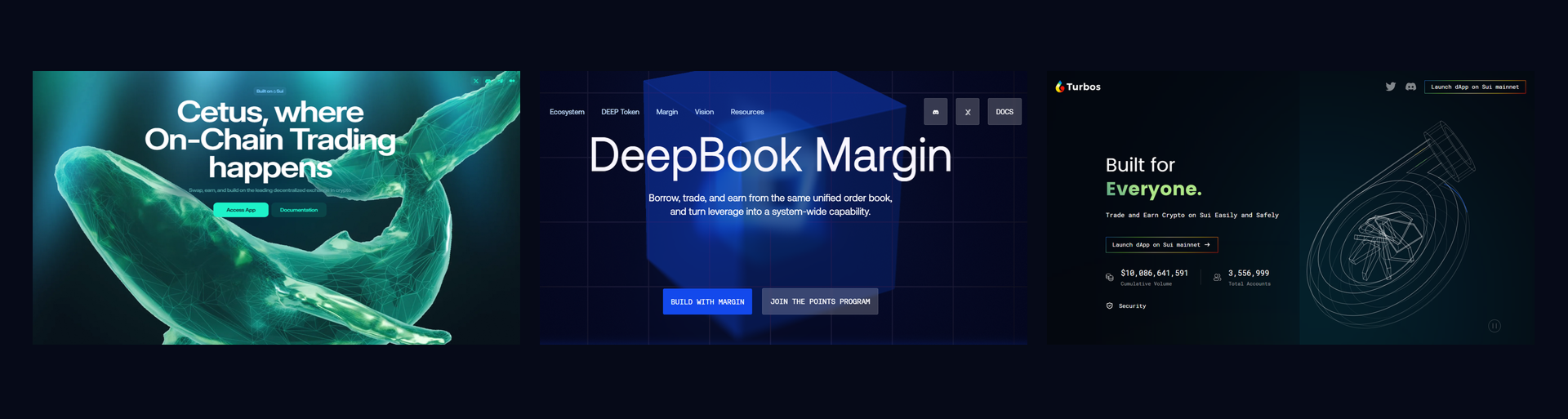
Cetus Protocol is Sui's leading DEX and concentrated liquidity AMM, holding roughly 65% TVL dominance across all Sui trading venues by mid-2025. Its "Liquidity as a Service" SDK makes it foundational infrastructure; other protocols plug into Cetus pools rather than building their own liquidity from scratch. In May 2025, Cetus suffered a $223M exploit; Sui validators froze ~$162M of stolen funds on-chain and Cetus relaunched within weeks, regaining its top position.
DeepBook is Sui's native on-chain central limit order book (CLOB), shared infrastructure built into the Sui framework that any DEX or trading app can plug into. It brings limit orders and professional market-making on-chain, reducing fragmented liquidity across competing AMMs. This is analogous to how spot market mechanics work on traditional exchanges, but executed trustlessly.
Turbos Finance is a concentrated liquidity DEX competing with Cetus, differentiated by a wider dynamic fee range and deeper aggregator integrations. Its revamped interface streamlines the LP experience, and it hosts its frontend on decentralized storage for added resilience.
Lending and Money Markets
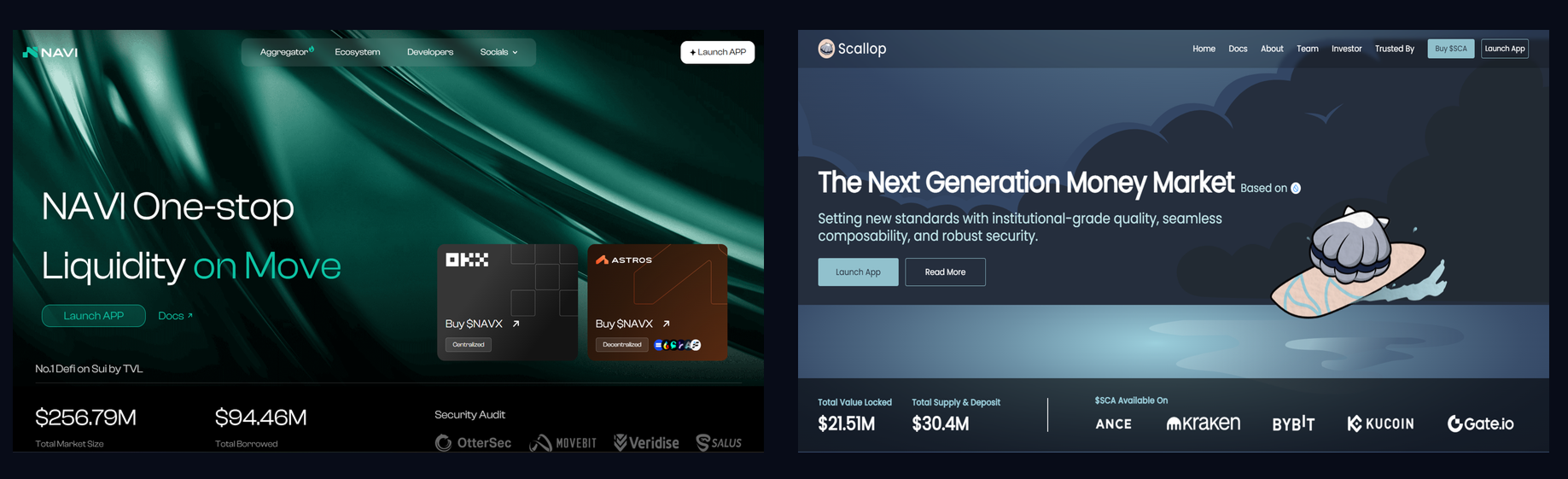
NAVI Protocol is Sui's leading lending and borrowing market, the closest equivalent to Aave on Ethereum. Users deposit SUI, USDC, wETH, wBTC, and other assets as collateral to borrow or earn yield. By end of 2025, NAVI had reached a peak TVL of $1 billion with over 1 million unique users, making it one of the fastest-growing money markets across all Layer 1s.
Scallop is one of Sui's major money markets and the first DeFi protocol to receive a Sui Foundation grant. Its architecture separates collateral from lending pools for stronger systemic resilience, and its sToken model (interest-bearing receipt tokens) enables composability with other protocols. The SCA token uses a vote-escrow (veSCA) model to align long-term participation.
NFTs and Digital Collectibles
TradePort and BlueMove are the two dominant NFT marketplaces on Sui. TradePort is preferred by high-volume traders for its advanced analytics and multi-chain support; BlueMove is community-driven with 0% listing fees and a strong launchpad for creators. Clutchy serves a gaming-specific niche, focused on Web3 in-game asset trading for Sui's growing GameFi projects. Top collections include Sui Frens, Prime Machin, and Fuddies, many leveraging Sui's object model to enable NFTs that can hold other assets inside them.
Infrastructure and Tooling
SuiNS (Sui Name Service) lets users replace wallet addresses with human-readable names like backpack.sui. Domains are Sui objects, transferable and composable across any dApp, and the NS token powers fully on-chain DAO governance, without multisig. Over 330,000 names had been registered by late 2025.
Sui Bridge is the network's native cross-chain bridge, operational since September 2024 and governed by Sui validators, the same set that secures the entire network. It supports ETH, WETH, WBTC, LBTC, and USDT between Ethereum and Sui. Alongside it, Wormhole (Connect and Portal Bridge) handles multi-chain routes to Solana, Avalanche, and BSC, while ZetaChain enables omnichain messaging. Understanding how assets move between chains matters for anyone managing a cross-chain portfolio, much like understanding futures trading mechanics matters for professional traders.
GameFi and Consumer Apps
Sui's gaming vertical is anchored by SuiPlay0X1, a handheld gaming device announced by Mysten Labs that natively integrates Sui wallets at the OS level, targeting mainstream Web3 adoption. On-chain games leverage Sui's fast finality and zkLogin so players truly own in-game items without needing a crypto wallet setup. This mirrors the broader trend of real-world assets being brought on-chain, applied to virtual economies.
Sui Ecosystem Comparison Table
How Does the Sui Ecosystem Compare to Solana?
Sui and Solana are often compared because both target high-throughput, low-latency applications and both have attracted significant developer and venture capital interest. The architectural differences are meaningful. Solana achieves speed through Proof of History, a cryptographic clock that sequences transactions globally before validation, enabling a single globally-ordered ledger to process tens of thousands of transactions per second. Sui achieves speed through parallel execution of independent transactions, meaning its theoretical throughput scales with hardware improvements and validator count rather than being fixed by a single sequencing mechanism.
In practice, Solana has a larger total ecosystem by TVL, user count, and number of established protocols as of early 2026, reflecting its 2020 mainnet launch versus Sui's 2023 launch. Sui's advantage is its newer, safer programming model and its consumer onboarding features like zkLogin. For developers, Solana's Rust-based programs offer familiarity, while Sui's Move language offers stronger asset safety guarantees. Neither is strictly superior; they represent different design bets on what matters most in a high-performance blockchain. Understanding these tradeoffs is as important as understanding the difference between fiscal and monetary policy when evaluating macro investment theses: the framing shapes the conclusion.
Is Investing in Sui Ecosystem Tokens Safe?
All cryptocurrency investments carry significant risk, and Sui ecosystem tokens are no exception. Most project tokens (CETUS, NAVX, SCA, and others) are governance or utility tokens with valuations tied to protocol usage, total value locked, and broader market sentiment. They are small-cap assets with higher volatility than SUI itself, which is already a volatile asset. Token emissions schedules, VC unlock events, and protocol security risks (smart contract bugs, oracle manipulation) are all material factors.
Due diligence on any Sui ecosystem project should include reviewing the protocol's audit history, tokenomics and vesting schedule, team credibility, and TVL trends. Projects with no audit, anonymous teams, and rapidly inflating token supplies carry substantially higher risk than established protocols with transparent governance. This is educational context, not financial advice. Always consult a licensed financial advisor before making investment decisions. Understanding how broader market instruments like futures contracts work can also help contextualize the risk management tools available to crypto investors.
What Are Sui Ecosystem Airdrops?
Several Sui ecosystem projects have distributed tokens to early users via airdrops, retroactive rewards for protocol usage, testnet participation, or NFT ownership. SuiNS distributed NS tokens to early domain registrants. Other protocols have announced or hinted at future token launches that may include airdrop components for early liquidity providers and traders.
Airdrop farming, deliberately using protocols to qualify for future token distributions, is a common activity in the Sui ecosystem. The strategy carries risks: protocols may change eligibility criteria, introduce Sybil resistance that disqualifies farmed wallets, or launch tokens below expectations. Airdrop activity also requires trusting unaudited or early-stage smart contracts with capital, which increases the risk profile substantially versus simply holding SUI.
The Bottom Line
The Sui ecosystem has evolved from a technically impressive but sparsely populated blockchain into a genuine DeFi and consumer application platform with live protocols handling real capital. Projects like Cetus, NAVI, DeepBook, and SuiNS form the core infrastructure layer, while a growing cohort of GameFi, NFT, and consumer applications builds the user-facing layer on top. Whether Sui's object model and Move language will prove to be a lasting advantage over competitors remains to be seen, but the ecosystem's trajectory from 2023 to 2026 has been one of consistent growth. For investors and developers tracking the next generation of Layer 1 networks, Sui deserves serious attention alongside established benchmarks like the S&P 500 of crypto infrastructure. Understanding the full ecosystem, its protocols, tokens, and underlying mechanics, is the first step to participating in it intelligently. As with any market, knowledge compounds faster than capital.
Learn more about Backpack
Exchange | Wallet | Twitter | Discord | Reddit
Disclaimer: This content is presented to you on an “as is” basis for general information and educational purposes only, without representation or warranty of any kind. It should not be construed as financial, legal or other professional advice, nor is it intended to recommend the purchase of any specific product or service. You should seek your own advice from appropriate professional advisors. Where the article is contributed by a third party contributor, please note that those views expressed belong to the third party contributor, and do not necessarily reflect those of Backpack. Please read our full disclaimer for further details. Digital asset prices can be volatile. The value of your investment may go down or up and you may not get back the amount invested. You are solely responsible for your investment decisions and Backpack is not liable for any losses you may incur. This material should not be construed as financial, legal or other professional advice.