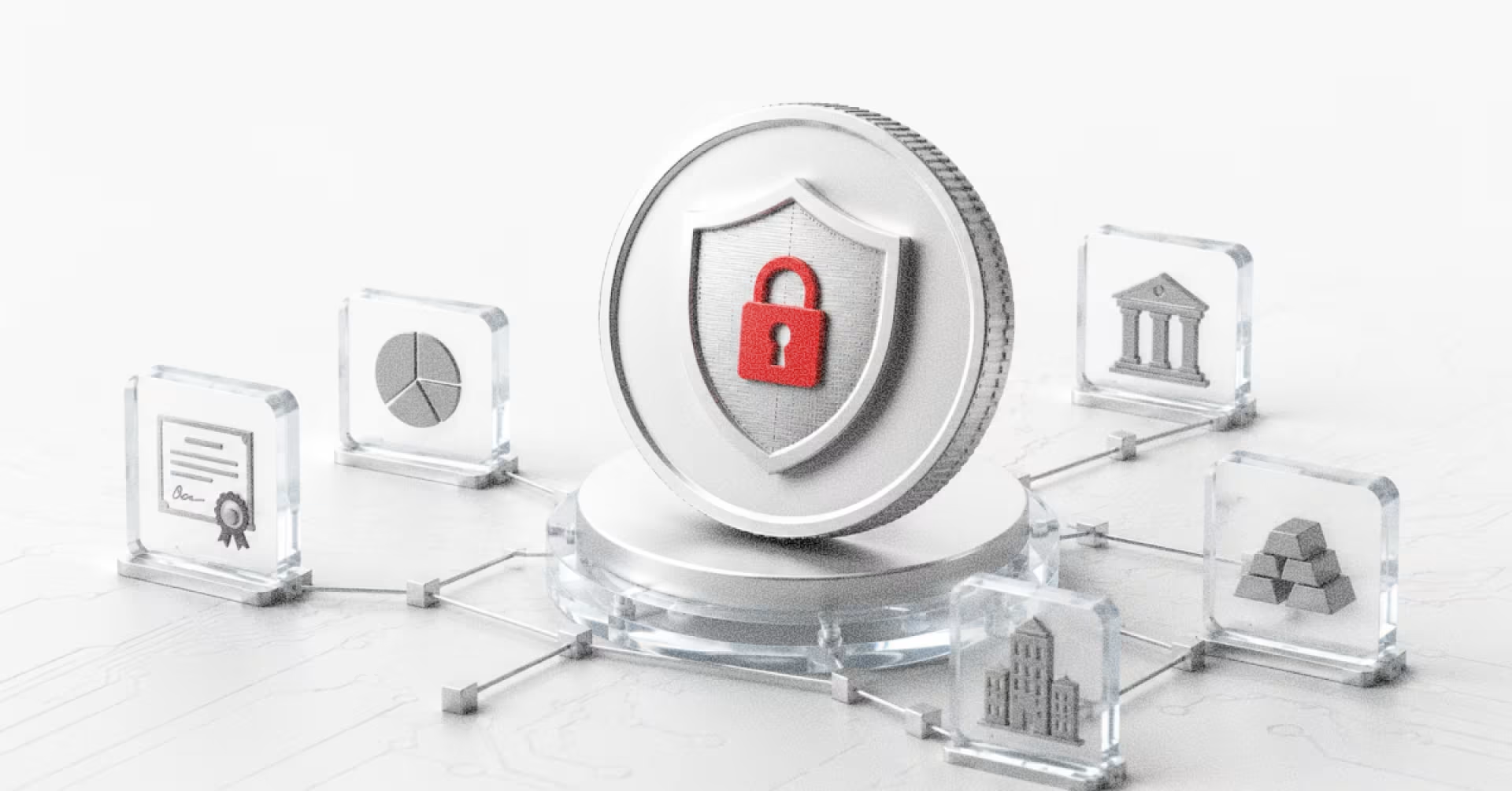
A security token is a blockchain-based digital asset that represents a regulated financial investment, such as shares in a company, a bond, or a fund interest. Unlike cryptocurrencies such as Bitcoin, security tokens derive their value from an external, legally recognized asset and are subject to securities laws in the jurisdictions where they are offered. In practice, a security token functions like a traditional security with blockchain infrastructure handling issuance, transfer, and settlement.
Note: in cybersecurity, "security token" can also refer to a physical or software device used for login authentication. This article covers the financial meaning of the term.
Key Takeaways
- A security token represents a regulated investment (equity, debt, funds, or real assets) issued and transferred on a blockchain, and it falls under securities law.
- In the United States, whether a token is a security is generally assessed using the Howey test, which looks at investment of money in a common enterprise with an expectation of profit from the efforts of others.
- Security tokens are not the same as utility tokens, and not all tokenized stock products grant ownership of the underlying asset. Structures vary significantly between platforms.
- The market for tokenized real-world assets passed roughly $33 billion in on-chain value by mid-2026 according to RWA.xyz, and institutions including the DTCC, Nasdaq, and BlackRock are building tokenized securities infrastructure.
How Does a Security Token Work?
A security token works by recording ownership of a financial asset on a blockchain instead of, or alongside, a traditional securities ledger. The issuer creates tokens through a smart contract, and each token represents a defined legal claim: a share of stock, a portion of a bond, an interest in a fund, or a fractional interest in an asset such as real estate.
Three components define how a specific security token behaves:
- The legal wrapper. This is the contract or regulatory framework that defines what the holder actually owns. Two tokens can look identical on-chain and carry completely different rights depending on the legal structure behind them.
- The custody arrangement. Someone must hold the underlying asset. This may be a regulated broker-dealer, a transfer agent, a special purpose vehicle, or the issuer itself. Custody determines what happens to investors if the platform fails.
- The transfer rules. Because securities laws restrict who can buy and sell regulated investments, most security tokens include programmable compliance: whitelisted wallets, jurisdiction checks, and lockup enforcement built into the token contract.
How Does a Token Become a Security?
In the United States, a token is generally treated as a security if it meets the criteria of the Howey test, a standard from the 1946 Supreme Court case SEC v. W.J. Howey Co. The test asks whether there is (1) an investment of money, (2) in a common enterprise, (3) with an expectation of profit, (4) derived from the efforts of others. The SEC's 2019 "Framework for 'Investment Contract' Analysis of Digital Assets" applies this test specifically to crypto tokens.
The practical consequence: if a token qualifies as a security, the issuer must register the offering with the SEC or use an exemption (such as Regulation D, Regulation S, or Regulation A+), and trading venues handling the token may need broker-dealer or exchange licenses. Other jurisdictions apply their own tests. In the European Union, the MiCA regulation explicitly excludes tokens that qualify as financial instruments, which instead fall under existing EU securities rules such as MiFID II.
Security Token vs. Utility Token: What Is the Difference?
The difference between a security token and a utility token is the source of value and the legal treatment. A security token represents an investment in an asset or enterprise and is regulated as a security. A utility token grants access to a product or service, such as paying for computation or storage on a network, and is generally not designed as an investment contract.
Regulators, not marketing labels, decide the category. Several tokens sold as "utility tokens" have later been treated as unregistered securities by the SEC, which is why the label an issuer uses matters less than the underlying structure.
Security Tokens vs. Tokenized Securities: Are They the Same Thing?
The terms overlap but are not identical, and the distinction matters for what you actually own.
- A security token is any blockchain token that qualifies as a security. It may be a native digital instrument with no off-chain counterpart.
- A tokenized security (or tokenized stock) is a blockchain representation of an existing traditional security, such as a listed US stock. The token mirrors an asset that also exists in conventional market infrastructure.
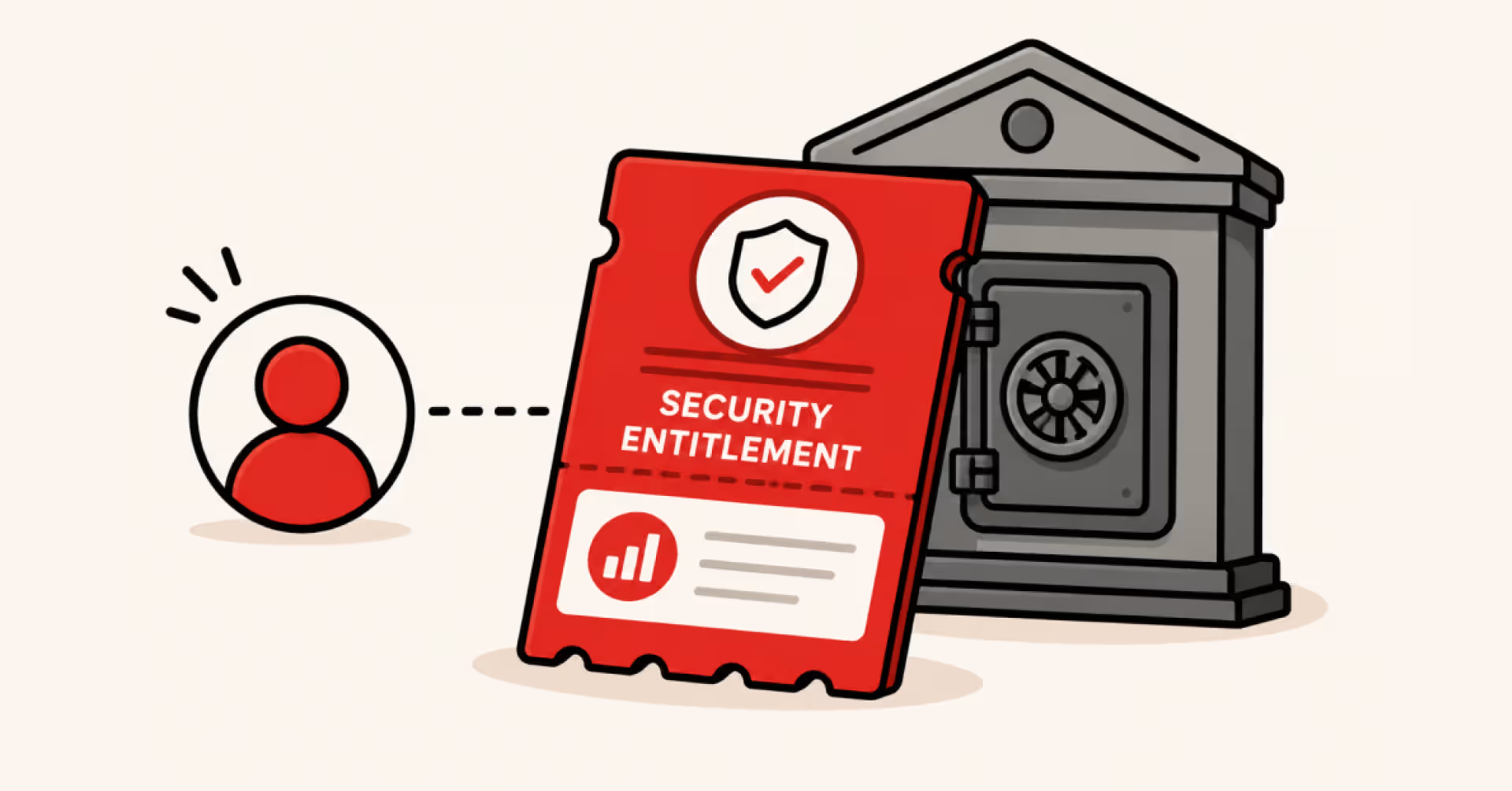
Within tokenized stocks, structures diverge further. Some products are wrappers or derivatives that track a stock's price without granting ownership of the underlying share. Others connect the token to real shares held through regulated brokerage infrastructure, where the investor holds a security entitlement, the standard legal form of ownership for brokerage-held securities under Article 8 of the New York Uniform Commercial Code. Backpack Securities is an example of the second model: investors hold US stocks as security entitlements, with the option to tokenize eligible holdings on Solana and redeem them back at any time. Before buying any tokenized stock, investors should confirm which of these models applies, because dividend treatment, corporate actions, redemption rights, and bankruptcy protections all depend on it.
How Big Is the Security Token Market?
There is no single official measure of the security token market, because definitions vary and the assets trade across many venues. The largest clearly measurable segment is tokenized US Treasuries, worth roughly $14 to $15 billion in mid-2026 and led by funds from BlackRock (BUIDL), Franklin Templeton (BENJI), Ondo, and Circle. Tokenized stocks are a smaller but fast-growing segment. Counting all tokenized real-world assets, a broader category that also includes private credit, commodities, and real estate, on-chain value reached approximately $33.5 billion by July 2026 according to RWA.xyz, nearly tripling year over year.
Institutional infrastructure is moving in the same direction. The DTCC, which settles nearly all US stock trades and custodies over $114 trillion in securities, began limited production trades of tokenized Russell 1000 stocks, major ETFs, and US Treasuries in July 2026, backed by an Industry Working Group of more than 50 firms including BlackRock, Goldman Sachs, JPMorgan, and Backpack, with a full service launch scheduled for October 2026. Boston Consulting Group has projected that tokenized assets could reach $16 trillion by 2030, though long-range forecasts in this sector vary widely and should be read as scenarios rather than predictions.
What Are the Benefits and Risks of Security Tokens?
Potential benefits:
- Faster settlement. Blockchain transfers can settle in seconds rather than the T+1 cycle of traditional US equity markets.
- Extended market access. Tokenized instruments can trade outside traditional exchange hours, including overnight and weekends on some platforms.
- Fractional ownership. High-value assets can be divided into smaller units, lowering minimum investment sizes.
- Global reach. Investors outside the issuing country can access assets through blockchain rails, subject to local regulation.
- Programmable compliance. Transfer restrictions and eligibility rules can be enforced automatically in the token contract.
Key risks:
- Structure risk. Not all tokens marketed as stock exposure grant ownership. Synthetic products carry counterparty risk that direct ownership does not.
- Liquidity risk. Many security tokens trade in thin markets, with wider spreads than their traditional counterparts, especially outside regular market hours.
- Regulatory risk. Rules differ by jurisdiction and continue to evolve. A product legal in one country may be unavailable or restricted in another.
- Platform risk. Custody arrangements determine investor protection if an issuer or platform fails. This is disclosed in offering documents and should be read before investing.
Common Misconceptions About Security Tokens
"A security token is the same as a tokenized stock." Not always. Security token is the broader legal category; tokenized stocks are one type, and even within tokenized stocks, some products grant ownership while others only track price.
"If a token pays dividends, I must own the underlying share." No. Some synthetic products adjust token balances to mirror dividends without granting any ownership rights. Payment mechanics and ownership are separate questions.
"Utility tokens can never be securities." Incorrect. Regulators assess the substance of the offering, not the label. Tokens marketed as utilities have been treated as unregistered securities when they met the Howey criteria.
"Blockchain settlement means no regulation." The opposite is closer to the truth. If the asset is a security, securities law applies regardless of the technology used to record ownership.
What Investors Should Look For
Before buying any security token or tokenized stock, confirm four things: what asset the token legally represents, who holds the underlying asset and under what regulatory framework, how dividends and corporate actions flow to holders, and whether the token can be redeemed or transferred freely. Platforms that answer these questions clearly in their documentation are easier to evaluate and compare.
Example: How Backpack Approaches Tokenized Securities
In practice, most investors first encounter the security token category through tokenized stocks, so the clearest real-world examples come from how platforms structure those products. Backpack Securities applies the ownership-first model described above. Investors hold real US stocks and ETFs as security entitlements under New York UCC Article 8, the same ownership form used by traditional brokerages, with rights to cash dividends and corporate actions. Eligible holdings can optionally be converted into tokenized securities on Solana and redeemed back into the underlying entitlement at any time. Accounts can be funded with fiat or stablecoins, and US equities trade 24/5, with select stocks available 24/7.
For investors comparing security token products, the Backpack model illustrates one end of the structural spectrum: tokenization built on top of direct ownership, rather than tokens that only reference an asset's price. Whichever platform you evaluate, the underlying question remains the same: does the token represent ownership, or only exposure?
Learn more about Backpack
Exchange | Wallet | Twitter | Discord | Reddit
Disclaimer: This content is presented to you on an “as is” basis for general information and educational purposes only, without representation or warranty of any kind. It should not be construed as financial, legal or other professional advice, nor is it intended to recommend the purchase of any specific product or service. You should seek your own advice from appropriate professional advisors. Where the article is contributed by a third party contributor, please note that those views expressed belong to the third party contributor, and do not necessarily reflect those of Backpack. Please read our full disclaimer for further details. Digital asset prices can be volatile. The value of your investment may go down or up and you may not get back the amount invested. You are solely responsible for your investment decisions and Backpack is not liable for any losses you may incur. This material should not be construed as financial, legal or other professional advice.