SPY is the ticker symbol for the State Street SPDR S&P 500 ETF Trust, an exchange-traded fund that seeks to track the S&P 500 Index before expenses. It gives investors exposure to large U.S. companies through one investment that trades on an exchange.
Buying SPY means buying shares in a fund that holds a portfolio of stocks. You do not need to purchase each underlying company separately, and your return follows the portfolio as a whole rather than any single company.
SPY ETF key facts
- Full name: State Street SPDR S&P 500 ETF Trust
- Ticker: SPY, listed on NYSE Arca and traded in U.S. dollars
- Benchmark: the S&P 500 Index, covering large U.S. companies across 11 sectors
- Annual expense ratio: 0.0945%
- Dividends: distributed quarterly
- Inception date: January 22, 1993
Fund details as of October 25, 2026.
How does SPY ETF work?
SPY tracks the S&P 500 by holding its constituent stocks in roughly the same proportions as the index. The fund adjusts its portfolio to reflect changes in the index’s composition and weightings. Its returns generally follow the benchmark, although expenses, transaction costs and cash holdings can cause differences.
As an investor, you buy and sell SPY shares on an exchange through a brokerage account, while the fund holds the underlying stocks. Two prices matter when trading SPY:
- Net asset value, or NAV: The value of the fund’s assets minus liabilities, divided by its outstanding shares.
- Market price: The price you actually pay or receive when trading SPY shares on the exchange.
SPY can trade above NAV, at a premium, or below it, at a discount. Large financial institutions called authorized participants can create and redeem shares, and their arbitrage generally keeps SPY’s market price close to NAV, although larger gaps can occur during market stress.
SPY is organized as a unit investment trust (UIT). Dividends received from its underlying stocks are held as cash until distributed to shareholders, generally quarterly, rather than reinvested in the portfolio.
Is SPY the same as the S&P 500
SPY is a fund; the S&P 500 is the index it tracks. The index measures the performance of 500 leading U.S. companies and covers approximately 80% of available U.S. equity market capitalization.
What stocks are in SPY ETF
SPY holds stocks across the S&P 500, including companies in technology, financials, healthcare and other sectors. Its holdings are not equally weighted. The benchmark weights companies by float-adjusted market capitalization, meaning the value of shares available for public trading, so larger companies carry more influence.
For example, State Street’s September 30, 2026 factsheet listed these as the largest positions:
Weights change over time as prices move and the index is rebalanced.
Owning hundreds of stocks does not mean spreading your money equally across them. In a hypothetical $1,000 investment, an 8% position represents about $80 of exposure, while a 0.2% position represents about $2. The largest holdings can therefore drive a substantial share of the fund’s movements.
A holdings list can contain more securities than companies because some companies have more than one share class in the index. Alphabet, for instance, appears as both Class A and Class C shares.
What is SPY’s expense ratio
SPY’s annual expense ratio is 0.0945%, which works out to roughly $9.45 a year for every $10,000 invested. The actual dollar cost varies with the value of your position.
Fund operating expenses are paid from fund assets and reflected in SPY’s returns; they are not billed separately to your brokerage account. These expenses are separate from the costs of trading the fund, such as brokerage commissions and the bid-ask spread, which is the gap between the prices available to buyers and sellers. A commission-free trade does not eliminate the spread.
Does SPY pay dividends
Yes. SPY distributes dividend income quarterly. The amount depends on the dividends received from its holdings after fund expenses, so payments vary and do not provide a fixed or guaranteed yield.
When checking SPY dividends, keep three figures apart:
- Dividend per share: The cash amount distributed for each eligible share.
- Trailing dividend yield: The past 12 months of distributions divided by the current share price.
- Total return: The combined effect of price changes and distributions.
To qualify for an upcoming distribution, you need to buy shares before the announced ex-dividend date. Buying on or after that date generally means the distribution goes to the seller.
SPY vs VOO vs IVV
SPY, VOO and IVV all track the S&P 500, so their stock exposure is nearly identical. The differences come down to cost, structure and trading conditions.
Expense ratios as of October 26, 2026.
On annual fund expenses, VOO and IVV cost less. At these rates the difference is about $6.45 a year per $10,000. Both are also open-end funds, so they can reinvest dividends between distributions, which SPY’s unit investment trust structure does not allow.
On trading, SPY is a heavily traded ETF with an active options market, which makes it popular with traders and institutions. Its liquidity can help keep spreads tight, but execution varies with market conditions and order size, so compare live quotes through your broker rather than assuming SPY always offers the best price.
Owning all three adds little diversification because they hold the same companies.
How is SPY different from QQQ
SPY tracks the S&P 500, while QQQ, managed by Invesco, tracks the Nasdaq-100. The Nasdaq-100 includes 100 of the largest nonfinancial companies listed on Nasdaq. Its narrower universe and emphasis on technology-related businesses can make QQQ’s returns more sensitive to developments affecting those companies.
Expense ratios as of October 26, 2026.
The two funds share most of their largest positions, including NVIDIA, Apple, Microsoft, Amazon and Alphabet. Owning both therefore adds less diversification than the different benchmarks suggest, so compare their full holdings before treating the pair as a spread of risk.
What are the risks of investing in SPY
PY can lose value when its underlying stocks fall. Spreading exposure across roughly 500 companies reduces dependence on any single business, but it does not protect against a broad stock market decline. The main risks are:
- Market losses: Recessions, changes in interest rates and weaker earnings can affect many holdings together. The S&P 500 fell roughly 57% between October 2007 and March 2009, and about 34% between February 19 and March 23, 2020.
- Concentration: A handful of mega-cap stocks carry outsized weight. As of September 30, 2026, NVIDIA alone accounted for 8.38% of the fund and the five largest holdings about 28%.
- Tracking differences: Expenses, trading costs and cash holdings can cause SPY’s returns to differ from the index.
- Trading risk: During market stress, the price you receive can differ significantly from NAV.
SPY is an equity investment with no guarantee of principal, as its prospectus sets out. A loss is also harder to recover than it looks: a 20% decline requires a 25% gain just to get back to the starting point.
How do you buy SPY ETF
You can buy SPY through any brokerage account with access to U.S.-listed ETFs. Availability depends on the broker, account type and jurisdiction.
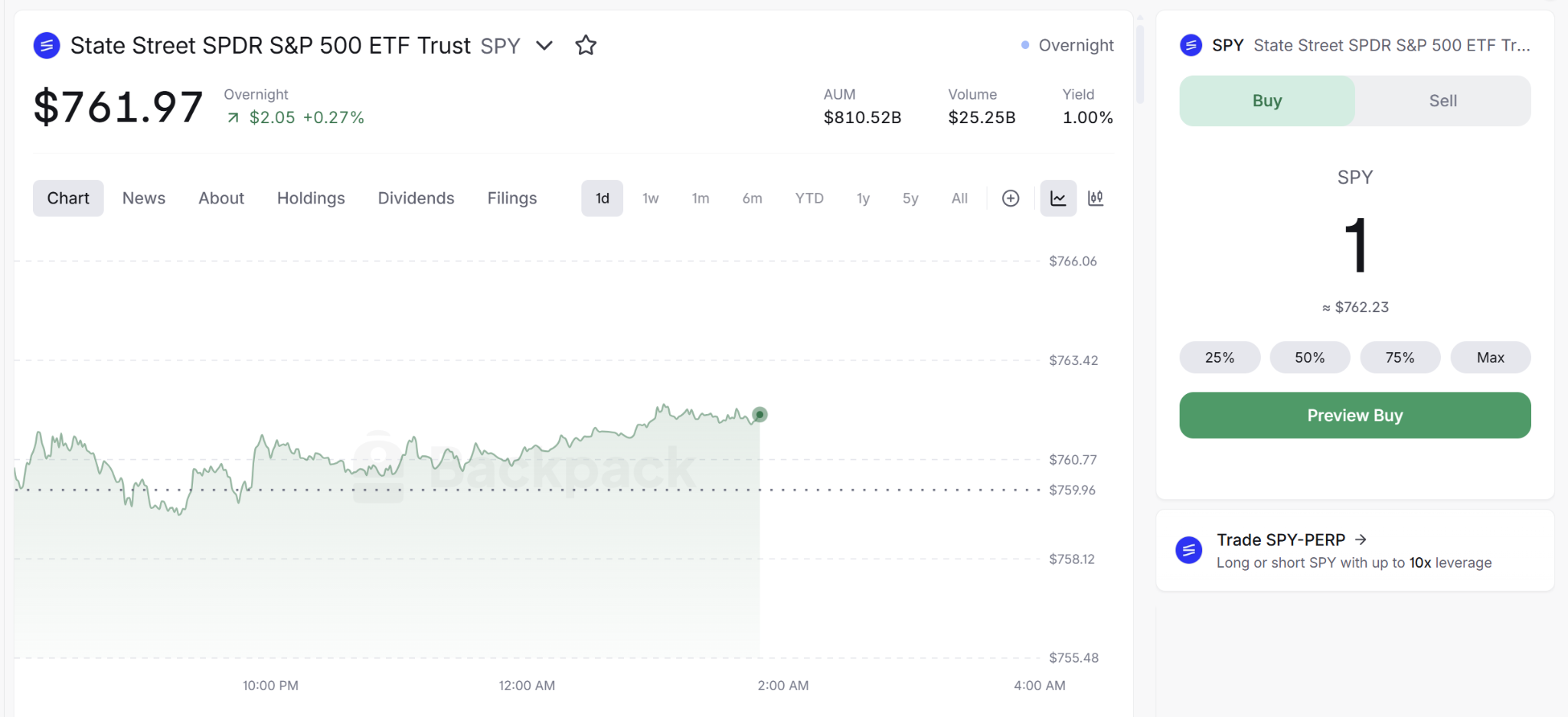
On Backpack, SPY is listed as a US ETF and bought the same way as a stock:
- Open Stocks and search for SPY.
- Enter the amount you want to buy.
- Review the quote, confirm the order and check its execution status. Once the order fills, your holdings update in your account.
What you get on Backpack:
- Real ownership. ETF shares bought on Backpack are held as real security entitlements, governed by New York law under UCC Article 8, the same property rights you would have at a conventional broker.
- One account. Your crypto, your stablecoins and your ETFs sit in the same account, so you are not moving money between a brokerage and an exchange to rebalance.
- Extended hours. SPY trades across US market sessions well beyond the regular 9:30am to 4:00pm ET window. Overnight, pre-market and after-hours trading requires whole shares.
Shares of SPY held on Backpack can also be used as collateral. Instead of selling, you can use part of their value to borrow USD, buy crypto on margin or support a perpetual futures position, all from the same account. Backpack also lists SPY-PERP, so you can trade SPY exposure outside regular market hours or open a short to hedge shares you already hold. How much each holding contributes as collateral depends on its weight, which is shown next to the asset in your Balances tab. Borrowing and leveraged trading involve risk, including liquidation.
Is SPY suitable for long-term investing
SPY can serve as the U.S. large-company core of a long-term portfolio. It offers broad exposure to the S&P 500 in a single position, pays quarterly distributions and has traded since 1993. Whether it fits you depends on your time horizon, how much S&P 500 exposure you already hold through other funds, and how comfortable you are with the drawdowns described above.
If SPY has a place in your portfolio, you can buy it on Backpack alongside your crypto and stablecoins, and put the shares to work as collateral when you need to.
Learn more about Backpack
Exchange | Wallet | Twitter | Discord | Reddit
Disclaimer: This content is presented to you on an “as is” basis for general information and educational purposes only, without representation or warranty of any kind. It should not be construed as financial, legal or other professional advice, nor is it intended to recommend the purchase of any specific product or service. You should seek your own advice from appropriate professional advisors. Where the article is contributed by a third party contributor, please note that those views expressed belong to the third party contributor, and do not necessarily reflect those of Backpack. Please read our full disclaimer for further details. Digital asset prices can be volatile. The value of your investment may go down or up and you may not get back the amount invested. You are solely responsible for your investment decisions and Backpack is not liable for any losses you may incur. This material should not be construed as financial, legal or other professional advice.