Key Takeaways
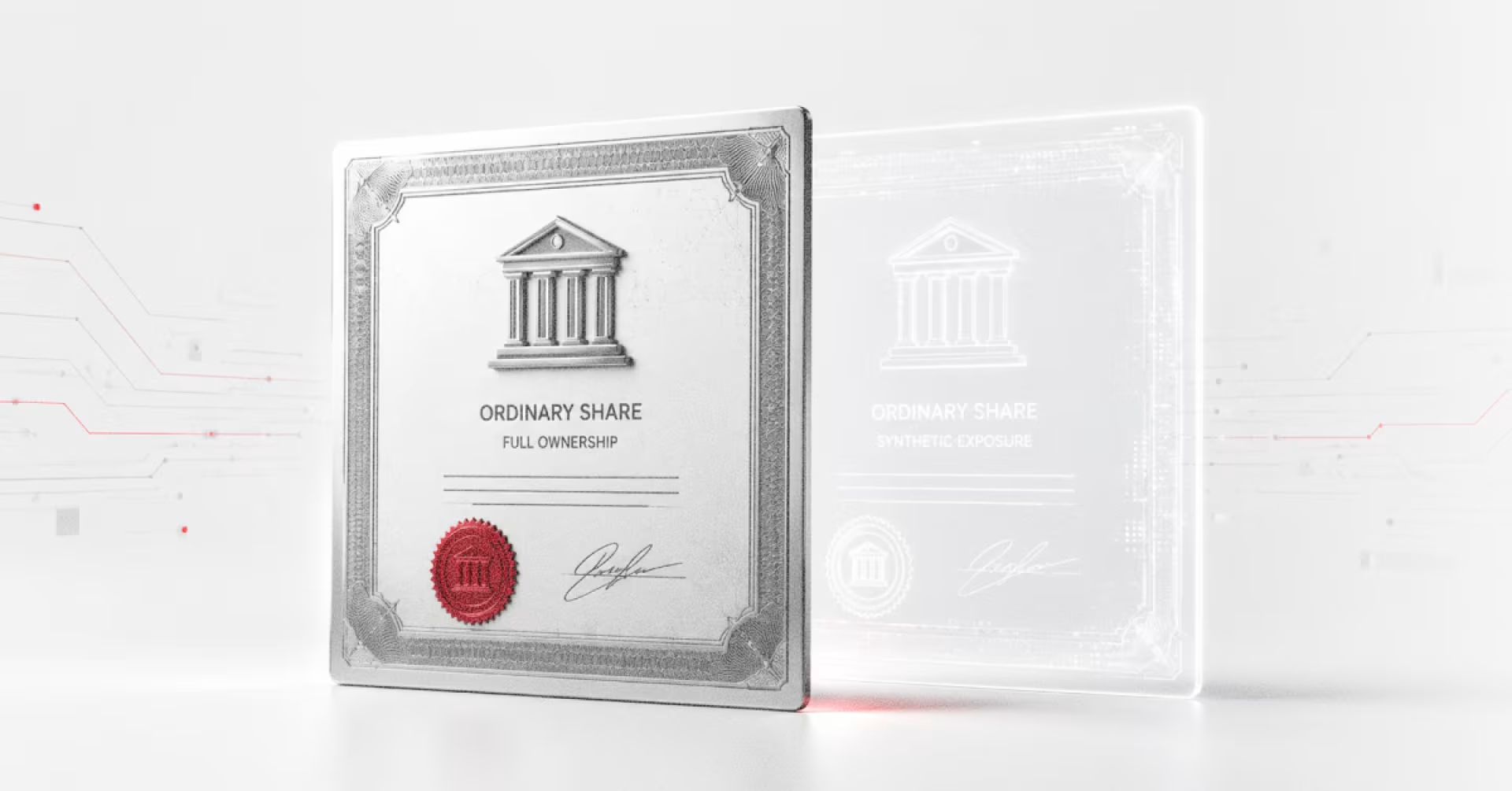
- Not every stock-like product gives investors ownership of the underlying asset. Some provide ownership rights, while others are designed primarily to provide price exposure.
- Real ownership and synthetic exposure can have different legal structures, investor rights, and treatment of dividends and corporate actions.
- Before investing, it is important to understand exactly what you hold, who custodies it, and whether your position represents an actual security or a separate instrument linked to that security.
- As tokenized equities grow, investors increasingly have access to platforms that offer both blockchain-based functionality and traditional securities ownership structures.
Introduction
For most investors, ownership seems straightforward. If you buy a stock, you own the stock.
But in today's financial markets, that assumption is not always correct.
Investors can now access U.S. equities through traditional brokerages, tokenized equities, synthetic products, derivatives, and other structures that may all look similar on the surface but function very differently underneath.
As stock trading moves beyond traditional brokerage accounts and onto blockchain infrastructure, one of the most important questions investors can ask is:
Do I actually own the asset I'm trading?
The answer can affect everything from custody and corporate actions to dividends, liquidity, and long-term investor protections.
Why This Matters
Many investors focus on pricing, fees, and availability when evaluating a platform. Yet ownership structure may ultimately be more important.
When a platform offers exposure to a stock, investors should understand:
- Whether they own a security or simply gain economic exposure
- Whether dividends flow through ownership rights or contractual mechanisms
- Whether the asset is backed 1:1 by underlying securities
- Whether shares are held through regulated brokerage infrastructure
- What happens if the platform experiences financial difficulties
These distinctions can become increasingly important as tokenized equities, onchain securities, and blockchain-based financial products gain adoption worldwide
Key Concepts Explained
What Is Real Ownership?
In traditional securities markets, investors typically hold securities through a brokerage account.
In the United States, many brokerage holdings are structured as security entitlements, a legal framework used throughout modern securities markets. This structure is used by major brokers and represents a direct property interest rather than unsecured debt.
Real ownership generally means the investor has a legally recognized interest in underlying securities held through regulated financial infrastructure.
What Is Synthetic Exposure?
Synthetic exposure refers to products designed to track or replicate the economic performance of an asset without necessarily granting ownership of the underlying security.
Examples can include:
- Contracts for difference (CFDs)
- Derivatives
- Certain tokenized representations
- Other structured products
The goal is often to provide price exposure rather than direct ownership.
While many investors use synthetic products successfully, understanding the difference is important because rights and protections may differ from holding the underlying security itself.
What Are Tokenized Equities?
Tokenized equities combine traditional financial assets with blockchain infrastructure.
These products can vary significantly.
Some models focus on providing exposure to stock performance through blockchain-based instruments.
Others connect blockchain tokens directly to underlying securities held through brokerage infrastructure. Because structures vary, investors should evaluate each offering individually rather than assuming all tokenized equities work the same way.
How To Evaluate Ownership: The REAL Framework
When evaluating any platform offering stocks, tokenized equities, or stock-like assets, ask four questions:
R: Rights
What rights come with the position? Does the investor have claims related to dividends, corporate actions, or voting rights? Or is the product designed primarily to mirror economic performance?
E: Exposure
Are you getting ownership or exposure? Many products provide stock exposure. Fewer provide direct ownership structures connected to underlying securities.
A: Asset Backing
How is the product backed? Is there a clearly disclosed relationship between the investment and underlying shares? If shares are held, how are they custodied?
L: Legal Structure
Which legal framework governs ownership? Investors should understand:
- Who holds assets
- Applicable law
- Custody structure
- Regulatory protections
The stronger the legal clarity, the easier it is to understand what you actually own.
Comparison Table
Common Misconceptions
"If it tracks a stock, I own the stock."
Not necessarily. Many products are designed to follow a stock's price without granting ownership of the underlying security.
"All tokenized stocks are the same."
Tokenized equity structures vary significantly. Investors should evaluate each platform based on how ownership, custody, backing, and redemption work.
"Dividends automatically mean ownership."
Not always. Some products replicate dividend economics without providing ownership rights.
For example, Kraken's xStocks page states that xStocks do not confer ownership, while balances may still increase to reflect real-world dividends.
"Blockchain assets are always synthetic."
Not necessarily. Some newer platforms are building tokenization systems directly on top of traditional brokerage and securities infrastructure.
What Investors Should Look For
Before investing in any stock, tokenized equity, or stock-linked asset, investors should understand:
- Whether they own the asset or simply gain exposure to it.
- How the position is backed.
- Who custodies the underlying assets.
- How dividends and corporate actions are handled.
- Whether ownership rights are governed by established securities law.
- Whether assets can move between traditional finance and blockchain systems.
The more transparent these answers are, the easier it becomes to evaluate risk and compare platforms fairly.
Example Platforms
Ownership has become one of the most important differentiators among newer equity platforms.
Kraken's xStocks product focuses on providing tokenized exposure to U.S. stocks and ETFs with 24/5 trading and onchain transferability. However, Kraken explicitly states that xStocks do not confer ownership of the underlying shares. Instead, investors receive a tokenized instrument whose balance may adjust to reflect dividends. Backpack takes a different approach.
Backpack Securities is built around real ownership first and tokenization second. Investors hold genuine U.S. securities through security entitlements governed by New York UCC Article 8, while eligible securities can also be tokenized and moved onchain.
The distinction is important.
Rather than choosing between traditional brokerage ownership and blockchain functionality, Backpack is attempting to combine both. The platform states that securities are held through regulated brokerage infrastructure, can be tokenized 1:1 on Solana, and remain connected to underlying ownership rights.
For investors evaluating the future of tokenized equities, the central question may not be whether an asset trades onchain. It may be whether that asset represents true ownership or simply exposure. And as the market evolves, platforms that successfully combine real ownership, traditional market protections, and blockchain-native functionality may ultimately define the next generation of investing.
Learn more about Backpack
Exchange | Wallet | Twitter | Discord | Reddit
Disclaimer: This content is presented to you on an “as is” basis for general information and educational purposes only, without representation or warranty of any kind. It should not be construed as financial, legal or other professional advice, nor is it intended to recommend the purchase of any specific product or service. You should seek your own advice from appropriate professional advisors. Where the article is contributed by a third party contributor, please note that those views expressed belong to the third party contributor, and do not necessarily reflect those of Backpack. Please read our full disclaimer for further details. Digital asset prices can be volatile. The value of your investment may go down or up and you may not get back the amount invested. You are solely responsible for your investment decisions and Backpack is not liable for any losses you may incur. This material should not be construed as financial, legal or other professional advice.