Holding a token that tracks the price of Apple is not the same as owning Apple. The two can sit side by side on a portfolio screen and move together candle for candle, yet differ on the question of what rights actually attach to the position. That gap, between price exposure and ownership, is what separates tokenized stocks from the equities they reference.
What Is a Traditional Stock?
A traditional stock is a unit of ownership in a publicly traded company. When an investor buys one through a brokerage, the share is recorded by central market infrastructure (in the United States, the Depository Trust and Clearing Corporation) and held in the investor's name through a "street name" arrangement. The brokerage acts as custodian, but the beneficial owner is the investor.
That structure carries a defined set of rights. Shareholders can vote on corporate resolutions, receive dividends paid by the company, and rely on regulatory protections such as Securities Investor Protection Corporation (SIPC) coverage, which insures brokerage holdings up to $500,000 if the broker fails. Settlement in U.S. equity markets runs on a T+1 cycle as of May 2024, meaning trades clear one business day after execution. Trading itself is bounded by exchange hours.
What Is a Tokenized Stock?
A tokenized stock is a blockchain-based token whose value is tied to a publicly traded share. Tokens are issued on networks such as Solana, Ethereum, or Base, can be held in self-custodial wallets, and transferred peer-to-peer across compatible exchanges and protocols.
The term covers two main structural models, and the differences matter more than the shared label suggests.
Asset-backed tokens are collateralized 1:1 by real shares held by a regulated custodian. The token represents the holder's claim on the underlying. The exact legal structure of that claim varies: some products are debt instruments redeemable for cash, others are claims convertible to the underlying share itself. Dividends and corporate actions are typically reflected via token mechanics such as rebasing or stablecoin distributions.
Synthetic tokens have no underlying share. Smart contracts and price oracles replicate the stock's performance, giving holders economic exposure to price movements alone, with no claim on dividends or shareholder rights.
Both are called tokenized stocks. What the holder actually owns is not the same.
Tokenized Stocks vs Traditional Stocks: At a Glance
The two compare as follows across the dimensions that matter most.
Key Differences Explained
Shareholder Rights
- Traditional: Direct beneficial ownership through a regulated broker, with binding voting rights, cash dividends, and legal standing in corporate actions.
- Tokenized: Rights vary by structure. Synthetic tokens give only price exposure. Asset-backed tokens give a claim on shares held in custody, with some products redeemable for cash and others convertible to the underlying share. Most products do not pass binding voting rights, though some offer advisory preferences.
Trading Hours
- Traditional: 9:30 AM to 4:00 PM Eastern, Monday through Friday, with limited extended sessions.
- Tokenized: Continuous trading on blockchain venues. Off-hour liquidity is typically thinner than during U.S. market sessions, and tokenized prices can diverge from the underlying share when traditional markets are closed.
Settlement Speed
- Traditional: T+1 cycle as of May 2024. Cash and ownership change hands one business day after the trade.
- Tokenized: On-chain settlement in seconds. The atomic nature of blockchain transactions removes the intermediate clearing window, allowing proceeds to be redeployed immediately.
Regulatory Framework
- Traditional: SIPC coverage up to $500,000 per investor (with a $250,000 cash sub-limit), under SEC oversight covering brokers, exchanges, and listed companies.
- Tokenized: Subject to securities laws once classified as securities; the SEC's January 2026 statement on tokenized securities confirmed this position. SIPC does not extend to most tokenized products, and protection in a failure scenario depends on the issuer's custodial arrangements and the token's legal structure.
The Regulatory Picture in 2026
Regulatory direction has firmed up noticeably. On March 17, 2026, the SEC and CFTC jointly issued an interpretive release confirming that tokenized securities are securities under federal law and subject to existing investor protections. The release distinguishes between tokenized traditional financial instruments (digital securities) and synthetic products that only reference an underlying share.
European regulators have taken a similar line. The European Securities and Markets Authority has flagged that many tokenized stocks currently offered fail to deliver voting rights or dividend entitlements, and that disclosure standards need to catch up with the product's growth.
The direction of travel favors models with real share backing and clear legal anchors, alongside continued scrutiny of synthetic products that offer price exposure without shareholder protections. NYSE and Nasdaq have each published frameworks aimed at integrating tokenized equities into existing market infrastructure rather than treating them as a parallel system.
Backpack Securities: Real Stocks Meet On-Chain Access
Backpack Securities combines real securities ownership with on-chain distribution.
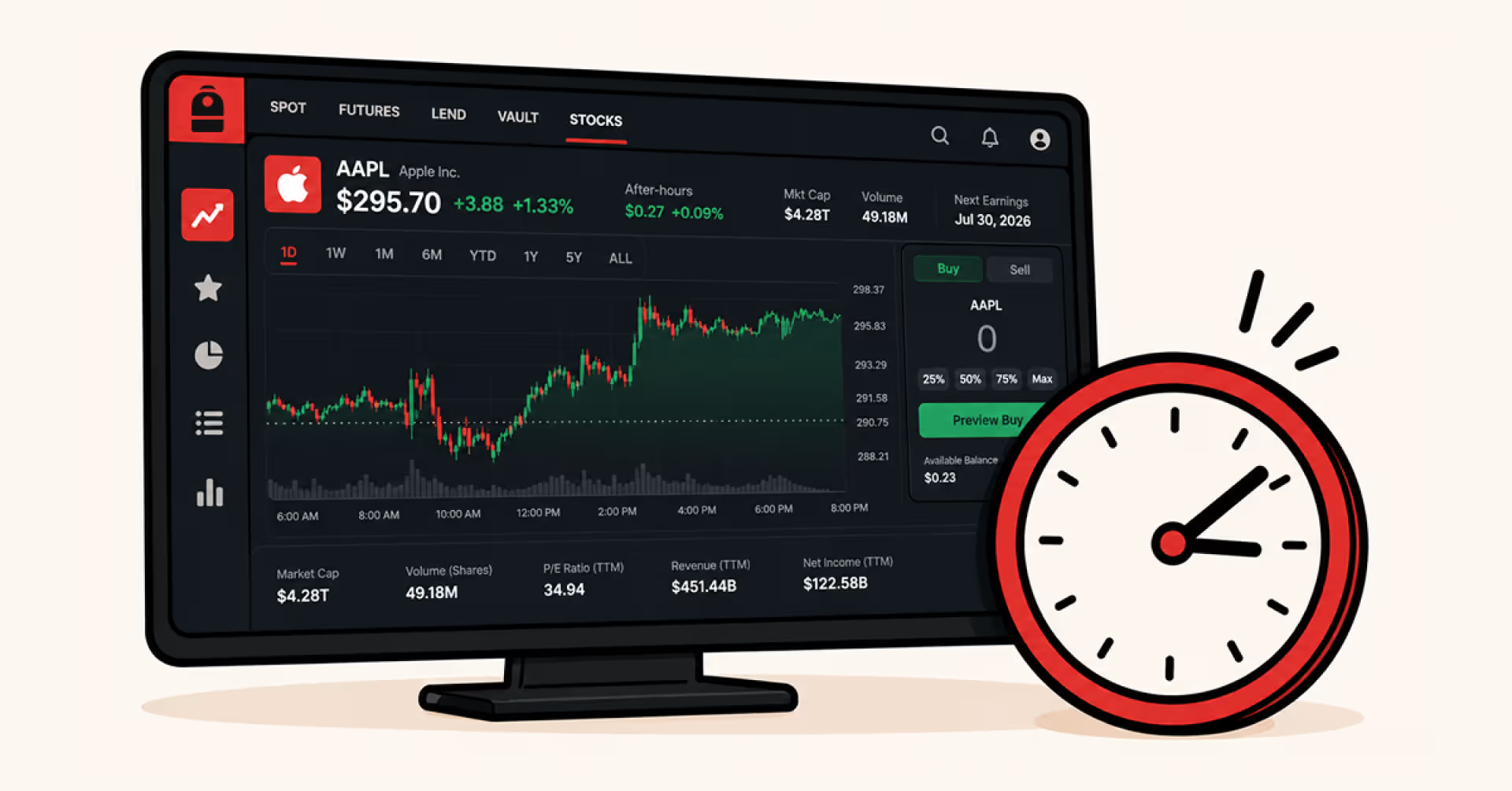
Traditional Securities on Backpack are the regulated brokerage layer. Eligible non-U.S. users can buy and hold real U.S.-listed stocks and ETFs through standard brokerage infrastructure, with holdings recognized as security entitlements under New York's UCC Article 8. The same account that holds crypto holds equities, settled in USD. Users are entitled to dividends and corporate actions, and positions can be transferred to other U.S. brokers via ACATS and DTCC rails. The product is in public beta and available on the web.
Tokenized Securities issued by Backpack are the on-chain form of those same security entitlements. Each token is backed 1:1 by a real share held by Backpack Securities. Users can convert security entitlements held through Backpack Securities into tokens, redeem tokens back into the corresponding security entitlement, and self-custody them in Backpack Wallet.
The result is a single platform where users can hold real shares through traditional brokerage, move them on-chain for 24/7 trading and self-custody, and bring them back into conventional infrastructure when needed.
Learn more about Backpack
Exchange | Wallet | Twitter | Discord | Reddit
Disclaimer: This content is presented to you on an “as is” basis for general information and educational purposes only, without representation or warranty of any kind. It should not be construed as financial, legal or other professional advice, nor is it intended to recommend the purchase of any specific product or service. You should seek your own advice from appropriate professional advisors. Where the article is contributed by a third party contributor, please note that those views expressed belong to the third party contributor, and do not necessarily reflect those of Backpack. Please read our full disclaimer for further details. Digital asset prices can be volatile. The value of your investment may go down or up and you may not get back the amount invested. You are solely responsible for your investment decisions and Backpack is not liable for any losses you may incur. This material should not be construed as financial, legal or other professional advice.