Invesco QQQ is an exchange-traded fund that tracks the Nasdaq-100 Index, a benchmark designed to represent 100 of the largest non-financial companies listed on Nasdaq. QQQ gives investors exposure to these businesses through one fund, and the portfolio is heavily weighted toward technology companies.
Buying QQQ means buying shares in a fund, rather than selecting and managing each underlying stock yourself. The convenience comes with a trade-off: owning many companies does not mean your investment is evenly spread across them.
QQQ ETF key facts
- Full name: Invesco QQQ Trust
- Ticker: QQQ, listed on Nasdaq and traded in U.S. dollars
- Benchmark: the Nasdaq-100 Index, covering 100 of the largest non-financial companies listed on Nasdaq
- Annual expense ratio: 0.18%
- Dividends: distributed quarterly
- Inception date: March 10, 1999
Fund details as of October 26, 2026.
What stocks does QQQ hold?
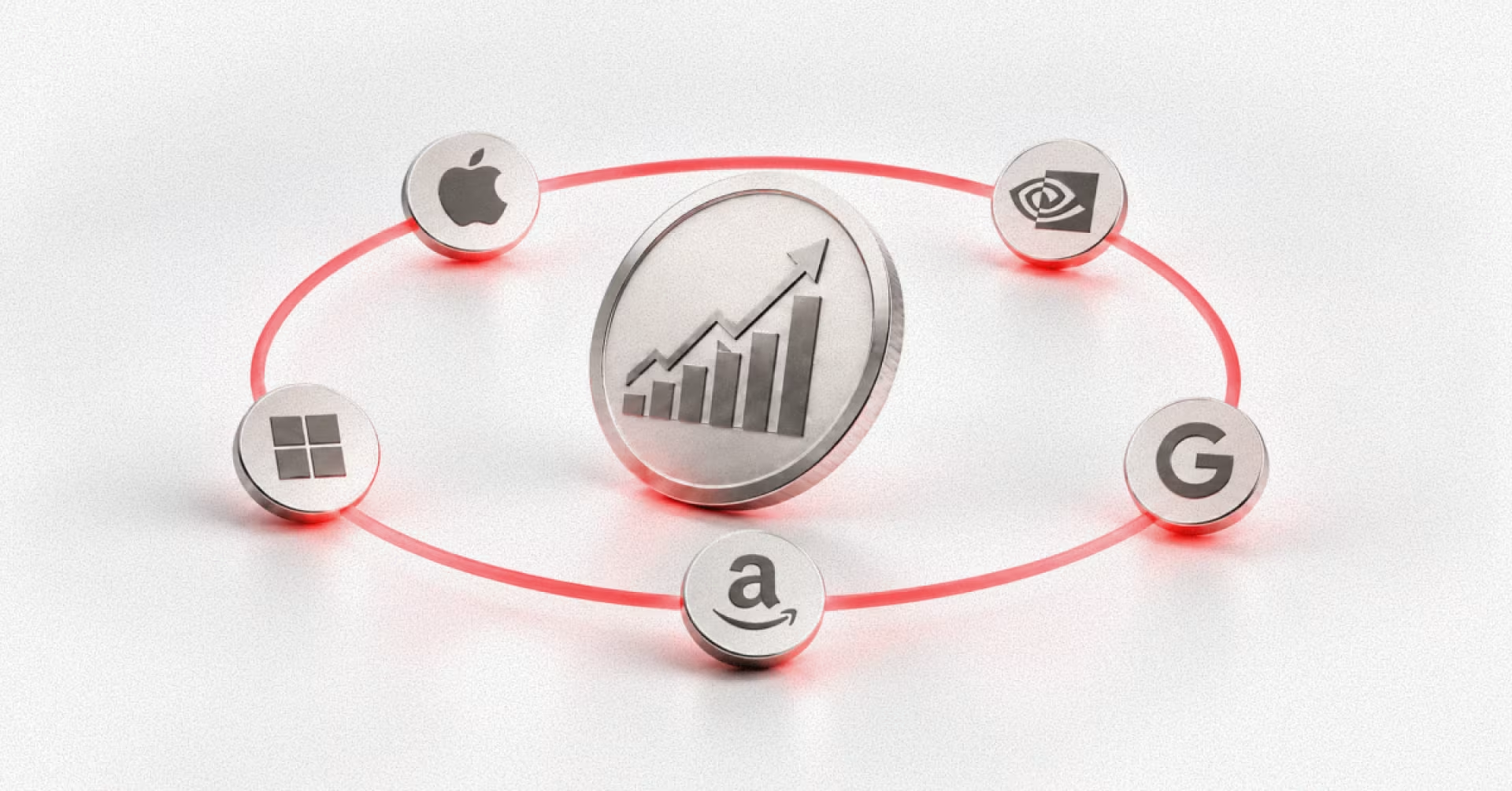
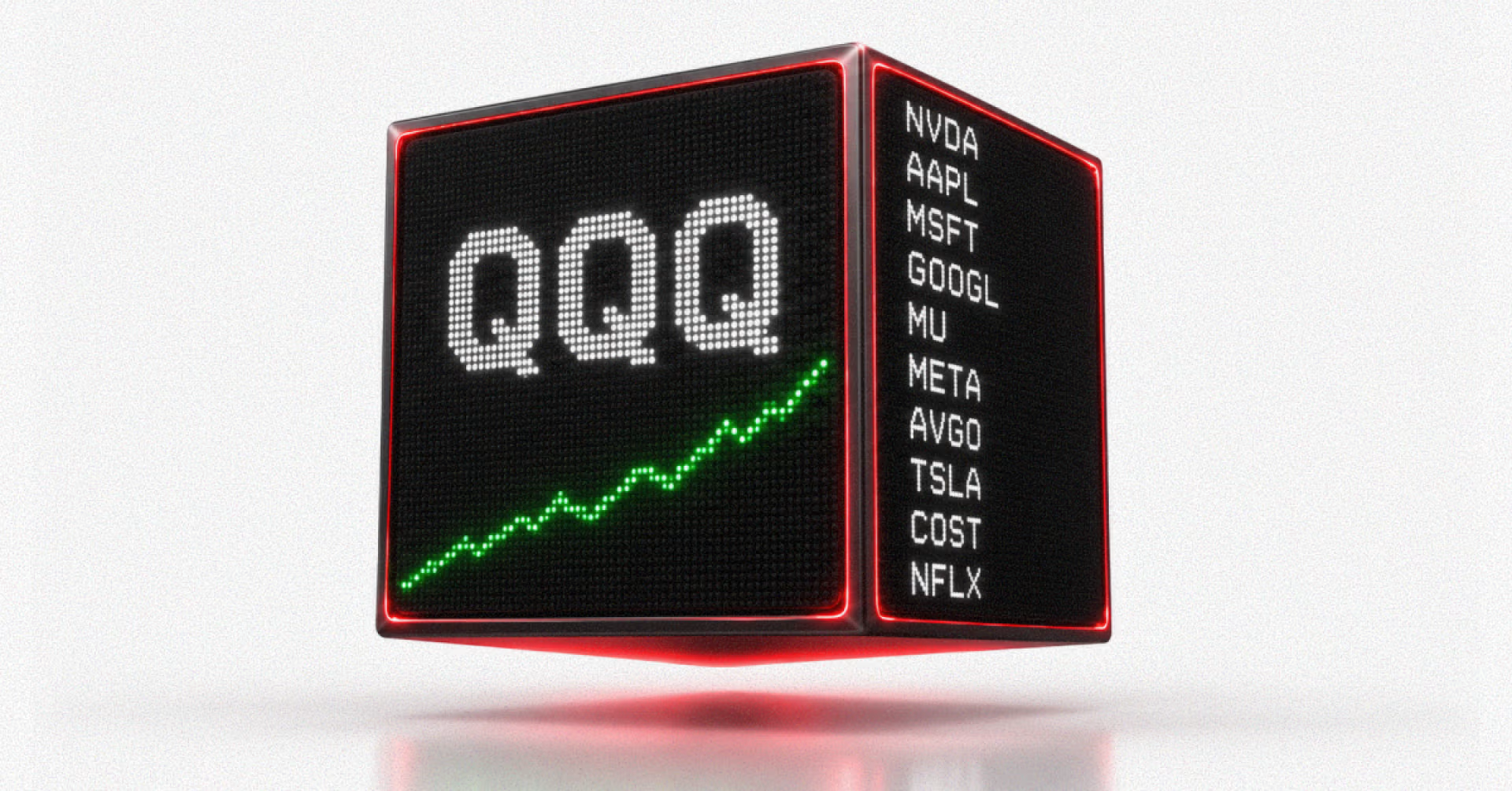
QQQ holds shares in the companies that make up the Nasdaq-100. As of October 23, 2026, its five largest company exposures were NVIDIA, Apple, Microsoft, Alphabet and Micron Technology.
Alphabet’s weight combines its Class A shares (GOOGL, 2.99%) and Class C shares (GOOG, 2.79%). Holdings and weights change over time.
QQQ also holds companies outside technology, including Costco, PepsiCo and Amgen. These businesses give the fund exposure to areas such as retail, consumer staples and biotechnology.
Is QQQ only a technology ETF?
No. QQQ is technology-heavy, but its benchmark selects eligible non-financial companies listed on Nasdaq rather than technology companies alone. Its portfolio spans multiple industries, although technology has a substantial influence on its performance.
A technology sector fund and QQQ can therefore hold different businesses. Investors comparing them should look at their underlying holdings and sector exposure rather than treating both as interchangeable ways to invest in technology.
Why the largest holdings matter
QQQ does not allocate an equal amount to every company. The Nasdaq-100 uses modified market-capitalization weighting, meaning larger companies generally receive higher weights, with adjustments designed to limit concentration.
Suppose one stock represents 8% of a portfolio and another 1%. A 10% rise in the first stock would contribute approximately 0.8 percentage points to the portfolio’s return, compared with 0.1 percentage points for the second, assuming everything else stays unchanged.
That is why the weights of QQQ’s largest positions tell you more about its concentration than the number of companies it holds.
How does QQQ work?
QQQ works by holding the stocks in the Nasdaq-100 in proportion to their index weights and adjusting the portfolio when the index changes. When you buy QQQ, you trade shares of the fund on an exchange through a brokerage account, while Invesco manages the underlying holdings, so you never handle the individual companies. The fund’s objective is to track the index, not to beat it, and its return typically trails the index by a small margin because of expenses and implementation costs.
The Nasdaq-100 rebalances quarterly and reviews its membership once a year. Rebalancing adjusts weights; reconstitution adds and removes companies. QQQ’s portfolio changes with these updates as companies grow, shrink or become eligible for inclusion.
Two prices matter when you trade QQQ:
- Net asset value, or NAV: the per-share value of QQQ’s holdings after liabilities.
- Market price: the price you pay or receive when trading QQQ shares on an exchange.
The two can differ slightly. Creation and redemption of fund shares by large institutions generally keep them close, although premiums and discounts can occur.
Is QQQ still a unit investment trust?
No. Since December 2025, QQQ has operated as an open-end ETF rather than a unit investment trust, the structure it used from launch. The change did not alter its investment objective, but it is why older articles describe QQQ’s structure and fee differently from how Invesco describes them today.
What is QQQ’s expense ratio?
QQQ’s annual expense ratio is 0.18%. On a $10,000 investment, that is about $18 a year, assuming the investment value and the fee stay constant.
The expense ratio covers the fund’s operating costs and is deducted from fund assets, so you never receive a separate bill for it. Trading spreads, broker commissions and any account charges are separate costs on top of it.
Older articles may quote 0.20%. The fee fell to 0.18% when QQQ converted to an open-end ETF in December 2025.
Does QQQ pay dividends?
Yes. QQQ typically distributes dividends quarterly, with amounts that vary from one payment to the next. Its objective is to track the Nasdaq-100, not to deliver a set level of income, so an income-focused investor should check whether its variable distributions fit their needs rather than stopping at the fact that it pays one.
When comparing performance, distinguish price return from total return. Price return measures the change in the share price. Total return also counts distributions, usually assuming they are reinvested. Comparing one fund’s price chart with another fund’s total return can give a misleading picture.
QQQ vs QQQM vs SPY
QQQ and QQQM track the same Nasdaq-100 benchmark, while SPY tracks the S&P 500. QQQ and QQQM differ mainly in cost and trading characteristics; QQQ and SPY differ in what they hold.
What is the difference between QQQ and QQQM?
QQQM gives the same Nasdaq-100 exposure as QQQ at a lower annual expense ratio of 0.15%. The 0.03-percentage-point gap works out to about $3 a year on a constant $10,000 investment. QQQ is the more heavily traded of the two and is commonly used by investors and traders who prioritize liquidity; Invesco positions QQQM for longer-term holding. The practical question is whether QQQ’s trading characteristics are worth the extra recurring cost for how you plan to use it.
Is QQQ better than SPY?
Neither fund is better in every period. SPY covers all 11 sectors, including financial companies, while QQQ holds a more concentrated Nasdaq-listed portfolio. Which performs better depends on the period and on how their holdings do.
Owning both does not spread your risk as much as it may appear. QQQ’s largest holdings, such as NVIDIA, Apple and Microsoft, are also among SPY’s largest, at different weights. Buying both adds more exposure to the same group of companies rather than to new ones.
What are the risks of investing in QQQ?
QQQ’s main risks are concentration in a small group of large technology-related companies, broad stock-market declines, and the possibility of lagging other parts of the market for long stretches. Holding a basket of stocks reduces dependence on any single company, but it does not protect you from losses.
- Concentration risk: weak results or falling valuations at QQQ’s heavily weighted companies have an outsized effect on the fund, and if you already own those companies directly, QQQ adds to the same exposure.
- Market risk: economic slowdowns, interest-rate changes and shifts in sentiment can push many holdings down at once. In 2022, QQQ fell about 32.6% on a total-return basis.
- Passive investment risk: QQQ follows its index. It does not move to cash because its manager expects a decline.
How to evaluate QQQ before investing
Start with the role QQQ would play in your portfolio. A fund can be easy to trade and still give you exposure that does not match what you want.
- Define the exposure you want. Decide whether you want Nasdaq-100 exposure, broader U.S. equities or a specific sector.
- Check holdings and overlap. Compare QQQ’s current positions and weights with what you already own.
- Compare total costs. Look at the expense ratio alongside spreads, broker charges and any currency-conversion costs.
- Use comparable performance data. Match dates and return definitions, and look at losses as well as gains.
- Consider your time horizon. Money you need soon may not suit a stock fund that can fall sharply.
The decision question is simple: do you want more exposure to these companies at their current weights?
How do you buy QQQ ETF?
You can buy QQQ through any brokerage account with access to U.S.-listed ETFs. Availability depends on the broker, account type and jurisdiction.
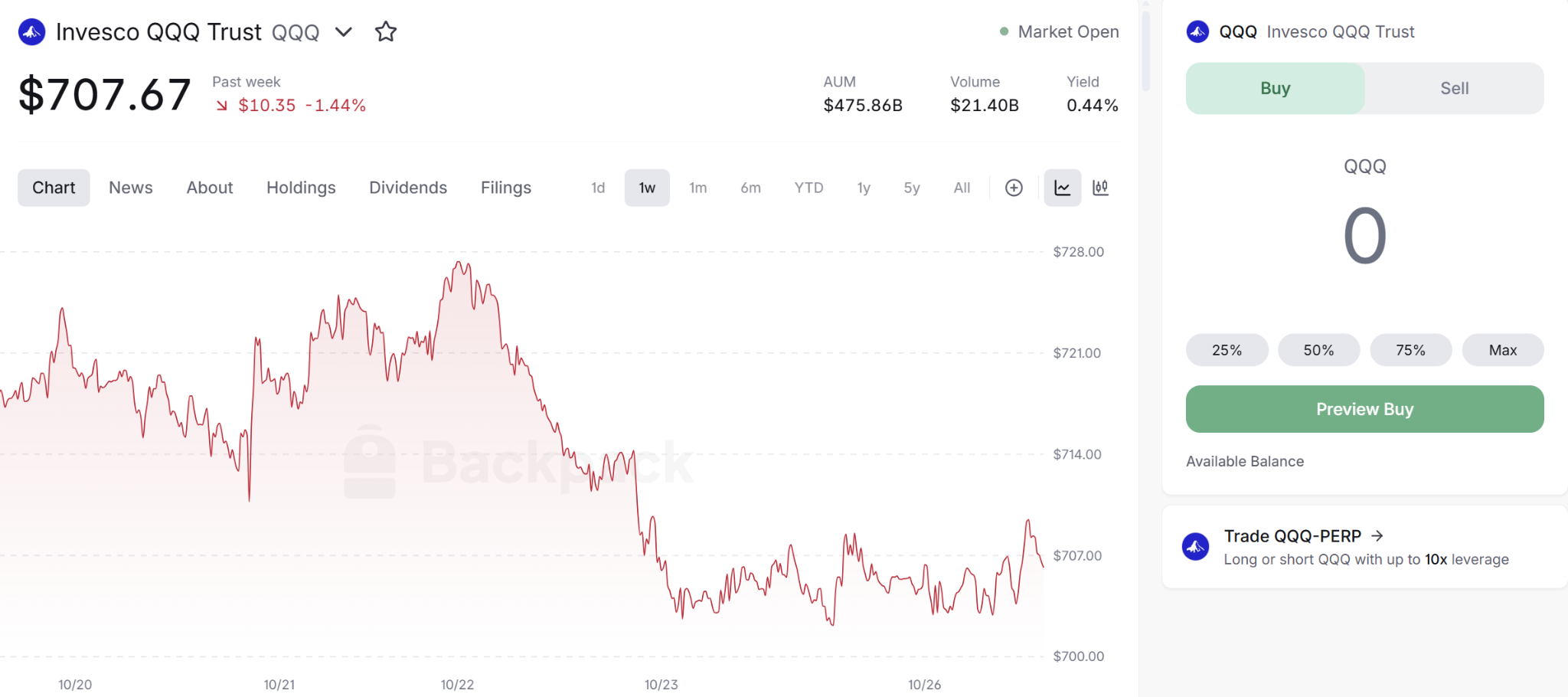
On Backpack, QQQ is listed as a US ETF and bought the same way as a stock:
- Open Stocks and search for QQQ.
- Enter the number of shares you want to buy.
- Review the quote, confirm the order and check its execution status. Once the order fills, your holdings update in your account.
What you get on Backpack:
- Real ownership: each QQQ holding is an actual security entitlement to the underlying share, not a derivative that tracks its price.
- One account: QQQ sits alongside your crypto and stablecoins, so you can move between them without transferring funds to another platform.
- Extended hours: QQQ can be traded beyond regular U.S. market hours, with details in our trading hours guide.
Shares of QQQ held on Backpack can also be used as collateral. Instead of selling, you can use part of their value to borrow USD, buy crypto on margin or support a perpetual futures position, all from the same account. Backpack also lists QQQ-PERP, so you can trade QQQ exposure outside regular market hours or open a short to hedge shares you already hold. How much each holding contributes as collateral depends on its weight, which is shown next to the asset in your Balances tab. Borrowing and leveraged trading involve risk, including liquidation.
Is QQQ a good investment?
QQQ can be a good investment for someone who wants concentrated exposure to the largest Nasdaq-listed companies and can hold through sharp declines like 2022. It does not cover financials or much of the broader market, and it overlaps heavily with any S&P 500 fund you already own, so it works differently from a broad-market fund as the core of a portfolio. Whether it fits you depends on your time horizon, your existing holdings and how much concentration in a few large companies you are comfortable with.
If QQQ has a place in your portfolio, you can buy it on Backpack alongside your crypto and stablecoins, and put the shares to work as collateral when you need to. Get started on Backpack.
Learn more about Backpack
Exchange | Wallet | Twitter | Discord | Reddit
Disclaimer: This content is presented to you on an “as is” basis for general information and educational purposes only, without representation or warranty of any kind. It should not be construed as financial, legal or other professional advice, nor is it intended to recommend the purchase of any specific product or service. You should seek your own advice from appropriate professional advisors. Where the article is contributed by a third party contributor, please note that those views expressed belong to the third party contributor, and do not necessarily reflect those of Backpack. Please read our full disclaimer for further details. Digital asset prices can be volatile. The value of your investment may go down or up and you may not get back the amount invested. You are solely responsible for your investment decisions and Backpack is not liable for any losses you may incur. This material should not be construed as financial, legal or other professional advice.