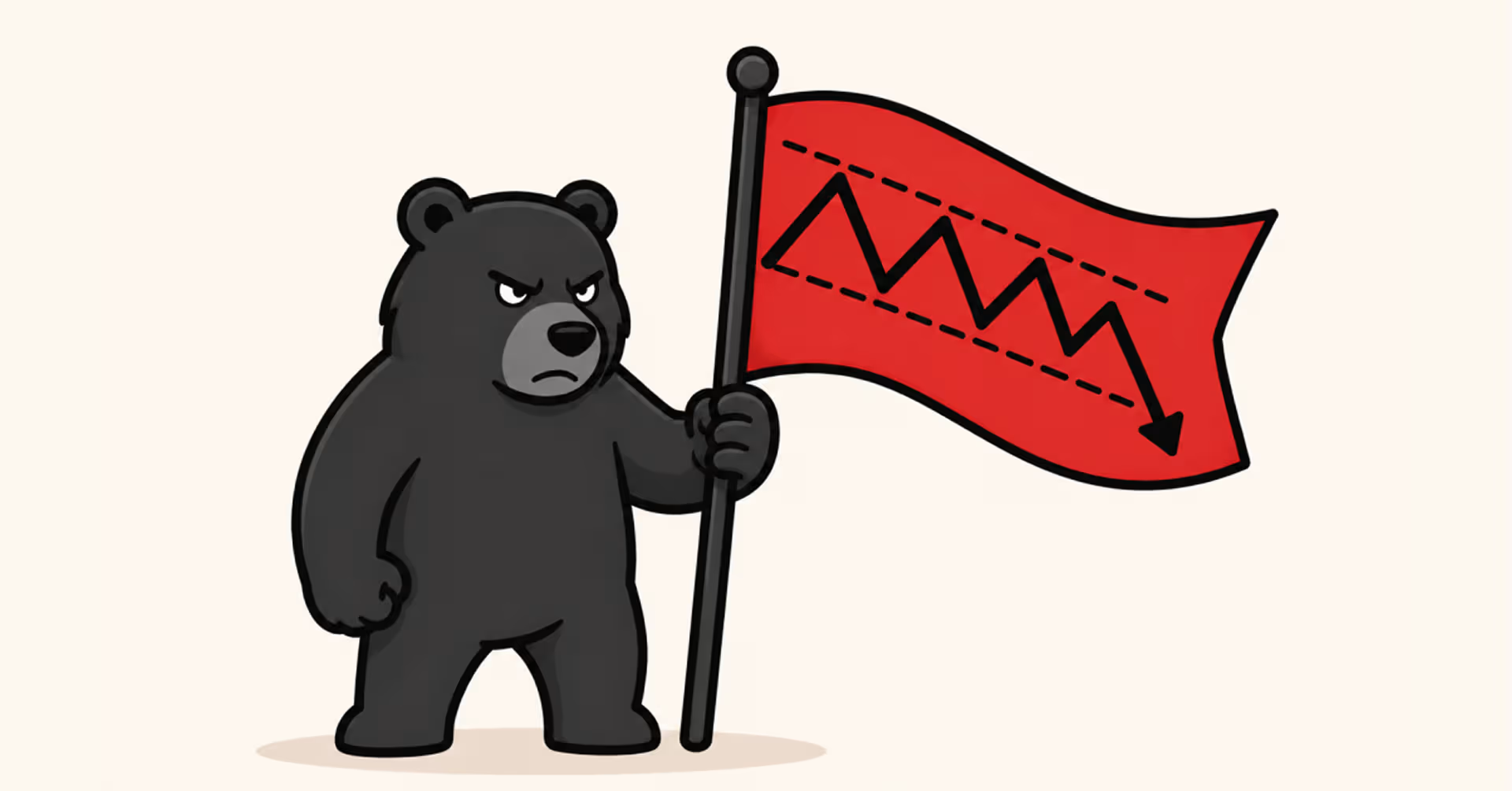

What Are Bull and Bear Markets?
Bull and bear markets are terms investors and traders use to describe the direction and mood of a market. A bull market points to rising prices, stronger confidence, and higher risk appetite. A bear market points to falling prices, weaker confidence, and lower risk appetite.
These terms often refer to the stock market, but they also apply to crypto, ETFs, commodities, and broader market indices. For example, people may describe the S&P 500, Nasdaq, Bitcoin, or the overall crypto market as bullish or bearish.
The key idea is simple: bull and bear markets describe broad trends, not guaranteed outcomes. They help market participants understand sentiment and context, but they do not predict what prices will do next.
Key Takeaways
- A bull market is a period when prices rise over time and investor sentiment becomes more optimistic.
- A bear market is a period when prices fall over time and investor sentiment becomes more cautious or pessimistic.
- Bull and bear markets can occur in stocks, ETFs, indices, crypto, commodities, and other assets.
- Market cycles are influenced by interest rates, inflation, liquidity, earnings, macroeconomic conditions, and investor psychology.
- Crypto bull and bear markets can move faster than traditional stock market cycles because crypto trades 24/7 and often reacts strongly to narratives.
- Bull and bear market labels should not be treated as direct buy or sell signals.
Bull Market vs Bear Market
Bull and bear markets describe opposite market environments. A bull market reflects rising prices and confidence. A bear market reflects falling prices and caution.
Markets rarely move in a straight line. A bull market can include sharp pullbacks, and a bear market can include strong rallies. The overall trend matters more than any single day or week.
What Is a Bull Market?
A bull market is a sustained period of rising prices. In traditional stock markets, a bull market is often associated with a broad market index rising 20% or more from a recent low, though investors also look at sentiment, earnings, liquidity, and market breadth.
Bull markets usually come with stronger confidence and higher risk appetite. More investors participate, trading activity can increase, and positive news often receives more attention.
The term “bullish” can also describe a positive view on a specific asset, such as a stock, an ETF, Bitcoin, or a sector, even when the broader market is mixed.
What Can Cause a Bull Market?
Bull markets can be supported by economic growth, stronger corporate earnings, lower interest rates, easier financial conditions, higher liquidity, or improving investor sentiment.
In crypto, bullish conditions can also be shaped by narratives such as Bitcoin halvings, ETF-related flows, regulatory clarity, new applications, or stronger on-chain activity.
What Is a Bear Market?
A bear market is a sustained period of falling prices. In traditional stock markets, a bear market is often defined as a decline of 20% or more from a recent high in a major index.
Bear markets usually come with weaker sentiment and lower risk appetite. Investors become more cautious, liquidity can shrink, and market participants often focus more on risk than potential return.
The term “bearish” can also describe a negative view on a specific asset, such as a stock, an ETF, a crypto asset, or an entire market.
What Can Cause a Bear Market?
Bear markets can be driven by recession fears, tighter monetary policy, rising interest rates, inflation pressure, weak earnings, high valuations, leverage unwind, or major market shocks.
In crypto, bearish conditions can also be shaped by liquidity stress, exchange risk, regulatory pressure, falling network activity, or the unwind of speculative narratives.
Bull and Bear Markets in Stocks
In stocks, bull and bear markets are usually measured through major indices. The S&P 500, Nasdaq, and Dow Jones help investors understand whether large parts of the market are rising or falling together.
A stock bull market often reflects improving earnings, stronger economic confidence, or easier financial conditions. Investors may pay higher prices for future growth when they expect companies to perform well.
A stock bear market often reflects concern about earnings, inflation, interest rates, recession risk, or valuation. Policy also matters. Monetary policy can affect borrowing costs and liquidity, while fiscal policy can influence spending, taxation, and economic demand.
Not every stock behaves like the broader market. Some sectors can outperform during a downturn, while others can lag during a rally. This is why market indices, sectors, and individual stocks can send different signals.
Bull and Bear Markets in Crypto
Crypto markets also move through bullish and bearish cycles. The language is similar, but the market structure is different.
Crypto trades 24/7, so sentiment can change quickly. News, liquidity, leverage, network activity, exchange flows, and narratives can move prices at any time. This can make crypto cycles feel faster and more volatile than traditional stock cycles.
Crypto participants also use “bullish” and “bearish” more broadly. A person may describe a token, ecosystem, protocol, trading setup, or macro view as bullish or bearish.
There is also a growing bridge between crypto and traditional markets. Real-world assets, tokenized assets, crypto ETFs, and Bitcoin treasury companies have made equity market concepts more relevant to crypto-native investors.
What Causes Market Cycles?
Market cycles form when prices, liquidity, expectations, and behavior interact. No single factor explains every bull or bear market.
Interest rates are one major driver. Lower rates can make risk assets more attractive by reducing borrowing costs and increasing liquidity. Higher rates can pressure valuations and make safer assets more competitive.
Inflation also matters. High inflation can reduce purchasing power and push central banks toward tighter policy. Lower inflation can support confidence if it gives policymakers more flexibility.
Earnings are important for stocks. If companies grow revenue and profits, investors may become more willing to pay higher prices. If earnings weaken, investors may reduce exposure.
Investor psychology connects all of these factors. Bull markets often strengthen optimism. Bear markets often strengthen fear. Markets can overshoot in both directions when emotion, leverage, and liquidity reinforce each other.
How Long Do Bull and Bear Markets Last?
Bull and bear markets do not have fixed lengths. Some last months. Others last years. The duration depends on economic conditions, liquidity, policy decisions, earnings, and investor behavior.
Stock market cycles often move around economic and earnings cycles. Crypto cycles can move faster because the market trades continuously and reacts quickly to liquidity, leverage, and narratives.
Past cycles do not guarantee future outcomes. A market can recover faster than expected, fall longer than expected, or move sideways while participants wait for clearer signals.
Real-World Examples of Bull and Bear Markets
Historical market cycles show that bull and bear markets can look different depending on the asset class, timeframe, and economic backdrop. The same terms can describe a long stock market expansion, a sudden crash, or a fast-moving crypto cycle.
One major stock market example is the U.S. bull market that began after the 2008 financial crisis. The S&P 500 bottomed on March 9, 2009, then reached a pre-COVID peak on February 19, 2020. That cycle lasted nearly 11 years and is often described as one of the longest bull markets in modern U.S. stock market history.
The 2020 COVID crash shows how quickly a bear market can unfold. The S&P 500 fell from 3,386.1 on February 19, 2020, to 2,237.4 on March 23, 2020, losing 33.9% of its value in just over a month.
Crypto markets have also moved through clear bull and bear cycles. Bitcoin traded near $20,000 in December 2017 before the 2018 crypto bear market, then rose above $67,000 in November 2021 before another major crypto downturn in 2022.
These examples show why bull and bear markets are best understood as broad market environments, not fixed timelines. A bull market can last for years, while a bear market can happen quickly when sentiment, liquidity, and risk appetite shift.
How Should Beginners Think About Bull and Bear Markets?
Beginners should treat bull and bear markets as context, not instructions. A bull market does not mean every asset is safe. A bear market does not mean every asset will keep falling.
Market labels can help explain sentiment, but they do not replace risk management. Investors and traders still need to understand their time horizon, position size, diversification, and tolerance for volatility.
Beginners should also separate market direction from financial advice. Learning what a bull or bear market means can help with education, but it does not tell anyone what to buy, sell, or hold.
The Bottom Line
Bull and bear markets describe broad market direction and sentiment. A bull market points to rising prices and confidence, while a bear market points to falling prices and caution.
These concepts matter across stocks, ETFs, indices, and crypto. Understanding them helps beginners read market conditions, compare asset classes, and avoid treating sentiment labels as trading signals.
了解更多关于Backpack的信息
交易所 | 钱包 | Twitter | Discord | Reddit
免责声明:本内容按“原样”提供,仅供一般信息和教育目的,不作任何形式的陈述或保证。不应将其解释为财务、法律或其他专业建议,也不旨在推荐购买任何特定产品或服务。您应向适当的专业顾问寻求自己的建议。如果文章由第三方贡献者提供,请注意,所表达的观点属于该第三方贡献者,不一定反映 Backpack 的观点。请阅读我们的完整免责声明以获取更多详情。数字资产价格可能波动剧烈。您的投资价值可能上涨或下跌,您可能无法收回投资金额。您对自己的投资决策负全部责任,Backpack 对您可能遭受的任何损失概不负责。本材料不应被解释为财务、法律或其他专业建议。